

Author: Bill Gilmore
How Pest Control Companies in West Palm Beach Can Use Google Business Profile in 2026
Google Business Profile
Google Business Profile for pest control companies in West Palm Beach FL is a narrow search, which is exactly why the page has to be useful. A pest control company in West Palm Beach is not looking for a broad marketing definition. They need to understand what to build, what to measure, and how the strategy should fit the local market.
Quick answer
Google Business Profile for pest control companies in West Palm Beach FL should be built as a focused local asset, not a generic marketing article. The page needs city context, industry proof, a conversion path, and tracking that shows whether the traffic becomes qualified conversations.
In this expanded guide
Primary keyword
Google Business Profile for pest control companies in West Palm Beach FL
Best-fit intent
A local business owner or manager comparing whether Google Business Profile can create better leads, better follow-up, or better search visibility for pest control companies in West Palm Beach.
Why the West Palm Beach market changes the strategy
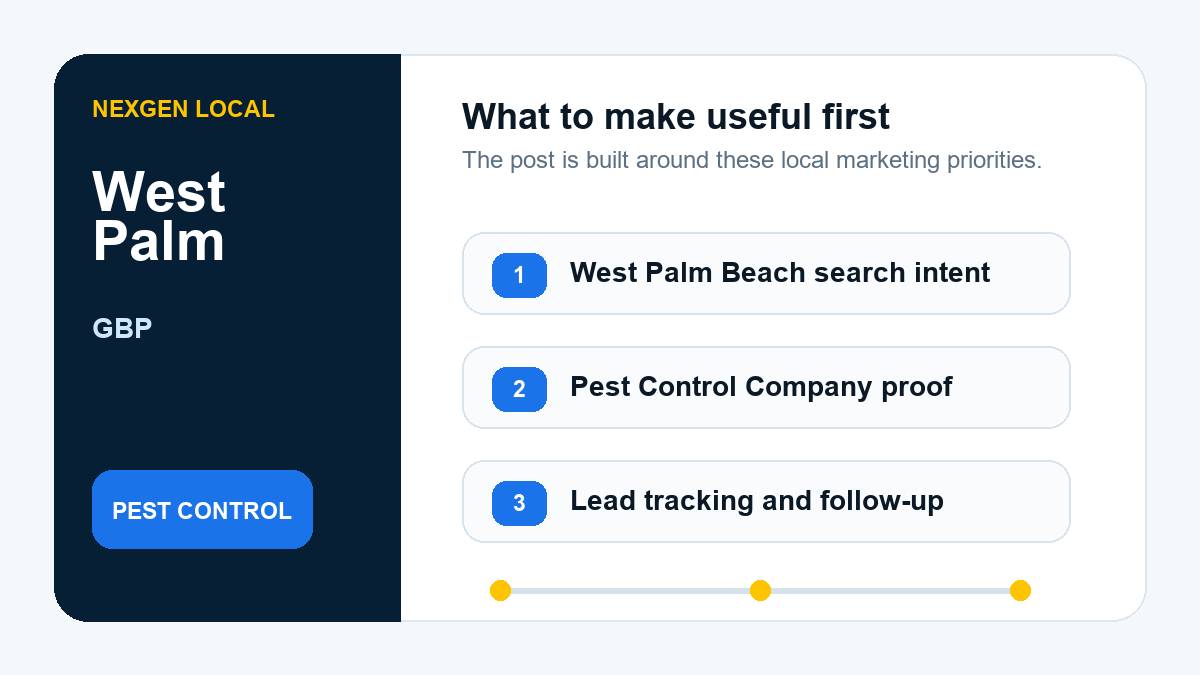
West Palm Beach searches are shaped by downtown demand, seasonal residents, Palm Beach County suburbs, and coastal communities with higher trust expectations.
Seasonal residents, coastal maintenance, and high-value home services make proof, response time, and premium positioning matter. That matters because local search is not just a list of keywords. The same phrase can mean a quick emergency call, a research-stage project, a bid request, or a high-trust consultation depending on the neighborhood, service line, and buyer type.
For pest control companies, a useful page should make the local fit obvious. It should mention the service area in plain language, explain who the offer is for, show proof that matches the work, and give the visitor one clear next step. When a page only swaps in a city name, it may technically target the keyword, but it usually fails to answer the buyer’s real question.
What West Palm Beach pest control companies need to prove
Seasonal pest issues create repeat demand, but many buyers compare several local providers. In West Palm Beach, that pain point becomes more specific because the market includes downtown West Palm Beach, Palm Beach County suburbs, and coastal communities. The page should reduce doubt before the visitor calls, clicks, or fills out a form.
Pest demand changes by season and property type, so one generic pest page rarely covers termite, mosquito, rodent, and prevention intent well.
A termite inspection lead should be routed differently from a mosquito control lead because the inspection, proof, and urgency are not the same.
Useful proof for this audience can include Pest-specific pages, treatment process explanations, prevention guides, neighborhood review language, and recurring-plan calls to action.. These details are not decoration. They help real visitors decide whether the company understands their job, and they help search engines connect the page to the right entity, service, and local context.
The Google Business Profile plan for this keyword
Google Business Profile work is useful when the listing becomes a clearer decision point, not just a filled-out directory profile.
For Google Business Profile for pest control companies in West Palm Beach FL, the strategy should start with one primary intent and one conversion path. The campaign can still support secondary questions, but the main page should not drift into every possible marketing topic. A focused article is easier to optimize, easier to measure, and easier to improve after Search Console data starts showing real queries.
Use language that reflects termite inspections, mosquito control, or rodent exclusion when those are the jobs the business actually wants.
Reference downtown West Palm Beach, Palm Beach County suburbs, and coastal communities, service-area fit, project types, photos, reviews, or process details that help a West Palm Beach buyer trust the next step.
Separate calls, forms, booked appointments, disqualified leads, and follow-up notes so the page is judged by qualified opportunities instead of traffic alone.
What to build first
The first version should be practical enough that a business owner can see the work. For pest control companies, the strongest page usually combines local explanation, industry proof, a clear call-to-action, and a measurement plan. That gives the content a reason to exist beyond keyword coverage.
| Build area | What to add | How to measure it |
|---|---|---|
| Profile completeness | Align categories, services, photos, hours, products or services, and description with actual buyer intent. | Track calls, profile actions, direction requests, review velocity, service visibility, and listing engagement for West Palm Beach pest control companies. |
| Review strategy | Ask for reviews that mention service type, location, response quality, and project context without scripting fake language. | Track calls, profile actions, direction requests, review velocity, service visibility, and listing engagement for West Palm Beach pest control companies. |
| Action tracking | Track calls, direction requests, website clicks, and profile actions so listing updates can be tied to behavior. | Track calls, profile actions, direction requests, review velocity, service visibility, and listing engagement for West Palm Beach pest control companies. |
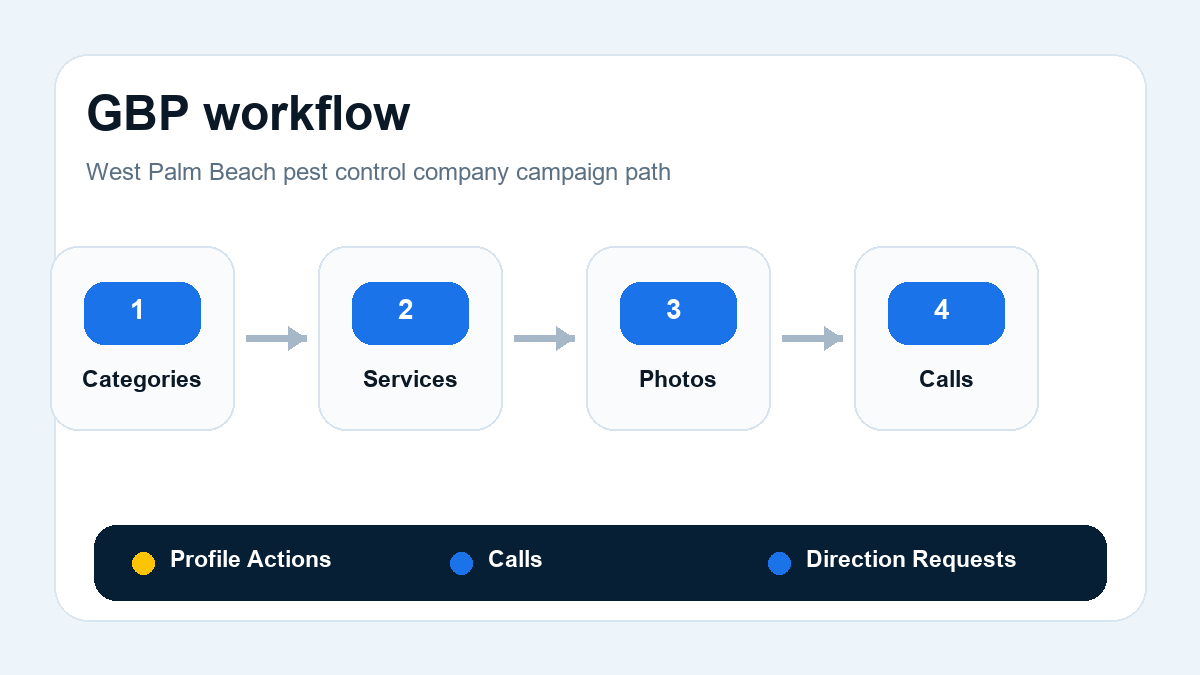
A small but complete build is better than a large campaign with no feedback loop. Start with one page or offer, connect it to the parent Google Business Profile service, support it with proof for the Pest Control Companies audience, and point local readers toward the West Palm Beach service area. Then use call and form data to decide what deserves expansion.
Local examples to make the content stronger
A stronger West Palm Beach page can include a short section for neighborhoods or service zones, a short explanation of seasonal demand, and a practical note about how buyers compare providers. For this post, the local examples should connect Palm Beach County context with pest control companies buying behavior.
For example, a pest control company serving West Palm Beach might need one message for urgent searchers, another for research-stage buyers, and another for high-value projects. The content should not pretend all leads are equal. It should explain how the business qualifies opportunities, what proof matters most, and what happens after the visitor takes action.
That is also where Google Business Profile becomes more than a marketing label. The service should help the business decide what to publish, what to promote, what to track, and what to stop doing. If a keyword gets impressions but no qualified action, the answer may be stronger proof, a clearer offer, better routing, or a more specific page.
Internal links and topical authority
This page should not sit alone. It supports the parent Google Business Profile page, reinforces the Pest Control Companies industry section, and connects back to the West Palm Beach service area. Those internal links help the article pass relevance back to the pages that matter most for Nexgen’s core SEO.
Internal links should be useful to the reader, not forced into every sentence. The best pattern is simple: link up to the parent service, link sideways to related Florida posts, and link forward to a clear conversion action such as a strategy review or contact page.
Frequently asked questions
How can Google Business Profile help pest control companies in West Palm Beach?
Google Business Profile helps a pest control company in West Palm Beach connect local intent to a clearer conversion path. The goal is to show the right proof, route the right inquiries, and measure lead quality instead of only counting traffic.
What should a West Palm Beach pest control company build first?
Start with one priority service, one primary page or offer, call and form tracking, and proof that matches downtown West Palm Beach, Palm Beach County suburbs, and coastal communities. After the first data comes in, expand into related services, nearby neighborhoods, or supporting blog content.
How long should pest control companies track this before scaling?
A useful test should run long enough to collect impressions, clicks, calls, forms, booked appointments, and disqualified lead notes. The decision to expand should come from lead quality and conversion data, not from traffic volume alone.
What makes this different from a generic Florida marketing page?
This page connects Google Business Profile, pest control companies, and West Palm Beach search behavior in one place. It uses local context, industry proof, internal links, and a tracking plan so the page can support both users and core service SEO.
Author and review note
About this guide: This article is published under Bill Gilmore’s Nexgen Local Marketing author profile and reviewed against Nexgen’s local search, paid media, conversion tracking, and content-quality checklist. It avoids unsupported ranking, lead, or revenue promises and focuses on practical steps a Florida business can verify.
Tracking, pruning, and improvement plan
After publishing, the page should be monitored in Google Search Console and Bing Webmaster Tools. The most useful early signals are impressions for the target topic, queries that include West Palm Beach, clicks from qualified searches, engagement with the call-to-action, and whether leads mention the service or location the page was built around.
Every quarter, the page should be reviewed. If it earns impressions but no clicks, the title and meta description may need work. If it earns clicks but no qualified actions, the offer, proof, form, or call path may need improvement. If it earns no meaningful impressions after enough time, it should be improved, merged into a stronger article, redirected, or noindexed instead of staying live as weak content.
Need a stronger Florida growth page for pest control companies?
Nexgen can review your West Palm Beach market, service mix, page structure, proof assets, and tracking setup before you scale content or ads.
Call 407-307-1995, email info@nexgenlocalmarketing.com, or request a Florida strategy review.
Fort Lauderdale Med Spas: Turning DaaS Into Better Local Leads
Data as a Service
Data as a Service for med spas in Fort Lauderdale FL is a narrow search, which is exactly why the page has to be useful. A med spa in Fort Lauderdale is not looking for a broad marketing definition. They need to understand what to build, what to measure, and how the strategy should fit the local market.
Quick answer
Data as a Service for med spas in Fort Lauderdale FL should be built as a focused local asset, not a generic marketing article. The page needs city context, industry proof, a conversion path, and tracking that shows whether the traffic becomes qualified conversations.
In this expanded guide
Primary keyword
Data as a Service for med spas in Fort Lauderdale FL
Best-fit intent
A local business owner or manager comparing whether Data as a Service can create better leads, better follow-up, or better search visibility for med spas in Fort Lauderdale.
Why the Fort Lauderdale market changes the strategy
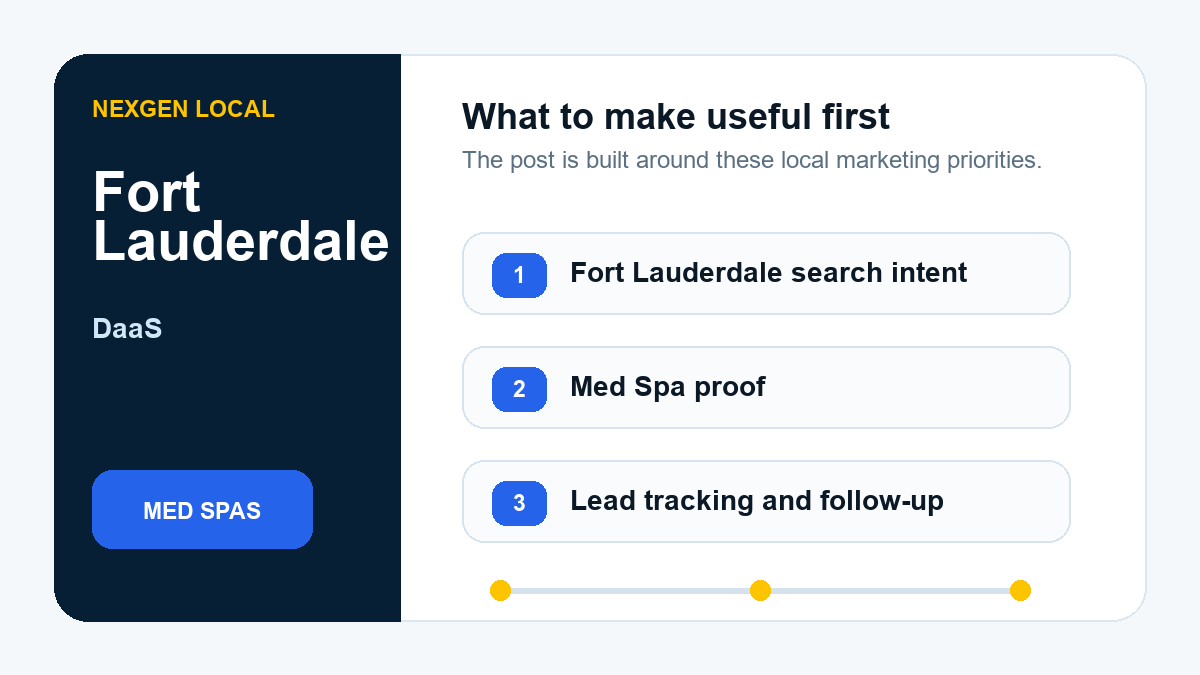
Fort Lauderdale brings a mix of Las Olas business traffic, Broward suburbs, waterfront properties, marina activity, and service calls tied to coastal living.
Marine activity, waterfront maintenance, rainy-season issues, and seasonal property ownership create narrow but valuable search intent. That matters because local search is not just a list of keywords. The same phrase can mean a quick emergency call, a research-stage project, a bid request, or a high-trust consultation depending on the neighborhood, service line, and buyer type.
For med spas, a useful page should make the local fit obvious. It should mention the service area in plain language, explain who the offer is for, show proof that matches the work, and give the visitor one clear next step. When a page only swaps in a city name, it may technically target the keyword, but it usually fails to answer the buyer’s real question.
What Fort Lauderdale med spas need to prove
Buyers need trust, clarity, and a simple booking path before they request a consultation. In Fort Lauderdale, that pain point becomes more specific because the market includes Las Olas, Victoria Park, waterfront neighborhoods, and Broward County suburbs. The page should reduce doubt before the visitor calls, clicks, or fills out a form.
Med spa marketing has to build trust before the consultation request, especially when treatments are personal, visual, and comparison-driven.
An injectables campaign should explain consultation flow, provider trust, treatment fit, and booking steps without overpromising outcomes.
Useful proof for this audience can include Treatment pages, provider bios, compliant before-and-after guidance, consultation FAQs, booking flows, and review language tied to experience.. These details are not decoration. They help real visitors decide whether the company understands their job, and they help search engines connect the page to the right entity, service, and local context.
The Data as a Service plan for this keyword
Data as a Service works when the business stops guessing which segments are worth attention and starts organizing lead, market, and job data into decisions.
For Data as a Service for med spas in Fort Lauderdale FL, the strategy should start with one primary intent and one conversion path. The campaign can still support secondary questions, but the main page should not drift into every possible marketing topic. A focused article is easier to optimize, easier to measure, and easier to improve after Search Console data starts showing real queries.
Use language that reflects injectables, laser treatments, or membership offers when those are the jobs the business actually wants.
Reference Las Olas, Victoria Park, waterfront neighborhoods, and Broward County suburbs, service-area fit, project types, photos, reviews, or process details that help a Fort Lauderdale buyer trust the next step.
Separate calls, forms, booked appointments, disqualified leads, and follow-up notes so the page is judged by qualified opportunities instead of traffic alone.
What to build first
The first version should be practical enough that a business owner can see the work. For med spas, the strongest page usually combines local explanation, industry proof, a clear call-to-action, and a measurement plan. That gives the content a reason to exist beyond keyword coverage.
| Build area | What to add | How to measure it |
|---|---|---|
| Lead source cleanup | Normalize forms, calls, campaigns, and offline notes so every lead can be traced back to a useful source. | Track source quality, close-rate patterns, service-line demand, local segments, and conversion gaps for Fort Lauderdale med spas. |
| Segment scoring | Score opportunities by service line, city, property type, margin potential, and fit instead of treating every inquiry the same. | Track source quality, close-rate patterns, service-line demand, local segments, and conversion gaps for Fort Lauderdale med spas. |
| Decision reporting | Turn the data into weekly actions: expand what works, fix weak pages, and cut waste from bad-fit channels. | Track source quality, close-rate patterns, service-line demand, local segments, and conversion gaps for Fort Lauderdale med spas. |
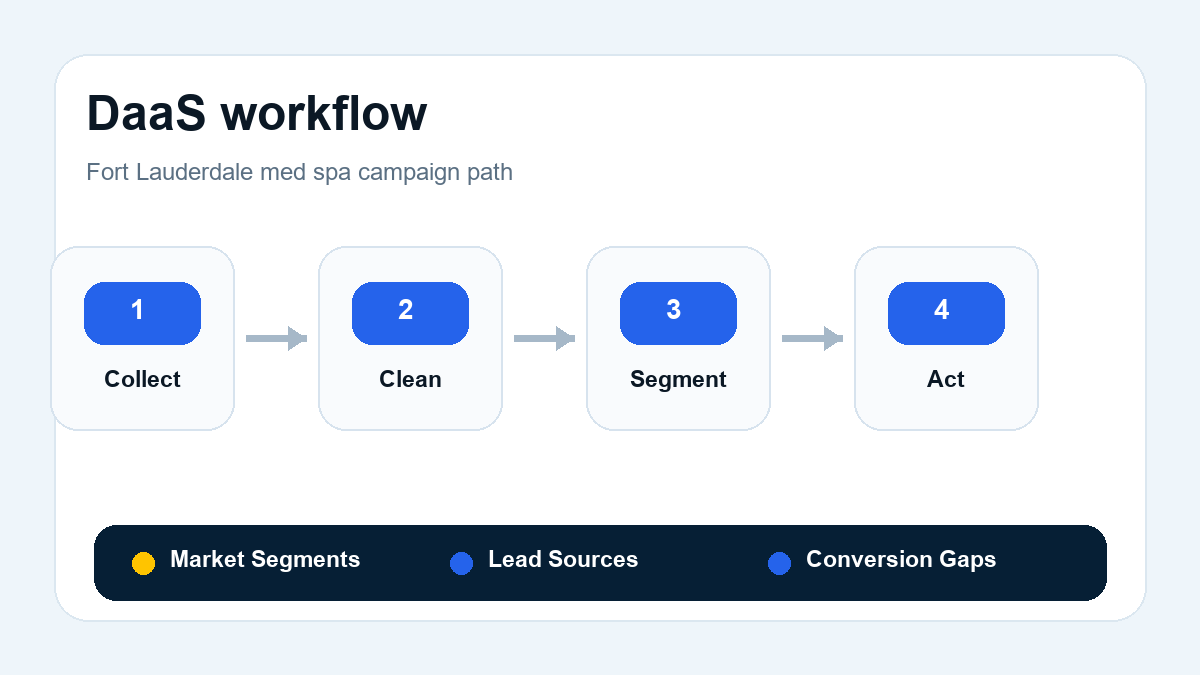
A small but complete build is better than a large campaign with no feedback loop. Start with one page or offer, connect it to the parent Data as a Service service, support it with proof for the Med Spas audience, and point local readers toward the Fort Lauderdale service area. Then use call and form data to decide what deserves expansion.
Local examples to make the content stronger
A stronger Fort Lauderdale page can include a short section for neighborhoods or service zones, a short explanation of seasonal demand, and a practical note about how buyers compare providers. For this post, the local examples should connect South Florida context with med spas buying behavior.
For example, a med spa serving Fort Lauderdale might need one message for urgent searchers, another for research-stage buyers, and another for high-value projects. The content should not pretend all leads are equal. It should explain how the business qualifies opportunities, what proof matters most, and what happens after the visitor takes action.
That is also where Data as a Service becomes more than a marketing label. The service should help the business decide what to publish, what to promote, what to track, and what to stop doing. If a keyword gets impressions but no qualified action, the answer may be stronger proof, a clearer offer, better routing, or a more specific page.
Internal links and topical authority
This page should not sit alone. It supports the parent Data as a Service page, reinforces the Med Spas industry section, and connects back to the Fort Lauderdale service area. Those internal links help the article pass relevance back to the pages that matter most for Nexgen’s core SEO.
Internal links should be useful to the reader, not forced into every sentence. The best pattern is simple: link up to the parent service, link sideways to related Florida posts, and link forward to a clear conversion action such as a strategy review or contact page.
Frequently asked questions
How can Data as a Service help med spas in Fort Lauderdale?
Data as a Service helps a med spa in Fort Lauderdale connect local intent to a clearer conversion path. The goal is to show the right proof, route the right inquiries, and measure lead quality instead of only counting traffic.
What should a Fort Lauderdale med spa build first?
Start with one priority service, one primary page or offer, call and form tracking, and proof that matches Las Olas, Victoria Park, waterfront neighborhoods, and Broward County suburbs. After the first data comes in, expand into related services, nearby neighborhoods, or supporting blog content.
How long should med spas track this before scaling?
A useful test should run long enough to collect impressions, clicks, calls, forms, booked appointments, and disqualified lead notes. The decision to expand should come from lead quality and conversion data, not from traffic volume alone.
What makes this different from a generic Florida marketing page?
This page connects Data as a Service, med spas, and Fort Lauderdale search behavior in one place. It uses local context, industry proof, internal links, and a tracking plan so the page can support both users and core service SEO.
Author and review note
About this guide: This article is published under Bill Gilmore’s Nexgen Local Marketing author profile and reviewed against Nexgen’s local search, paid media, conversion tracking, and content-quality checklist. It avoids unsupported ranking, lead, or revenue promises and focuses on practical steps a Florida business can verify.
Tracking, pruning, and improvement plan
After publishing, the page should be monitored in Google Search Console and Bing Webmaster Tools. The most useful early signals are impressions for the target topic, queries that include Fort Lauderdale, clicks from qualified searches, engagement with the call-to-action, and whether leads mention the service or location the page was built around.
Every quarter, the page should be reviewed. If it earns impressions but no clicks, the title and meta description may need work. If it earns clicks but no qualified actions, the offer, proof, form, or call path may need improvement. If it earns no meaningful impressions after enough time, it should be improved, merged into a stronger article, redirected, or noindexed instead of staying live as weak content.
Need a stronger Florida growth page for med spas?
Nexgen can review your Fort Lauderdale market, service mix, page structure, proof assets, and tracking setup before you scale content or ads.
Call 407-307-1995, email info@nexgenlocalmarketing.com, or request a Florida strategy review.
A Florida-Focused Google Business Profile Playbook for Fort Lauderdale Pool Builders
Google Business Profile
Google Business Profile for pool builders in Fort Lauderdale FL is a narrow search, which is exactly why the page has to be useful. A pool builder in Fort Lauderdale is not looking for a broad marketing definition. They need to understand what to build, what to measure, and how the strategy should fit the local market.
Quick answer
Google Business Profile for pool builders in Fort Lauderdale FL should be built as a focused local asset, not a generic marketing article. The page needs city context, industry proof, a conversion path, and tracking that shows whether the traffic becomes qualified conversations.
In this expanded guide
Primary keyword
Google Business Profile for pool builders in Fort Lauderdale FL
Best-fit intent
A local business owner or manager comparing whether Google Business Profile can create better leads, better follow-up, or better search visibility for pool builders in Fort Lauderdale.
Why the Fort Lauderdale market changes the strategy
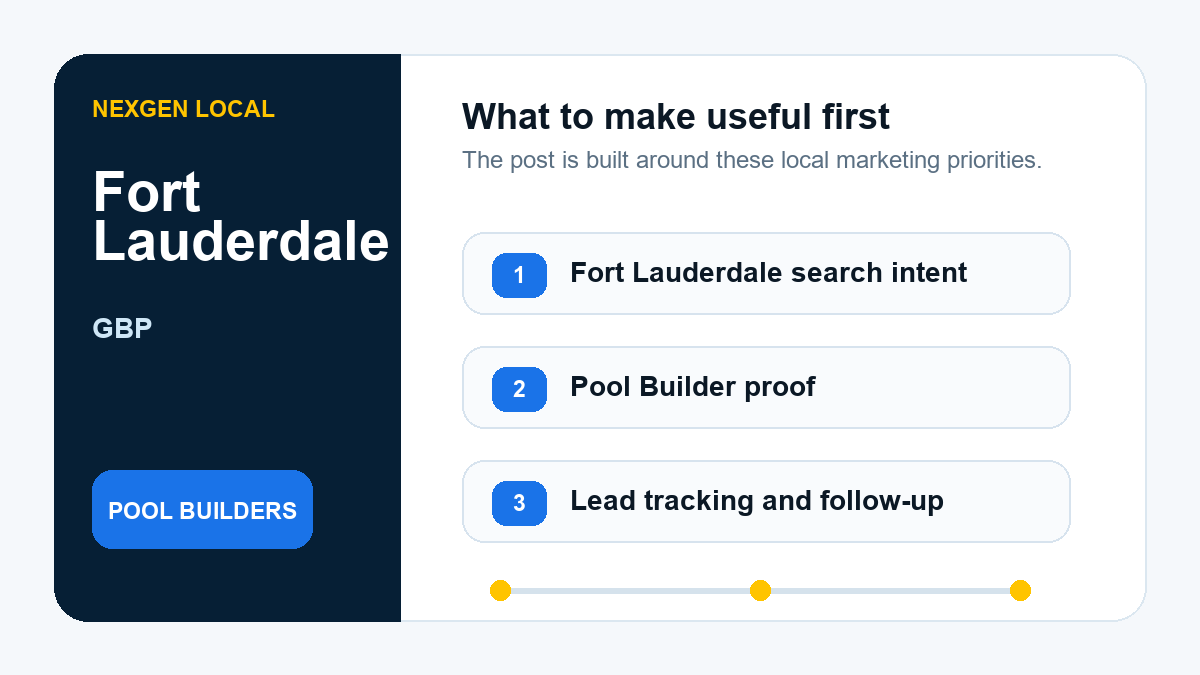
Fort Lauderdale brings a mix of Las Olas business traffic, Broward suburbs, waterfront properties, marina activity, and service calls tied to coastal living.
Marine activity, waterfront maintenance, rainy-season issues, and seasonal property ownership create narrow but valuable search intent. That matters because local search is not just a list of keywords. The same phrase can mean a quick emergency call, a research-stage project, a bid request, or a high-trust consultation depending on the neighborhood, service line, and buyer type.
For pool builders, a useful page should make the local fit obvious. It should mention the service area in plain language, explain who the offer is for, show proof that matches the work, and give the visitor one clear next step. When a page only swaps in a city name, it may technically target the keyword, but it usually fails to answer the buyer’s real question.
What Fort Lauderdale pool builders need to prove
High-ticket projects need visual proof, financing clarity, and strong local credibility. In Fort Lauderdale, that pain point becomes more specific because the market includes Las Olas, Victoria Park, waterfront neighborhoods, and Broward County suburbs. The page should reduce doubt before the visitor calls, clicks, or fills out a form.
Pool projects are high-ticket and comparison-heavy, so the campaign has to show process, design fit, financing or timeline clarity, and local credibility.
A custom pool lead should be qualified by project type, location, timeline, financing interest, and whether the buyer needs design, resurfacing, or enclosure work.
Useful proof for this audience can include Gallery pages, process explainers, permit or timeline FAQs, service-area pages, review themes, and quote request tracking.. These details are not decoration. They help real visitors decide whether the company understands their job, and they help search engines connect the page to the right entity, service, and local context.
The Google Business Profile plan for this keyword
Google Business Profile work is useful when the listing becomes a clearer decision point, not just a filled-out directory profile.
For Google Business Profile for pool builders in Fort Lauderdale FL, the strategy should start with one primary intent and one conversion path. The campaign can still support secondary questions, but the main page should not drift into every possible marketing topic. A focused article is easier to optimize, easier to measure, and easier to improve after Search Console data starts showing real queries.
Use language that reflects custom pools, pool resurfacing, or screen enclosures when those are the jobs the business actually wants.
Reference Las Olas, Victoria Park, waterfront neighborhoods, and Broward County suburbs, service-area fit, project types, photos, reviews, or process details that help a Fort Lauderdale buyer trust the next step.
Separate calls, forms, booked appointments, disqualified leads, and follow-up notes so the page is judged by qualified opportunities instead of traffic alone.
What to build first
The first version should be practical enough that a business owner can see the work. For pool builders, the strongest page usually combines local explanation, industry proof, a clear call-to-action, and a measurement plan. That gives the content a reason to exist beyond keyword coverage.
| Build area | What to add | How to measure it |
|---|---|---|
| Profile completeness | Align categories, services, photos, hours, products or services, and description with actual buyer intent. | Track calls, profile actions, direction requests, review velocity, service visibility, and listing engagement for Fort Lauderdale pool builders. |
| Review strategy | Ask for reviews that mention service type, location, response quality, and project context without scripting fake language. | Track calls, profile actions, direction requests, review velocity, service visibility, and listing engagement for Fort Lauderdale pool builders. |
| Action tracking | Track calls, direction requests, website clicks, and profile actions so listing updates can be tied to behavior. | Track calls, profile actions, direction requests, review velocity, service visibility, and listing engagement for Fort Lauderdale pool builders. |
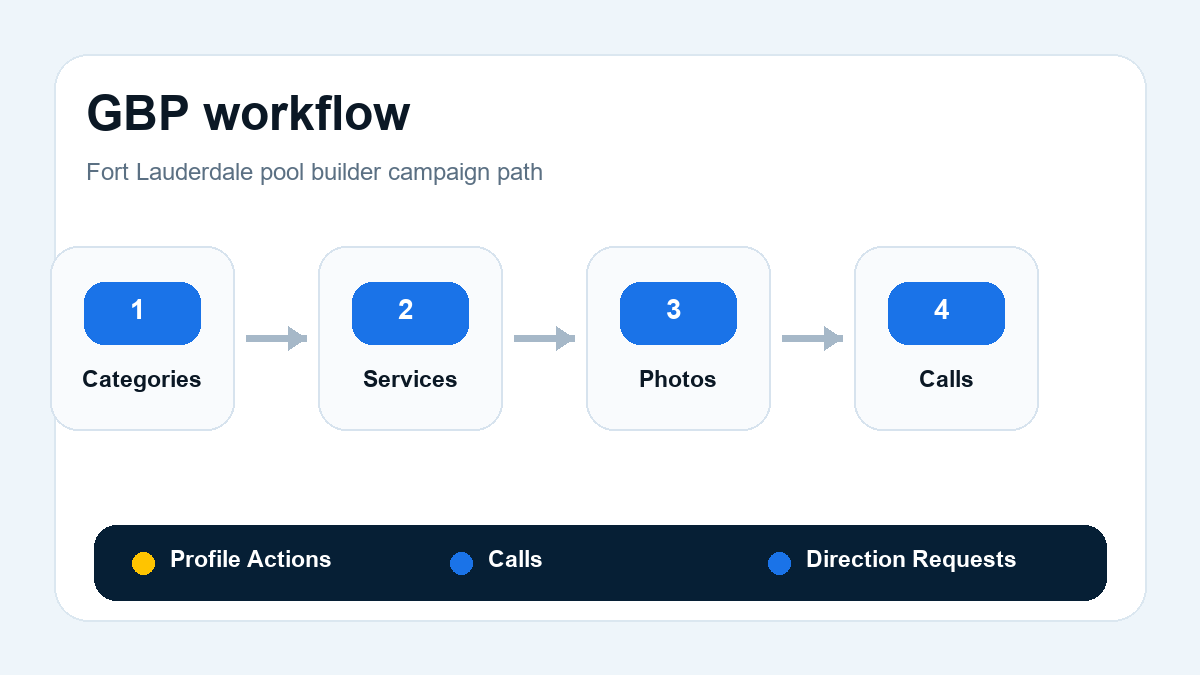
A small but complete build is better than a large campaign with no feedback loop. Start with one page or offer, connect it to the parent Google Business Profile service, support it with proof for the Pool Builders audience, and point local readers toward the Fort Lauderdale service area. Then use call and form data to decide what deserves expansion.
Local examples to make the content stronger
A stronger Fort Lauderdale page can include a short section for neighborhoods or service zones, a short explanation of seasonal demand, and a practical note about how buyers compare providers. For this post, the local examples should connect South Florida context with pool builders buying behavior.
For example, a pool builder serving Fort Lauderdale might need one message for urgent searchers, another for research-stage buyers, and another for high-value projects. The content should not pretend all leads are equal. It should explain how the business qualifies opportunities, what proof matters most, and what happens after the visitor takes action.
That is also where Google Business Profile becomes more than a marketing label. The service should help the business decide what to publish, what to promote, what to track, and what to stop doing. If a keyword gets impressions but no qualified action, the answer may be stronger proof, a clearer offer, better routing, or a more specific page.
Internal links and topical authority
This page should not sit alone. It supports the parent Google Business Profile page, reinforces the Pool Builders industry section, and connects back to the Fort Lauderdale service area. Those internal links help the article pass relevance back to the pages that matter most for Nexgen’s core SEO.
Internal links should be useful to the reader, not forced into every sentence. The best pattern is simple: link up to the parent service, link sideways to related Florida posts, and link forward to a clear conversion action such as a strategy review or contact page.
Frequently asked questions
How can Google Business Profile help pool builders in Fort Lauderdale?
Google Business Profile helps a pool builder in Fort Lauderdale connect local intent to a clearer conversion path. The goal is to show the right proof, route the right inquiries, and measure lead quality instead of only counting traffic.
What should a Fort Lauderdale pool builder build first?
Start with one priority service, one primary page or offer, call and form tracking, and proof that matches Las Olas, Victoria Park, waterfront neighborhoods, and Broward County suburbs. After the first data comes in, expand into related services, nearby neighborhoods, or supporting blog content.
How long should pool builders track this before scaling?
A useful test should run long enough to collect impressions, clicks, calls, forms, booked appointments, and disqualified lead notes. The decision to expand should come from lead quality and conversion data, not from traffic volume alone.
What makes this different from a generic Florida marketing page?
This page connects Google Business Profile, pool builders, and Fort Lauderdale search behavior in one place. It uses local context, industry proof, internal links, and a tracking plan so the page can support both users and core service SEO.
Author and review note
About this guide: This article is published under Bill Gilmore’s Nexgen Local Marketing author profile and reviewed against Nexgen’s local search, paid media, conversion tracking, and content-quality checklist. It avoids unsupported ranking, lead, or revenue promises and focuses on practical steps a Florida business can verify.
Tracking, pruning, and improvement plan
After publishing, the page should be monitored in Google Search Console and Bing Webmaster Tools. The most useful early signals are impressions for the target topic, queries that include Fort Lauderdale, clicks from qualified searches, engagement with the call-to-action, and whether leads mention the service or location the page was built around.
Every quarter, the page should be reviewed. If it earns impressions but no clicks, the title and meta description may need work. If it earns clicks but no qualified actions, the offer, proof, form, or call path may need improvement. If it earns no meaningful impressions after enough time, it should be improved, merged into a stronger article, redirected, or noindexed instead of staying live as weak content.
Need a stronger Florida growth page for pool builders?
Nexgen can review your Fort Lauderdale market, service mix, page structure, proof assets, and tracking setup before you scale content or ads.
Call 407-307-1995, email info@nexgenlocalmarketing.com, or request a Florida strategy review.
Tampa Plumbing Companies: Turning PPC Into Better Local Leads
Pay Per Click Marketing
PPC for plumbing companies in Tampa FL is a narrow search, which is exactly why the page has to be useful. A plumbing company in Tampa is not looking for a broad marketing definition. They need to understand what to build, what to measure, and how the strategy should fit the local market.
Quick answer
PPC for plumbing companies in Tampa FL should be built as a focused local asset, not a generic marketing article. The page needs city context, industry proof, a conversion path, and tracking that shows whether the traffic becomes qualified conversations.
In this expanded guide
Primary keyword
PPC for plumbing companies in Tampa FL
Best-fit intent
A local business owner or manager comparing whether PPC can create better leads, better follow-up, or better search visibility for plumbing companies in Tampa.
Why the Tampa market changes the strategy
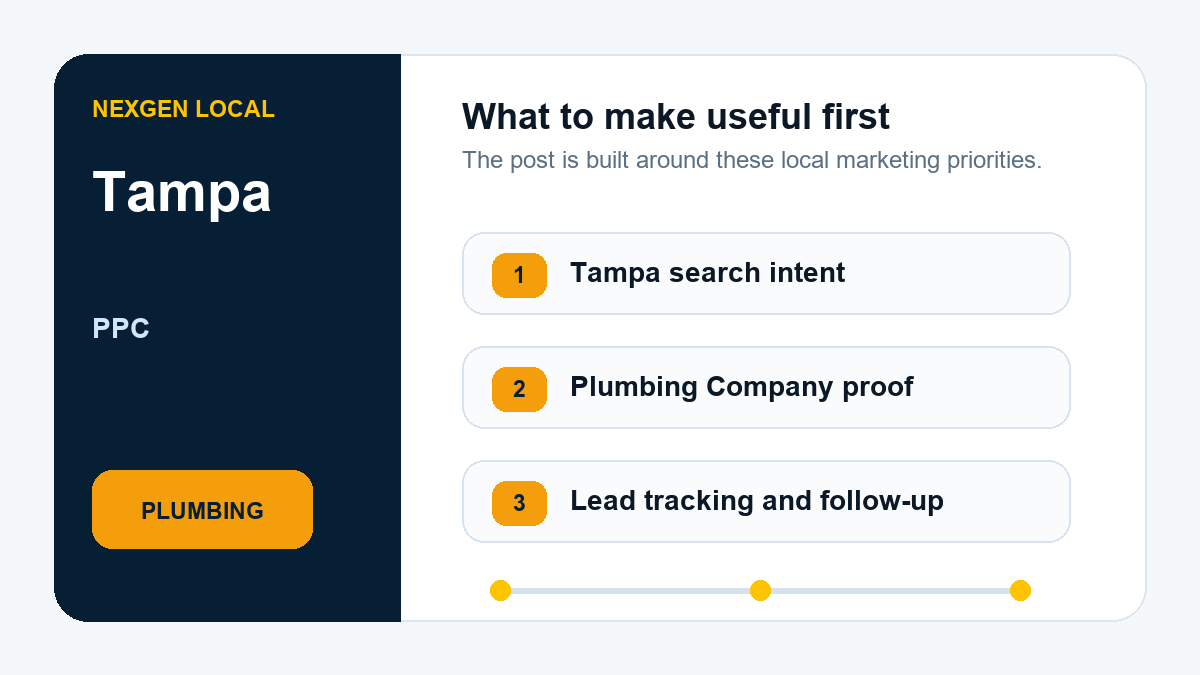
Tampa campaigns need to account for South Tampa, Westshore, Carrollwood, Brandon, and the broader bay-area pattern where homeowners compare several nearby providers.
Summer heat, hurricane planning, and bay-area homeowner demand make speed, reviews, and clear service areas especially important. That matters because local search is not just a list of keywords. The same phrase can mean a quick emergency call, a research-stage project, a bid request, or a high-trust consultation depending on the neighborhood, service line, and buyer type.
For plumbing companies, a useful page should make the local fit obvious. It should mention the service area in plain language, explain who the offer is for, show proof that matches the work, and give the visitor one clear next step. When a page only swaps in a city name, it may technically target the keyword, but it usually fails to answer the buyer’s real question.
What Tampa plumbing companies need to prove
Urgent searches need trust fast, especially when water damage is already happening. In Tampa, that pain point becomes more specific because the market includes South Tampa, Westshore, Carrollwood, Brandon, and the wider Tampa Bay market. The page should reduce doubt before the visitor calls, clicks, or fills out a form.
Plumbing buyers often search under stress, so the page has to answer trust, response, and service-fit questions immediately.
A leak repair or water heater replacement page should route mobile visitors to a call action while still giving enough detail for research-stage homeowners.
Useful proof for this audience can include License notes where appropriate, repair photos, emergency pages, neighborhood reviews, and forms that capture the type of plumbing issue.. These details are not decoration. They help real visitors decide whether the company understands their job, and they help search engines connect the page to the right entity, service, and local context.
The PPC plan for this keyword
PPC only works when search intent, landing page proof, and lead tracking are managed as one system.
For PPC for plumbing companies in Tampa FL, the strategy should start with one primary intent and one conversion path. The campaign can still support secondary questions, but the main page should not drift into every possible marketing topic. A focused article is easier to optimize, easier to measure, and easier to improve after Search Console data starts showing real queries.
Use language that reflects leak repair, repiping, or water heater replacement when those are the jobs the business actually wants.
Reference South Tampa, Westshore, Carrollwood, Brandon, and the wider Tampa Bay market, service-area fit, project types, photos, reviews, or process details that help a Tampa buyer trust the next step.
Separate calls, forms, booked appointments, disqualified leads, and follow-up notes so the page is judged by qualified opportunities instead of traffic alone.
What to build first
The first version should be practical enough that a business owner can see the work. For plumbing companies, the strongest page usually combines local explanation, industry proof, a clear call-to-action, and a measurement plan. That gives the content a reason to exist beyond keyword coverage.
| Build area | What to add | How to measure it |
|---|---|---|
| Campaign structure | Separate emergency, research, branded, and high-value service searches so budget is not diluted by mixed intent. | Track cost per qualified lead, call quality, booked appointments, search term quality, and landing page conversion rate for Tampa plumbing companies. |
| Landing page fit | Match ad copy to the service, city, proof, and call-to-action visitors expect after clicking. | Track cost per qualified lead, call quality, booked appointments, search term quality, and landing page conversion rate for Tampa plumbing companies. |
| Cost control | Review search terms, call quality, form quality, and booked outcomes before increasing spend. | Track cost per qualified lead, call quality, booked appointments, search term quality, and landing page conversion rate for Tampa plumbing companies. |
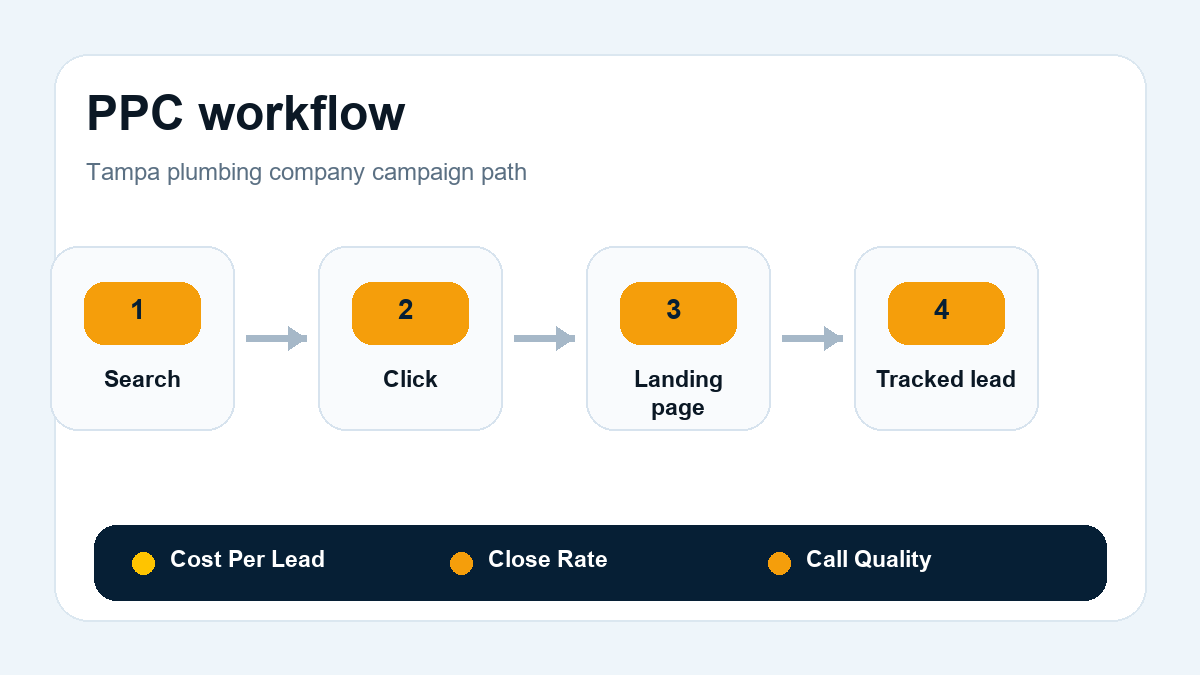
A small but complete build is better than a large campaign with no feedback loop. Start with one page or offer, connect it to the parent PPC service, support it with proof for the Plumbing Companies audience, and point local readers toward the Tampa service area. Then use call and form data to decide what deserves expansion.
Local examples to make the content stronger
A stronger Tampa page can include a short section for neighborhoods or service zones, a short explanation of seasonal demand, and a practical note about how buyers compare providers. For this post, the local examples should connect Tampa Bay context with plumbing companies buying behavior.
For example, a plumbing company serving Tampa might need one message for urgent searchers, another for research-stage buyers, and another for high-value projects. The content should not pretend all leads are equal. It should explain how the business qualifies opportunities, what proof matters most, and what happens after the visitor takes action.
That is also where PPC becomes more than a marketing label. The service should help the business decide what to publish, what to promote, what to track, and what to stop doing. If a keyword gets impressions but no qualified action, the answer may be stronger proof, a clearer offer, better routing, or a more specific page.
Internal links and topical authority
This page should not sit alone. It supports the parent PPC page, reinforces the Plumbing Companies industry section, and connects back to the Tampa service area. Those internal links help the article pass relevance back to the pages that matter most for Nexgen’s core SEO.
Internal links should be useful to the reader, not forced into every sentence. The best pattern is simple: link up to the parent service, link sideways to related Florida posts, and link forward to a clear conversion action such as a strategy review or contact page.
Frequently asked questions
How can PPC help plumbing companies in Tampa?
PPC helps a plumbing company in Tampa connect local intent to a clearer conversion path. The goal is to show the right proof, route the right inquiries, and measure lead quality instead of only counting traffic.
What should a Tampa plumbing company build first?
Start with one priority service, one primary page or offer, call and form tracking, and proof that matches South Tampa, Westshore, Carrollwood, Brandon, and the wider Tampa Bay market. After the first data comes in, expand into related services, nearby neighborhoods, or supporting blog content.
How long should plumbing companies track this before scaling?
A useful test should run long enough to collect impressions, clicks, calls, forms, booked appointments, and disqualified lead notes. The decision to expand should come from lead quality and conversion data, not from traffic volume alone.
What makes this different from a generic Florida marketing page?
This page connects PPC, plumbing companies, and Tampa search behavior in one place. It uses local context, industry proof, internal links, and a tracking plan so the page can support both users and core service SEO.
Author and review note
About this guide: This article is published under Bill Gilmore’s Nexgen Local Marketing author profile and reviewed against Nexgen’s local search, paid media, conversion tracking, and content-quality checklist. It avoids unsupported ranking, lead, or revenue promises and focuses on practical steps a Florida business can verify.
Tracking, pruning, and improvement plan
After publishing, the page should be monitored in Google Search Console and Bing Webmaster Tools. The most useful early signals are impressions for the target topic, queries that include Tampa, clicks from qualified searches, engagement with the call-to-action, and whether leads mention the service or location the page was built around.
Every quarter, the page should be reviewed. If it earns impressions but no clicks, the title and meta description may need work. If it earns clicks but no qualified actions, the offer, proof, form, or call path may need improvement. If it earns no meaningful impressions after enough time, it should be improved, merged into a stronger article, redirected, or noindexed instead of staying live as weak content.
Need a stronger Florida growth page for plumbing companies?
Nexgen can review your Tampa market, service mix, page structure, proof assets, and tracking setup before you scale content or ads.
Call 407-307-1995, email info@nexgenlocalmarketing.com, or request a Florida strategy review.
How Smart Home Installers in Tampa Can Use Data as a Service in 2026
Data as a Service
Data as a Service for smart home installers in Tampa FL is a narrow search, which is exactly why the page has to be useful. A smart home installer in Tampa is not looking for a broad marketing definition. They need to understand what to build, what to measure, and how the strategy should fit the local market.
Quick answer
Data as a Service for smart home installers in Tampa FL should be built as a focused local asset, not a generic marketing article. The page needs city context, industry proof, a conversion path, and tracking that shows whether the traffic becomes qualified conversations.
In this expanded guide
Primary keyword
Data as a Service for smart home installers in Tampa FL
Best-fit intent
A local business owner or manager comparing whether Data as a Service can create better leads, better follow-up, or better search visibility for smart home installers in Tampa.
Why the Tampa market changes the strategy
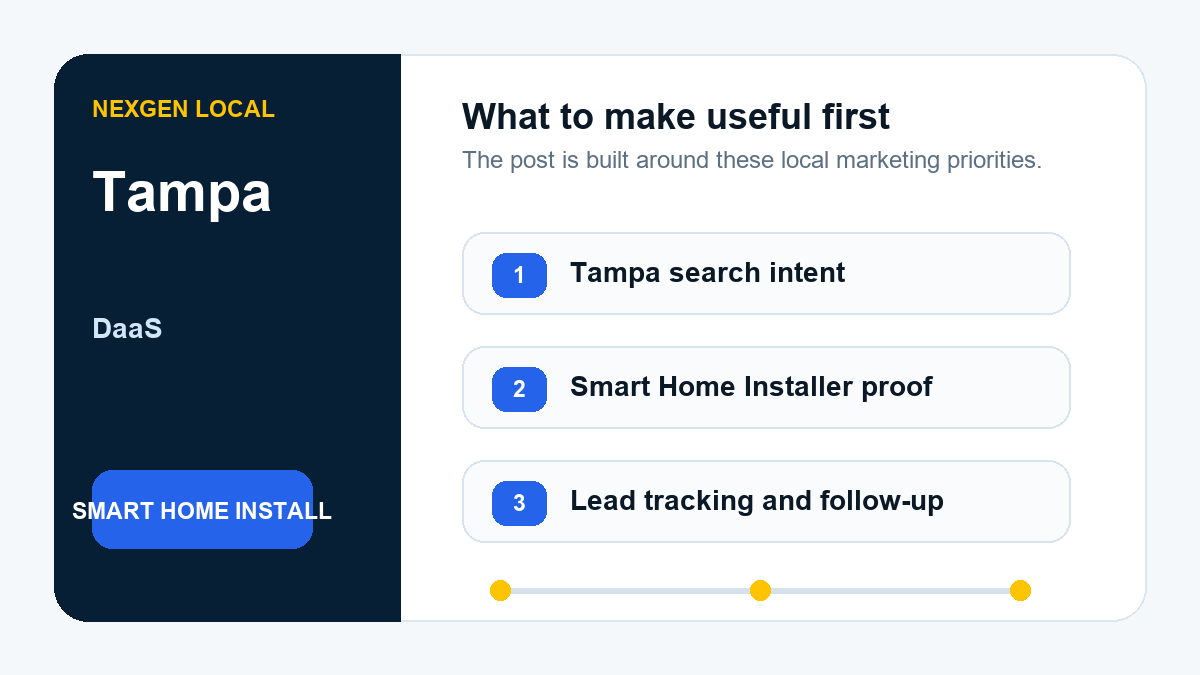
Tampa campaigns need to account for South Tampa, Westshore, Carrollwood, Brandon, and the broader bay-area pattern where homeowners compare several nearby providers.
Summer heat, hurricane planning, and bay-area homeowner demand make speed, reviews, and clear service areas especially important. That matters because local search is not just a list of keywords. The same phrase can mean a quick emergency call, a research-stage project, a bid request, or a high-trust consultation depending on the neighborhood, service line, and buyer type.
For smart home installers, a useful page should make the local fit obvious. It should mention the service area in plain language, explain who the offer is for, show proof that matches the work, and give the visitor one clear next step. When a page only swaps in a city name, it may technically target the keyword, but it usually fails to answer the buyer’s real question.
What Tampa smart home installers need to prove
Customers need confidence that the installer can connect devices into one reliable system. In Tampa, that pain point becomes more specific because the market includes South Tampa, Westshore, Carrollwood, Brandon, and the wider Tampa Bay market. The page should reduce doubt before the visitor calls, clicks, or fills out a form.
Smart home buyers need confidence that devices, security, lighting, audio, and automation will work as one system.
A whole-home automation lead should capture existing devices, desired rooms, network concerns, budget range, and whether the project is new construction or retrofit.
Useful proof for this audience can include System diagrams, product compatibility pages, project examples, consultation forms, and troubleshooting or upgrade FAQs.. These details are not decoration. They help real visitors decide whether the company understands their job, and they help search engines connect the page to the right entity, service, and local context.
The Data as a Service plan for this keyword
Data as a Service works when the business stops guessing which segments are worth attention and starts organizing lead, market, and job data into decisions.
For Data as a Service for smart home installers in Tampa FL, the strategy should start with one primary intent and one conversion path. The campaign can still support secondary questions, but the main page should not drift into every possible marketing topic. A focused article is easier to optimize, easier to measure, and easier to improve after Search Console data starts showing real queries.
Use language that reflects lighting control, security systems, or whole-home automation when those are the jobs the business actually wants.
Reference South Tampa, Westshore, Carrollwood, Brandon, and the wider Tampa Bay market, service-area fit, project types, photos, reviews, or process details that help a Tampa buyer trust the next step.
Separate calls, forms, booked appointments, disqualified leads, and follow-up notes so the page is judged by qualified opportunities instead of traffic alone.
What to build first
The first version should be practical enough that a business owner can see the work. For smart home installers, the strongest page usually combines local explanation, industry proof, a clear call-to-action, and a measurement plan. That gives the content a reason to exist beyond keyword coverage.
| Build area | What to add | How to measure it |
|---|---|---|
| Lead source cleanup | Normalize forms, calls, campaigns, and offline notes so every lead can be traced back to a useful source. | Track source quality, close-rate patterns, service-line demand, local segments, and conversion gaps for Tampa smart home installers. |
| Segment scoring | Score opportunities by service line, city, property type, margin potential, and fit instead of treating every inquiry the same. | Track source quality, close-rate patterns, service-line demand, local segments, and conversion gaps for Tampa smart home installers. |
| Decision reporting | Turn the data into weekly actions: expand what works, fix weak pages, and cut waste from bad-fit channels. | Track source quality, close-rate patterns, service-line demand, local segments, and conversion gaps for Tampa smart home installers. |
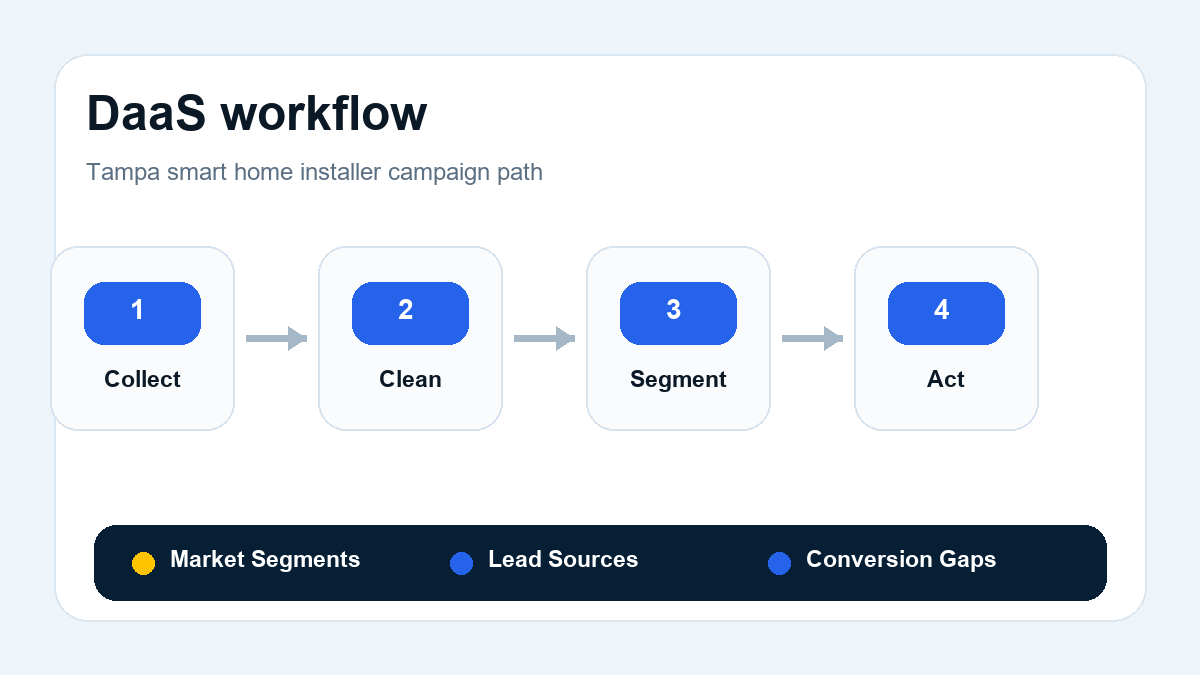
A small but complete build is better than a large campaign with no feedback loop. Start with one page or offer, connect it to the parent Data as a Service service, support it with proof for the Smart Home Installers audience, and point local readers toward the Tampa service area. Then use call and form data to decide what deserves expansion.
Local examples to make the content stronger
A stronger Tampa page can include a short section for neighborhoods or service zones, a short explanation of seasonal demand, and a practical note about how buyers compare providers. For this post, the local examples should connect Tampa Bay context with smart home installers buying behavior.
For example, a smart home installer serving Tampa might need one message for urgent searchers, another for research-stage buyers, and another for high-value projects. The content should not pretend all leads are equal. It should explain how the business qualifies opportunities, what proof matters most, and what happens after the visitor takes action.
That is also where Data as a Service becomes more than a marketing label. The service should help the business decide what to publish, what to promote, what to track, and what to stop doing. If a keyword gets impressions but no qualified action, the answer may be stronger proof, a clearer offer, better routing, or a more specific page.
Internal links and topical authority
This page should not sit alone. It supports the parent Data as a Service page, reinforces the Smart Home Installers industry section, and connects back to the Tampa service area. Those internal links help the article pass relevance back to the pages that matter most for Nexgen’s core SEO.
Internal links should be useful to the reader, not forced into every sentence. The best pattern is simple: link up to the parent service, link sideways to related Florida posts, and link forward to a clear conversion action such as a strategy review or contact page.
Frequently asked questions
How can Data as a Service help smart home installers in Tampa?
Data as a Service helps a smart home installer in Tampa connect local intent to a clearer conversion path. The goal is to show the right proof, route the right inquiries, and measure lead quality instead of only counting traffic.
What should a Tampa smart home installer build first?
Start with one priority service, one primary page or offer, call and form tracking, and proof that matches South Tampa, Westshore, Carrollwood, Brandon, and the wider Tampa Bay market. After the first data comes in, expand into related services, nearby neighborhoods, or supporting blog content.
How long should smart home installers track this before scaling?
A useful test should run long enough to collect impressions, clicks, calls, forms, booked appointments, and disqualified lead notes. The decision to expand should come from lead quality and conversion data, not from traffic volume alone.
What makes this different from a generic Florida marketing page?
This page connects Data as a Service, smart home installers, and Tampa search behavior in one place. It uses local context, industry proof, internal links, and a tracking plan so the page can support both users and core service SEO.
Author and review note
About this guide: This article is published under Bill Gilmore’s Nexgen Local Marketing author profile and reviewed against Nexgen’s local search, paid media, conversion tracking, and content-quality checklist. It avoids unsupported ranking, lead, or revenue promises and focuses on practical steps a Florida business can verify.
Tracking, pruning, and improvement plan
After publishing, the page should be monitored in Google Search Console and Bing Webmaster Tools. The most useful early signals are impressions for the target topic, queries that include Tampa, clicks from qualified searches, engagement with the call-to-action, and whether leads mention the service or location the page was built around.
Every quarter, the page should be reviewed. If it earns impressions but no clicks, the title and meta description may need work. If it earns clicks but no qualified actions, the offer, proof, form, or call path may need improvement. If it earns no meaningful impressions after enough time, it should be improved, merged into a stronger article, redirected, or noindexed instead of staying live as weak content.
Need a stronger Florida growth page for smart home installers?
Nexgen can review your Tampa market, service mix, page structure, proof assets, and tracking setup before you scale content or ads.
Call 407-307-1995, email info@nexgenlocalmarketing.com, or request a Florida strategy review.
Google Business Profile for Tampa Aviation Service Companies: What to Build First
Google Business Profile
Google Business Profile for aviation service companies in Tampa FL is a narrow search, which is exactly why the page has to be useful. A aviation service company in Tampa is not looking for a broad marketing definition. They need to understand what to build, what to measure, and how the strategy should fit the local market.
Quick answer
Google Business Profile for aviation service companies in Tampa FL should be built as a focused local asset, not a generic marketing article. The page needs city context, industry proof, a conversion path, and tracking that shows whether the traffic becomes qualified conversations.
In this expanded guide
Primary keyword
Google Business Profile for aviation service companies in Tampa FL
Best-fit intent
A local business owner or manager comparing whether Google Business Profile can create better leads, better follow-up, or better search visibility for aviation service companies in Tampa.
Why the Tampa market changes the strategy
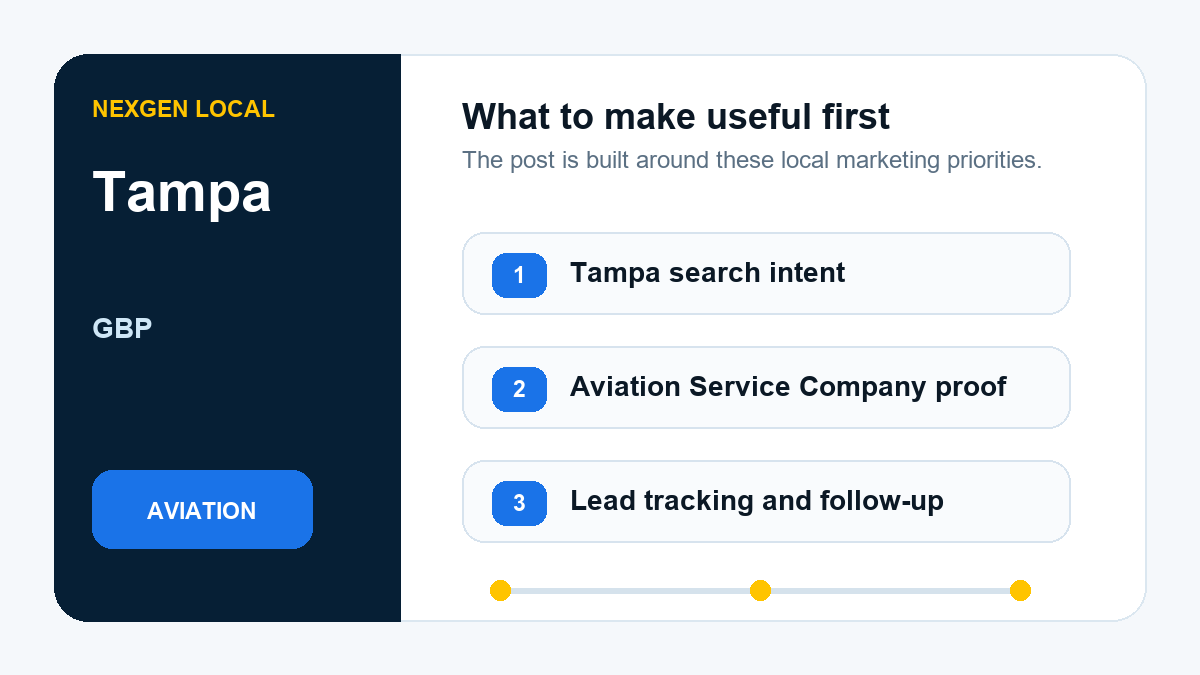
Tampa campaigns need to account for South Tampa, Westshore, Carrollwood, Brandon, and the broader bay-area pattern where homeowners compare several nearby providers.
Summer heat, hurricane planning, and bay-area homeowner demand make speed, reviews, and clear service areas especially important. That matters because local search is not just a list of keywords. The same phrase can mean a quick emergency call, a research-stage project, a bid request, or a high-trust consultation depending on the neighborhood, service line, and buyer type.
For aviation service companies, a useful page should make the local fit obvious. It should mention the service area in plain language, explain who the offer is for, show proof that matches the work, and give the visitor one clear next step. When a page only swaps in a city name, it may technically target the keyword, but it usually fails to answer the buyer’s real question.
What Tampa aviation service companies need to prove
Aviation buyers search with specific intent and need credibility before they start a conversation. In Tampa, that pain point becomes more specific because the market includes South Tampa, Westshore, Carrollwood, Brandon, and the wider Tampa Bay market. The page should reduce doubt before the visitor calls, clicks, or fills out a form.
Aviation searchers need technical specificity and credibility before they call, especially for charter, MRO, training, or aircraft services.
A flight training or aircraft service campaign should separate student, owner, and operator intent instead of sending all traffic to one generic page.
Useful proof for this audience can include Certification references where valid, service-specific pages, airport-area location signals, inquiry tracking, and technical FAQs.. These details are not decoration. They help real visitors decide whether the company understands their job, and they help search engines connect the page to the right entity, service, and local context.
The Google Business Profile plan for this keyword
Google Business Profile work is useful when the listing becomes a clearer decision point, not just a filled-out directory profile.
For Google Business Profile for aviation service companies in Tampa FL, the strategy should start with one primary intent and one conversion path. The campaign can still support secondary questions, but the main page should not drift into every possible marketing topic. A focused article is easier to optimize, easier to measure, and easier to improve after Search Console data starts showing real queries.
Use language that reflects charter inquiries, MRO services, or flight training when those are the jobs the business actually wants.
Reference South Tampa, Westshore, Carrollwood, Brandon, and the wider Tampa Bay market, service-area fit, project types, photos, reviews, or process details that help a Tampa buyer trust the next step.
Separate calls, forms, booked appointments, disqualified leads, and follow-up notes so the page is judged by qualified opportunities instead of traffic alone.
What to build first
The first version should be practical enough that a business owner can see the work. For aviation service companies, the strongest page usually combines local explanation, industry proof, a clear call-to-action, and a measurement plan. That gives the content a reason to exist beyond keyword coverage.
| Build area | What to add | How to measure it |
|---|---|---|
| Profile completeness | Align categories, services, photos, hours, products or services, and description with actual buyer intent. | Track calls, profile actions, direction requests, review velocity, service visibility, and listing engagement for Tampa aviation service companies. |
| Review strategy | Ask for reviews that mention service type, location, response quality, and project context without scripting fake language. | Track calls, profile actions, direction requests, review velocity, service visibility, and listing engagement for Tampa aviation service companies. |
| Action tracking | Track calls, direction requests, website clicks, and profile actions so listing updates can be tied to behavior. | Track calls, profile actions, direction requests, review velocity, service visibility, and listing engagement for Tampa aviation service companies. |
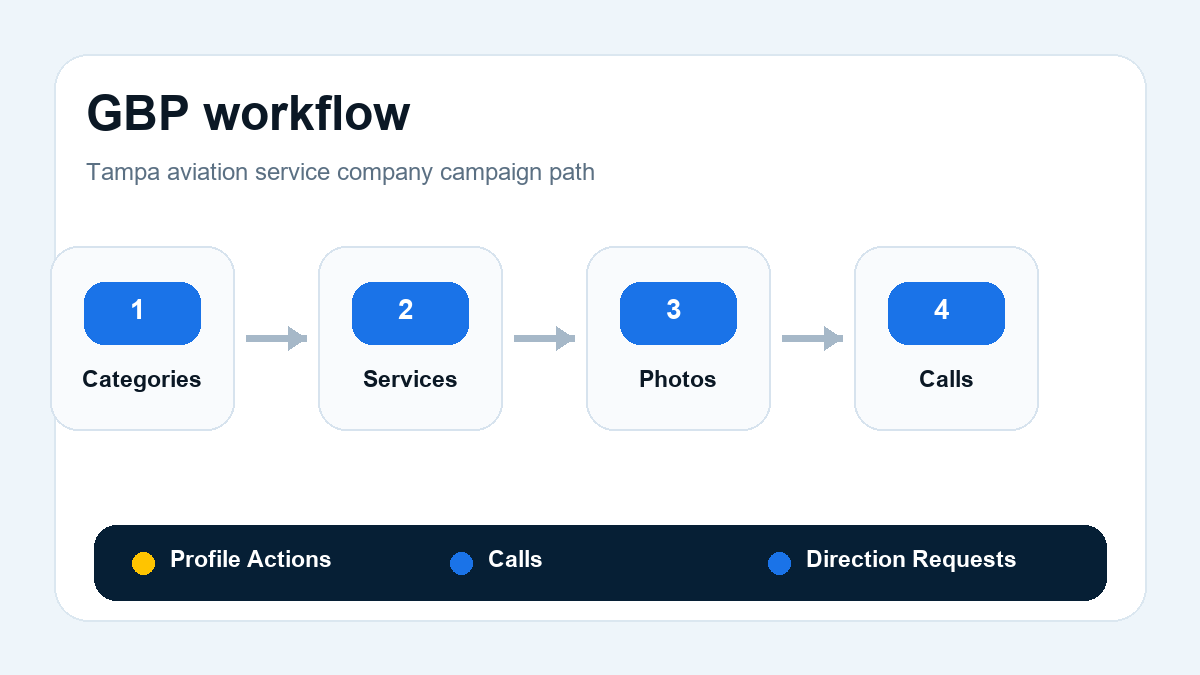
A small but complete build is better than a large campaign with no feedback loop. Start with one page or offer, connect it to the parent Google Business Profile service, support it with proof for the Aviation Service Companies audience, and point local readers toward the Tampa service area. Then use call and form data to decide what deserves expansion.
Local examples to make the content stronger
A stronger Tampa page can include a short section for neighborhoods or service zones, a short explanation of seasonal demand, and a practical note about how buyers compare providers. For this post, the local examples should connect Tampa Bay context with aviation service companies buying behavior.
For example, a aviation service company serving Tampa might need one message for urgent searchers, another for research-stage buyers, and another for high-value projects. The content should not pretend all leads are equal. It should explain how the business qualifies opportunities, what proof matters most, and what happens after the visitor takes action.
That is also where Google Business Profile becomes more than a marketing label. The service should help the business decide what to publish, what to promote, what to track, and what to stop doing. If a keyword gets impressions but no qualified action, the answer may be stronger proof, a clearer offer, better routing, or a more specific page.
Internal links and topical authority
This page should not sit alone. It supports the parent Google Business Profile page, reinforces the Aviation Service Companies industry section, and connects back to the Tampa service area. Those internal links help the article pass relevance back to the pages that matter most for Nexgen’s core SEO.
Internal links should be useful to the reader, not forced into every sentence. The best pattern is simple: link up to the parent service, link sideways to related Florida posts, and link forward to a clear conversion action such as a strategy review or contact page.
Frequently asked questions
How can Google Business Profile help aviation service companies in Tampa?
Google Business Profile helps a aviation service company in Tampa connect local intent to a clearer conversion path. The goal is to show the right proof, route the right inquiries, and measure lead quality instead of only counting traffic.
What should a Tampa aviation service company build first?
Start with one priority service, one primary page or offer, call and form tracking, and proof that matches South Tampa, Westshore, Carrollwood, Brandon, and the wider Tampa Bay market. After the first data comes in, expand into related services, nearby neighborhoods, or supporting blog content.
How long should aviation service companies track this before scaling?
A useful test should run long enough to collect impressions, clicks, calls, forms, booked appointments, and disqualified lead notes. The decision to expand should come from lead quality and conversion data, not from traffic volume alone.
What makes this different from a generic Florida marketing page?
This page connects Google Business Profile, aviation service companies, and Tampa search behavior in one place. It uses local context, industry proof, internal links, and a tracking plan so the page can support both users and core service SEO.
Author and review note
About this guide: This article is published under Bill Gilmore’s Nexgen Local Marketing author profile and reviewed against Nexgen’s local search, paid media, conversion tracking, and content-quality checklist. It avoids unsupported ranking, lead, or revenue promises and focuses on practical steps a Florida business can verify.
Tracking, pruning, and improvement plan
After publishing, the page should be monitored in Google Search Console and Bing Webmaster Tools. The most useful early signals are impressions for the target topic, queries that include Tampa, clicks from qualified searches, engagement with the call-to-action, and whether leads mention the service or location the page was built around.
Every quarter, the page should be reviewed. If it earns impressions but no clicks, the title and meta description may need work. If it earns clicks but no qualified actions, the offer, proof, form, or call path may need improvement. If it earns no meaningful impressions after enough time, it should be improved, merged into a stronger article, redirected, or noindexed instead of staying live as weak content.
Need a stronger Florida growth page for aviation service companies?
Nexgen can review your Tampa market, service mix, page structure, proof assets, and tracking setup before you scale content or ads.
Call 407-307-1995, email info@nexgenlocalmarketing.com, or request a Florida strategy review.
Miami Plumbing Companies GBP: A Practical Local Growth Plan
Google Business Profile
Google Business Profile for plumbing companies in Miami FL is a narrow search, which is exactly why the page has to be useful. A plumbing company in Miami is not looking for a broad marketing definition. They need to understand what to build, what to measure, and how the strategy should fit the local market.
Quick answer
Google Business Profile for plumbing companies in Miami FL should be built as a focused local asset, not a generic marketing article. The page needs city context, industry proof, a conversion path, and tracking that shows whether the traffic becomes qualified conversations.
In this expanded guide
Primary keyword
Google Business Profile for plumbing companies in Miami FL
Best-fit intent
A local business owner or manager comparing whether Google Business Profile can create better leads, better follow-up, or better search visibility for plumbing companies in Miami.
Why the Miami market changes the strategy
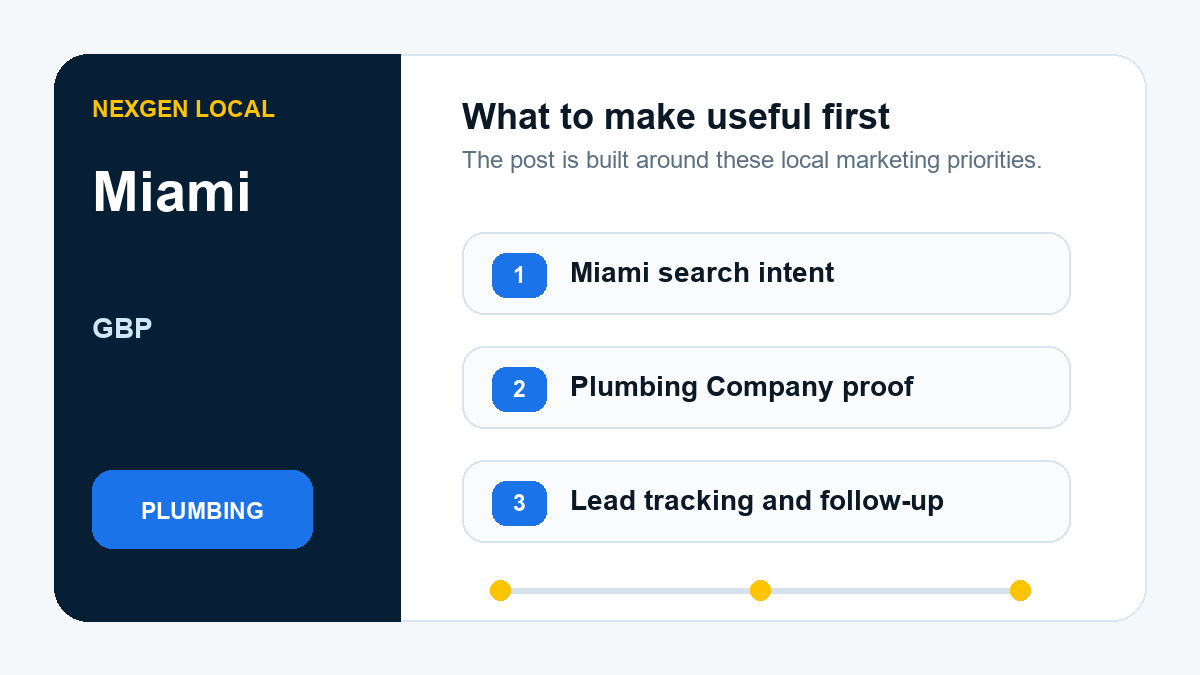
Miami searches can change by neighborhood: Brickell buyers behave differently from Doral business owners, Miami Beach condo managers, and Coral Gables homeowners.
Seasonality can include winter visitor demand, rainy-season service issues, luxury-property maintenance, and bilingual search paths. That matters because local search is not just a list of keywords. The same phrase can mean a quick emergency call, a research-stage project, a bid request, or a high-trust consultation depending on the neighborhood, service line, and buyer type.
For plumbing companies, a useful page should make the local fit obvious. It should mention the service area in plain language, explain who the offer is for, show proof that matches the work, and give the visitor one clear next step. When a page only swaps in a city name, it may technically target the keyword, but it usually fails to answer the buyer’s real question.
What Miami plumbing companies need to prove
Urgent searches need trust fast, especially when water damage is already happening. In Miami, that pain point becomes more specific because the market includes Brickell, Coral Gables, Miami Beach, Doral, and high-rise condo corridors. The page should reduce doubt before the visitor calls, clicks, or fills out a form.
Plumbing buyers often search under stress, so the page has to answer trust, response, and service-fit questions immediately.
A leak repair or water heater replacement page should route mobile visitors to a call action while still giving enough detail for research-stage homeowners.
Useful proof for this audience can include License notes where appropriate, repair photos, emergency pages, neighborhood reviews, and forms that capture the type of plumbing issue.. These details are not decoration. They help real visitors decide whether the company understands their job, and they help search engines connect the page to the right entity, service, and local context.
The Google Business Profile plan for this keyword
Google Business Profile work is useful when the listing becomes a clearer decision point, not just a filled-out directory profile.
For Google Business Profile for plumbing companies in Miami FL, the strategy should start with one primary intent and one conversion path. The campaign can still support secondary questions, but the main page should not drift into every possible marketing topic. A focused article is easier to optimize, easier to measure, and easier to improve after Search Console data starts showing real queries.
Use language that reflects leak repair, repiping, or water heater replacement when those are the jobs the business actually wants.
Reference Brickell, Coral Gables, Miami Beach, Doral, and high-rise condo corridors, service-area fit, project types, photos, reviews, or process details that help a Miami buyer trust the next step.
Separate calls, forms, booked appointments, disqualified leads, and follow-up notes so the page is judged by qualified opportunities instead of traffic alone.
What to build first
The first version should be practical enough that a business owner can see the work. For plumbing companies, the strongest page usually combines local explanation, industry proof, a clear call-to-action, and a measurement plan. That gives the content a reason to exist beyond keyword coverage.
| Build area | What to add | How to measure it |
|---|---|---|
| Profile completeness | Align categories, services, photos, hours, products or services, and description with actual buyer intent. | Track calls, profile actions, direction requests, review velocity, service visibility, and listing engagement for Miami plumbing companies. |
| Review strategy | Ask for reviews that mention service type, location, response quality, and project context without scripting fake language. | Track calls, profile actions, direction requests, review velocity, service visibility, and listing engagement for Miami plumbing companies. |
| Action tracking | Track calls, direction requests, website clicks, and profile actions so listing updates can be tied to behavior. | Track calls, profile actions, direction requests, review velocity, service visibility, and listing engagement for Miami plumbing companies. |
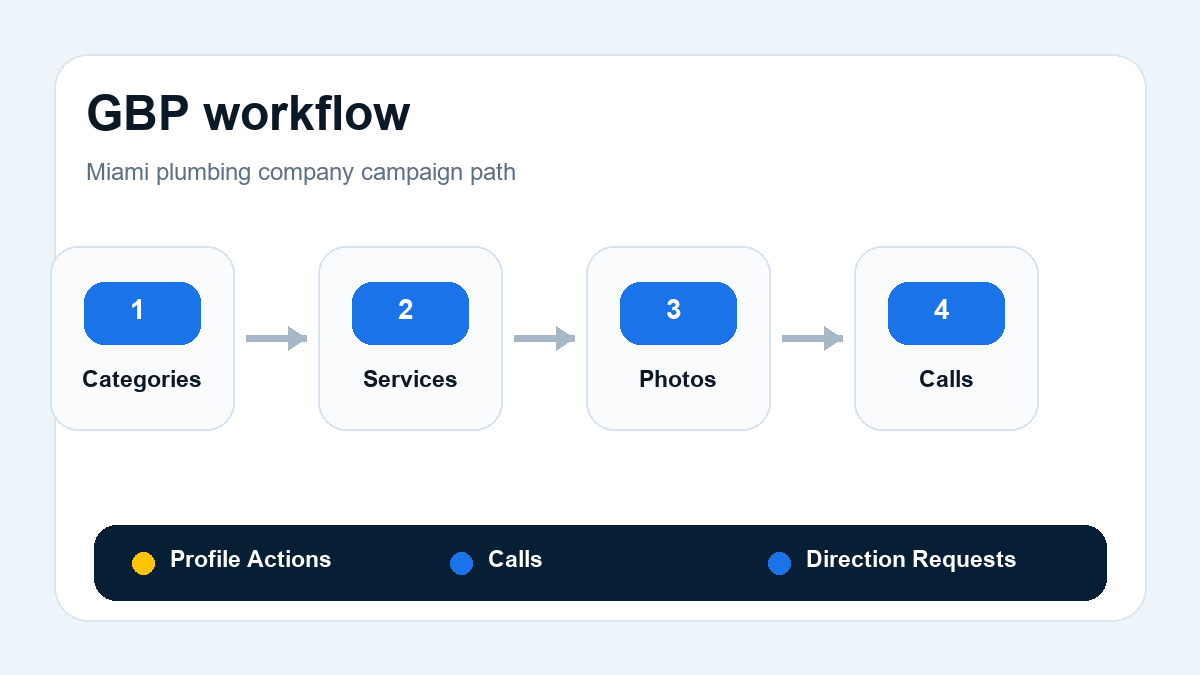
A small but complete build is better than a large campaign with no feedback loop. Start with one page or offer, connect it to the parent Google Business Profile service, support it with proof for the Plumbing Companies audience, and point local readers toward the Miami service area. Then use call and form data to decide what deserves expansion.
Local examples to make the content stronger
A stronger Miami page can include a short section for neighborhoods or service zones, a short explanation of seasonal demand, and a practical note about how buyers compare providers. For this post, the local examples should connect South Florida context with plumbing companies buying behavior.
For example, a plumbing company serving Miami might need one message for urgent searchers, another for research-stage buyers, and another for high-value projects. The content should not pretend all leads are equal. It should explain how the business qualifies opportunities, what proof matters most, and what happens after the visitor takes action.
That is also where Google Business Profile becomes more than a marketing label. The service should help the business decide what to publish, what to promote, what to track, and what to stop doing. If a keyword gets impressions but no qualified action, the answer may be stronger proof, a clearer offer, better routing, or a more specific page.
Internal links and topical authority
This page should not sit alone. It supports the parent Google Business Profile page, reinforces the Plumbing Companies industry section, and connects back to the Miami service area. Those internal links help the article pass relevance back to the pages that matter most for Nexgen’s core SEO.
Internal links should be useful to the reader, not forced into every sentence. The best pattern is simple: link up to the parent service, link sideways to related Florida posts, and link forward to a clear conversion action such as a strategy review or contact page.
Frequently asked questions
How can Google Business Profile help plumbing companies in Miami?
Google Business Profile helps a plumbing company in Miami connect local intent to a clearer conversion path. The goal is to show the right proof, route the right inquiries, and measure lead quality instead of only counting traffic.
What should a Miami plumbing company build first?
Start with one priority service, one primary page or offer, call and form tracking, and proof that matches Brickell, Coral Gables, Miami Beach, Doral, and high-rise condo corridors. After the first data comes in, expand into related services, nearby neighborhoods, or supporting blog content.
How long should plumbing companies track this before scaling?
A useful test should run long enough to collect impressions, clicks, calls, forms, booked appointments, and disqualified lead notes. The decision to expand should come from lead quality and conversion data, not from traffic volume alone.
What makes this different from a generic Florida marketing page?
This page connects Google Business Profile, plumbing companies, and Miami search behavior in one place. It uses local context, industry proof, internal links, and a tracking plan so the page can support both users and core service SEO.
Author and review note
About this guide: This article is published under Bill Gilmore’s Nexgen Local Marketing author profile and reviewed against Nexgen’s local search, paid media, conversion tracking, and content-quality checklist. It avoids unsupported ranking, lead, or revenue promises and focuses on practical steps a Florida business can verify.
Tracking, pruning, and improvement plan
After publishing, the page should be monitored in Google Search Console and Bing Webmaster Tools. The most useful early signals are impressions for the target topic, queries that include Miami, clicks from qualified searches, engagement with the call-to-action, and whether leads mention the service or location the page was built around.
Every quarter, the page should be reviewed. If it earns impressions but no clicks, the title and meta description may need work. If it earns clicks but no qualified actions, the offer, proof, form, or call path may need improvement. If it earns no meaningful impressions after enough time, it should be improved, merged into a stronger article, redirected, or noindexed instead of staying live as weak content.
Need a stronger Florida growth page for plumbing companies?
Nexgen can review your Miami market, service mix, page structure, proof assets, and tracking setup before you scale content or ads.
Call 407-307-1995, email info@nexgenlocalmarketing.com, or request a Florida strategy review.
Data as a Service for Orlando Pest Control Companies: What to Build First
Data as a Service
Data as a Service for pest control companies in Orlando FL is a narrow search, which is exactly why the page has to be useful. A pest control company in Orlando is not looking for a broad marketing definition. They need to understand what to build, what to measure, and how the strategy should fit the local market.
Quick answer
Data as a Service for pest control companies in Orlando FL should be built as a focused local asset, not a generic marketing article. The page needs city context, industry proof, a conversion path, and tracking that shows whether the traffic becomes qualified conversations.
In this expanded guide
Primary keyword
Data as a Service for pest control companies in Orlando FL
Best-fit intent
A local business owner or manager comparing whether Data as a Service can create better leads, better follow-up, or better search visibility for pest control companies in Orlando.
Why the Orlando market changes the strategy
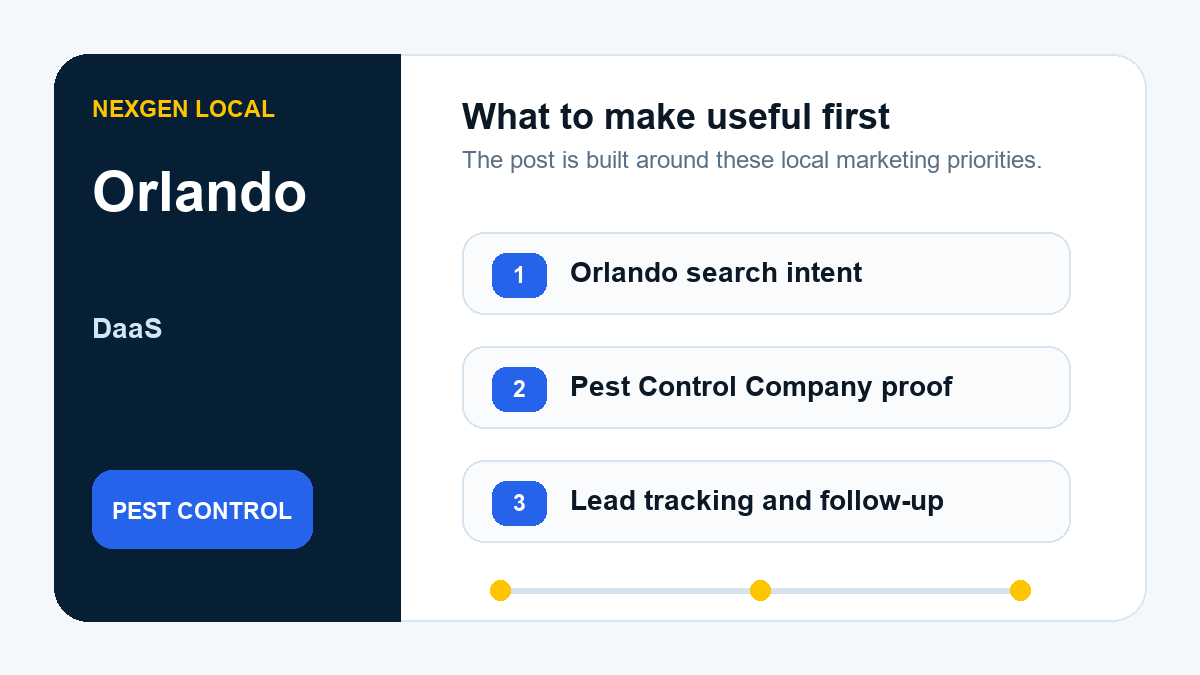
Orlando demand often splits between tourism corridors, Lake Nona growth, Winter Park searches, and contractors serving suburbs across Central Florida.
Seasonality often comes from travel cycles, summer storms, convention traffic, and families moving across Central Florida suburbs. That matters because local search is not just a list of keywords. The same phrase can mean a quick emergency call, a research-stage project, a bid request, or a high-trust consultation depending on the neighborhood, service line, and buyer type.
For pest control companies, a useful page should make the local fit obvious. It should mention the service area in plain language, explain who the offer is for, show proof that matches the work, and give the visitor one clear next step. When a page only swaps in a city name, it may technically target the keyword, but it usually fails to answer the buyer’s real question.
What Orlando pest control companies need to prove
Seasonal pest issues create repeat demand, but many buyers compare several local providers. In Orlando, that pain point becomes more specific because the market includes theme-park corridors, Lake Nona, Winter Park, and surrounding suburbs. The page should reduce doubt before the visitor calls, clicks, or fills out a form.
Pest demand changes by season and property type, so one generic pest page rarely covers termite, mosquito, rodent, and prevention intent well.
A termite inspection lead should be routed differently from a mosquito control lead because the inspection, proof, and urgency are not the same.
Useful proof for this audience can include Pest-specific pages, treatment process explanations, prevention guides, neighborhood review language, and recurring-plan calls to action.. These details are not decoration. They help real visitors decide whether the company understands their job, and they help search engines connect the page to the right entity, service, and local context.
The Data as a Service plan for this keyword
Data as a Service works when the business stops guessing which segments are worth attention and starts organizing lead, market, and job data into decisions.
For Data as a Service for pest control companies in Orlando FL, the strategy should start with one primary intent and one conversion path. The campaign can still support secondary questions, but the main page should not drift into every possible marketing topic. A focused article is easier to optimize, easier to measure, and easier to improve after Search Console data starts showing real queries.
Use language that reflects termite inspections, mosquito control, or rodent exclusion when those are the jobs the business actually wants.
Reference theme-park corridors, Lake Nona, Winter Park, and surrounding suburbs, service-area fit, project types, photos, reviews, or process details that help a Orlando buyer trust the next step.
Separate calls, forms, booked appointments, disqualified leads, and follow-up notes so the page is judged by qualified opportunities instead of traffic alone.
What to build first
The first version should be practical enough that a business owner can see the work. For pest control companies, the strongest page usually combines local explanation, industry proof, a clear call-to-action, and a measurement plan. That gives the content a reason to exist beyond keyword coverage.
| Build area | What to add | How to measure it |
|---|---|---|
| Lead source cleanup | Normalize forms, calls, campaigns, and offline notes so every lead can be traced back to a useful source. | Track source quality, close-rate patterns, service-line demand, local segments, and conversion gaps for Orlando pest control companies. |
| Segment scoring | Score opportunities by service line, city, property type, margin potential, and fit instead of treating every inquiry the same. | Track source quality, close-rate patterns, service-line demand, local segments, and conversion gaps for Orlando pest control companies. |
| Decision reporting | Turn the data into weekly actions: expand what works, fix weak pages, and cut waste from bad-fit channels. | Track source quality, close-rate patterns, service-line demand, local segments, and conversion gaps for Orlando pest control companies. |
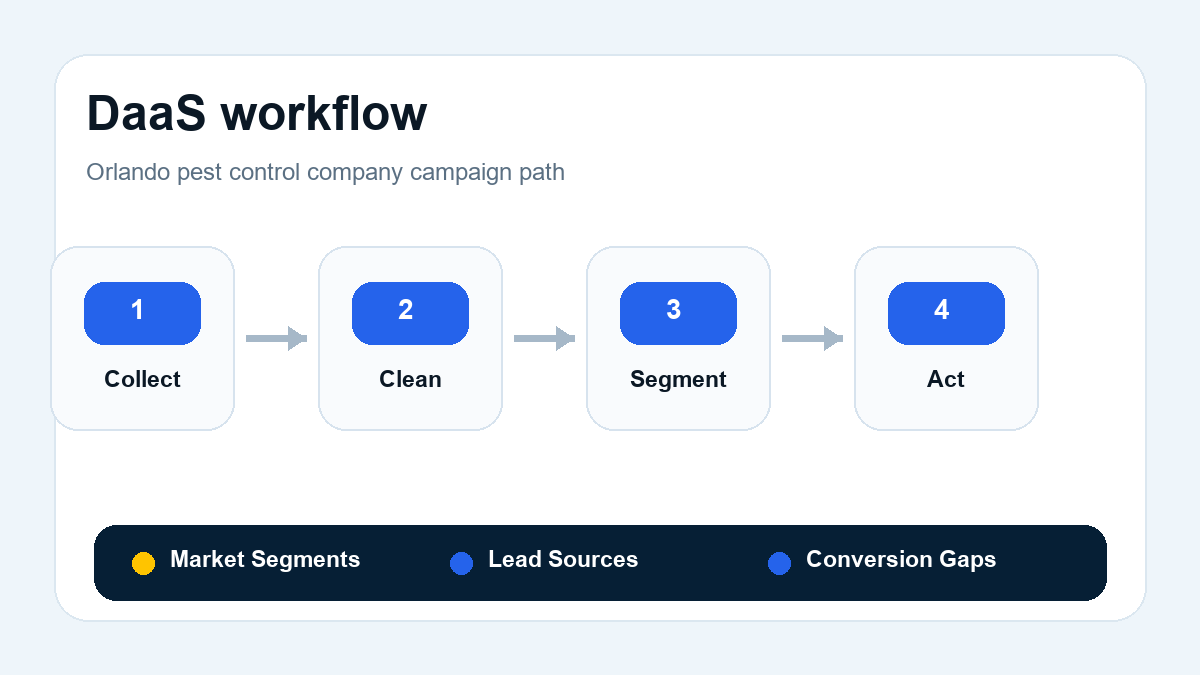
A small but complete build is better than a large campaign with no feedback loop. Start with one page or offer, connect it to the parent Data as a Service service, support it with proof for the Pest Control Companies audience, and point local readers toward the Orlando service area. Then use call and form data to decide what deserves expansion.
Local examples to make the content stronger
A stronger Orlando page can include a short section for neighborhoods or service zones, a short explanation of seasonal demand, and a practical note about how buyers compare providers. For this post, the local examples should connect Central Florida context with pest control companies buying behavior.
For example, a pest control company serving Orlando might need one message for urgent searchers, another for research-stage buyers, and another for high-value projects. The content should not pretend all leads are equal. It should explain how the business qualifies opportunities, what proof matters most, and what happens after the visitor takes action.
That is also where Data as a Service becomes more than a marketing label. The service should help the business decide what to publish, what to promote, what to track, and what to stop doing. If a keyword gets impressions but no qualified action, the answer may be stronger proof, a clearer offer, better routing, or a more specific page.
Internal links and topical authority
This page should not sit alone. It supports the parent Data as a Service page, reinforces the Pest Control Companies industry section, and connects back to the Orlando service area. Those internal links help the article pass relevance back to the pages that matter most for Nexgen’s core SEO.
Internal links should be useful to the reader, not forced into every sentence. The best pattern is simple: link up to the parent service, link sideways to related Florida posts, and link forward to a clear conversion action such as a strategy review or contact page.
Frequently asked questions
How can Data as a Service help pest control companies in Orlando?
Data as a Service helps a pest control company in Orlando connect local intent to a clearer conversion path. The goal is to show the right proof, route the right inquiries, and measure lead quality instead of only counting traffic.
What should a Orlando pest control company build first?
Start with one priority service, one primary page or offer, call and form tracking, and proof that matches theme-park corridors, Lake Nona, Winter Park, and surrounding suburbs. After the first data comes in, expand into related services, nearby neighborhoods, or supporting blog content.
How long should pest control companies track this before scaling?
A useful test should run long enough to collect impressions, clicks, calls, forms, booked appointments, and disqualified lead notes. The decision to expand should come from lead quality and conversion data, not from traffic volume alone.
What makes this different from a generic Florida marketing page?
This page connects Data as a Service, pest control companies, and Orlando search behavior in one place. It uses local context, industry proof, internal links, and a tracking plan so the page can support both users and core service SEO.
Author and review note
About this guide: This article is published under Bill Gilmore’s Nexgen Local Marketing author profile and reviewed against Nexgen’s local search, paid media, conversion tracking, and content-quality checklist. It avoids unsupported ranking, lead, or revenue promises and focuses on practical steps a Florida business can verify.
Tracking, pruning, and improvement plan
After publishing, the page should be monitored in Google Search Console and Bing Webmaster Tools. The most useful early signals are impressions for the target topic, queries that include Orlando, clicks from qualified searches, engagement with the call-to-action, and whether leads mention the service or location the page was built around.
Every quarter, the page should be reviewed. If it earns impressions but no clicks, the title and meta description may need work. If it earns clicks but no qualified actions, the offer, proof, form, or call path may need improvement. If it earns no meaningful impressions after enough time, it should be improved, merged into a stronger article, redirected, or noindexed instead of staying live as weak content.
Need a stronger Florida growth page for pest control companies?
Nexgen can review your Orlando market, service mix, page structure, proof assets, and tracking setup before you scale content or ads.
Call 407-307-1995, email info@nexgenlocalmarketing.com, or request a Florida strategy review.
Short-Form Video Marketing for Local Businesses in 2026: TikTok, Reels, and YouTube Shorts
Video Marketing
Are you seeing your competitors on TikTok and Reels and wondering if you're missing out? You have a feeling short-form video is important, but the idea of creating a steady stream of content feels overwhelming, and you're not even sure it works for a local service business. This guide cuts through the noise to give you a realistic, actionable plan for using short-form video marketing to attract local customers in 2026, without needing a Hollywood budget or a dance routine.
Quick answer
Short-form video works for local businesses when it answers real buyer questions, shows the work, and gets repurposed consistently across platforms.
Show the service
This is one of the core pieces that makes short-form video work as a practical business strategy.
Answer objections
This is one of the core pieces that makes short-form video work as a practical business strategy.
The 2026 Reality: Short-Form Video Dominates Attention
Let’s be direct: the way people discover and connect with local businesses has fundamentally changed. While a strong website and Google Business Profile are still foundational, the battle for top-of-mind awareness is now fought in 15-to-90-second increments on social media. By 2026, the trend that started years ago is now an established reality. Short-form video isn’t just *a* format; for a huge segment of your potential customer base, it’s *the* primary format they consume.
Algorithm shifts across major platforms from 2024 to 2026 have consistently favored authentic, engaging video. Instagram’s pivot to a “video-first” experience is complete, TikTok’s search functionality has become a genuine competitor to Google for discovery, and YouTube Shorts is the platform’s answer to retaining users with shorter attention spans. Attention has fragmented. Instead of searching “plumbers near me” on Google, a homeowner might now see a compelling video on Reels of a local plumber fixing a common leak, save it for later, and remember that company when the need arises.
Despite this, the majority of local businesses are still on the sidelines. They either don’t participate, or they post sporadically without a strategy, assuming it’s a game only for influencers and e-commerce brands. This is a massive opportunity. The bar for entry is lower than you think, and the reward for consistency is a direct line to the eyes and ears of your community.
Platform-by-Platform: TikTok vs. Instagram Reels vs. YouTube Shorts
While often grouped together, the three dominant platforms for short form video marketing local business have distinct nuances in 2026. Choosing where to focus depends on your specific goals and target audience.
-
TikTok:
- Audience: While still dominant with Gen Z and Millennials, the user base has significantly broadened. You’ll find homeowners, professionals, and decision-makers of all ages scrolling. The vibe is less curated and more about authenticity and entertainment.
- Algorithm: TikTok’s algorithm is famously powerful at interest-based discovery. It can take a brand-new account with zero followers and show its video to thousands of relevant local users if the content is engaging. It’s less about who you know and more about the quality of the video itself.
- Ad Platform: The ad platform is robust, offering sophisticated targeting options, including location-based campaigns that are perfect for local businesses. However, ad creative needs to feel native to the platform to be effective.
- Search & Discoverability: “TikTok SEO” is a real and powerful strategy. Users increasingly use TikTok’s search bar like a mini-Google to find reviews, tutorials, and local recommendations. Optimizing your captions and on-screen text for search is critical.
-
Instagram Reels:
- Audience: Generally skews slightly older than TikTok, with a strong Millennial and Gen X presence. Users often have a higher purchase intent, and the platform is more integrated with established business profiles and shopping features.
- Algorithm: The algorithm still favors connections and your existing audience more than TikTok’s does, but it heavily prioritizes Reels content in feeds and the Explore page. High-quality, visually appealing content tends to perform best.
- Ad Platform: Seamlessly integrated with Meta’s powerful Ads Manager. You can easily promote a Reel to a highly specific local audience based on demographics, interests, and behaviors. It’s arguably the most mature ad platform of the three for granular local targeting. This is a core part of our social media marketing services.
- Search & Discoverability: Instagram’s search is more hashtag and keyword-driven. Using a mix of broad and hyper-local hashtags is key to being discovered by users in your service area.
-
YouTube Shorts:
- Audience: The audience is vast and diverse, mirroring YouTube’s overall user base. A key advantage is that these users are already in a “video mindset” when they open the app.
- Algorithm: The Shorts algorithm is designed to pull viewers into a continuous feed. A major benefit is that a popular Short can drive subscribers and traffic to your main, longer-form YouTube channel, creating a powerful content ecosystem.
- Ad Platform: Leverages the Google Ads ecosystem, which is powerful but can be more complex. Your Shorts can appear as ads within the Shorts feed, offering another touchpoint with potential customers.
- Search & Discoverability: This is Shorts’ superpower. Your videos are indexed by Google, the world’s largest search engine. A well-titled Short answering a common question (e.g., “How to Reset a Garbage Disposal”) can appear in both YouTube search and Google search results for years, providing long-term value.
What Works for Local Service Businesses
E-commerce brands can succeed with flashy product showcases and trend-chasing. Local service businesses need a different playbook. Your goal is to build trust, demonstrate expertise, and create a human connection. Forget viral dances; focus on value and authenticity.
- Demonstration Videos: Don’t just tell people you’re a great painter; show them your crisp cut-in lines in a 30-second time-lapse. If you’re a landscaper, show the process of turning a messy yard into a pristine oasis. These videos prove your skill without a hard sell.
- Behind-the-Scenes (BTS): Show your team loading up the truck for the day, cleaning the equipment, or having a morning meeting. This humanizes your business and builds a sense of familiarity and trust. People buy from people they feel they know.
- Before & After: This is the single most powerful format for any business that creates a visible transformation. Roofing, pressure washing, auto detailing, landscaping, home organization—the visual payoff is immense and instantly communicates the value you provide. We’ve seen clients achieve fantastic results with this strategy, as noted in some of our case studies.
- Customer Question Q&A: Take common questions you get on the phone or via email and answer them in a short video. “How much does a new AC unit cost?” “What’s the difference between SEO and SEM?” “Is pressure washing safe for my roof?” This positions you as the expert and pre-qualifies customers.
- Fast Tips: Share quick, valuable advice related to your industry. A plumber could show how to fix a running toilet. An electrician could explain what to do when a breaker trips. This content gets saved and shared, extending your reach far beyond a direct sales pitch.
Production: How Much is Enough?
The fear of needing expensive equipment stops many business owners before they start. Here’s the 2026 truth: your phone is enough. Modern smartphone cameras are more than capable of producing high-quality video for TikTok, Reels, and Shorts. The authenticity of phone-shot content often performs better than overly polished, corporate-style video.
However, you can make a huge impact by focusing on three basics:
- Lighting: You don’t need a professional lighting kit. A simple $30 ring light can dramatically improve the quality of indoor shots. When outdoors, simply facing the sun instead of having it behind you makes a world of difference. Good lighting is the #1 differentiator between amateur and professional-looking video.
- Audio: Viewers will tolerate mediocre video quality, but not bad audio. The built-in mic on your phone is okay in a quiet space, but for less than $50 you can get a lavalier microphone that clips onto your shirt. This small investment makes your audio crisp and clear, even with background noise.
- Vertical Framing: These platforms are built for vertical video. Always shoot in a 9:16 aspect ratio. Turning your phone sideways is a rookie mistake that immediately signals you don’t understand the platform. Keep it vertical.
Your goal is not a Netflix-quality production. It’s to be clear, audible, and authentic. For a deeper dive into the fundamentals, check out our guide on how to make the most of video marketing.
Cadence and Consistency: A Realistic Plan
You are not a full-time creator. You’re a business owner. Burning out by trying to post three times a day is a recipe for failure. Consistency is far more important than frequency. The algorithms reward accounts that post regularly over a long period.
Here’s a realistic starting goal: Commit to posting 2-3 videos per week.
This is achievable. The key is to “batch” your content creation. Dedicate two hours on a Monday morning to shoot 3-4 simple videos. This could be a few Q&A’s, a quick tour of a job site, and a before/after. Then, throughout the week, you just need a few minutes each day to post them. This approach removes the daily pressure of “What should I post today?” and makes the process manageable.
Captions, Hashtags, and On-Screen Text: 2026 Best Practices
A great video can fall flat without the right optimization. Each element plays a role in discovery and engagement.
- On-Screen Text: This is non-negotiable. The majority of users watch videos with the sound off. Use bold, clear on-screen text to state your main point within the first 3 seconds. This is your “hook” to stop their scroll. Use it to summarize key points throughout the video.
- Captions (The Description): Keep it concise. Your caption should add context that isn’t in the video. Ask a question to encourage comments. Most importantly, treat the caption like a mini-blog post for search. Include your focus keywords and related terms naturally. For example, “Here’s how we transformed this Orlando home with a new roof. This architectural shingle is a great choice for Florida weather. #OrlandoRoofer #CentralFloridaRoofing #RoofReplacement”.
- Hashtags: The strategy has evolved. In 2026, a mix of broad and niche/local hashtags is optimal.
- TikTok: 3-5 hashtags. (e.g., #plumbingtips #orlandoflorida #smallbusiness)
- Instagram Reels: 5-10 hashtags. You can use more here. (e.g., #hvaclife #acmaintenance #kissimmeeFL #supportlocal #orlandohome)
- YouTube Shorts: 2-3 hashtags in the description and use the “Tags” section in the video details for more keywords.
Always include a location-specific hashtag to attract a local audience.
Cross-Posting Strategy: Same Video, Multiple Platforms?
Yes, you absolutely should be cross-posting, but with minor edits. The effort to create one video is too high to not leverage it across all three platforms. Here’s the workflow:
- Create and edit your “master” video in a third-party app (like CapCut or even directly on your phone’s editor). Do not add text or music yet.
- Save this clean version.
- Upload this video to each platform (TikTok, Instagram, YouTube Shorts) individually.
- Use each platform’s native text and music features. The algorithms tend to give a slight preference to videos that use their native creative tools. TikTok’s trending sounds are different from Reels’, so this step is important.
- Crucially, when you download a video from TikTok, it has a watermark. Platforms like Instagram have been known to suppress the reach of videos that have a competing platform’s watermark. The “edit once, upload everywhere” workflow avoids this issue entirely.
Measuring What Matters: Views are Vanity
A video with 100,000 views that results in zero leads is a failure. A video with 1,200 hyper-local views that results in two booked appointments is a massive success. You must track the right metrics.
- Vanity Metrics: Views, Likes. Nice to have, but they don’t pay the bills.
- Signal Metrics:
- Watch Time / Completion Rate: Are people watching your whole video? This tells the algorithm your content is engaging and that it should be shown to more people.
- Saves: This is a huge signal. When someone saves your video, they are saying, “This is valuable, and I want to come back to it.” This is a common action for tips, tutorials, and inspiring before/afters.
- Shares: A user sharing your content is a personal endorsement to their network.
- Comments & DMs: Engagement is great, but direct messages are leads. When someone takes the time to slide into your DMs to ask a question, they are a warm lead.
How to track booked appointments: This is the most important step. Implement a simple question into your client intake process: “How did you hear about us?” Add “TikTok/Instagram/YouTube” as an option. Over time, you will see a clear correlation between your video efforts and your bottom line. For more complex tracking, you can use dedicated landing pages or special offers mentioned only in your videos, but starting with the simple question is effective and costs nothing.
Paid Promotion: When to Boost vs. Run Dedicated Ads
Organic reach is powerful, but a small ad budget can amplify your results significantly. This is a core component of a holistic short form video marketing local business strategy.
- Boosting Organic Content: Did a video perform unusually well organically? This is a sign that you’ve struck a chord. “Boosting” this post (using the simple “Promote” button on Instagram or TikTok) is a great way to get it in front of more local people who don’t yet follow you. Think of this as pouring gasoline on a fire that’s already burning. A budget of $50-$100 can dramatically expand the reach of a proven video.
- Dedicated Short-Form Ads: This is for more direct-response goals, like driving lead form submissions or calls. Here, you would create a video specifically as an ad, with a clear Call to Action (CTA). You’ll use the full power of Meta Ads Manager or TikTok Ads Manager to build a precise local audience. This is less about brand building and more about immediate lead generation. Budget tiers can start as low as $15-$25 per day to start generating measurable results.
A balanced strategy uses both. Use boosts to amplify your best brand-building content and dedicated ads for your specific, high-intent offers. If you’re unsure where to start, our video marketing team can help build a strategy that fits your budget.
Frequently Asked Questions (FAQ)
Do I need to dance or do silly trends?
Absolutely not. This is a common misconception. For a local service business, your credibility comes from your expertise, not your entertainment value. Focus on the value-driven content types listed above: demos, tips, and before-and-afters. Authenticity and expertise will win over trying to be something you’re not.
Can I outsource my video creation?
Yes, and for many busy owners, this is the most sustainable path. You can hire a local videographer, a marketing agency, or a content creator. A hybrid approach often works best: you capture the raw video clips on your phone from job sites (since you’re the one there), and you send them to a professional editor who can package them into compelling short-form videos. This saves you time while ensuring a polished final product. Our team at Nexgen Local Marketing offers exactly these kinds of flexible video marketing packages.
How does this work for “boring” industries like HVAC, plumbing, or legal?
There’s no such thing as a boring industry, only boring content. These “unsexy” industries are often the best performers in short-form video because the content is so practical and needed. An HVAC tech can show how to clean a filter. A lawyer can explain a complex legal concept in simple terms. A plumber can show the gunk they just cleared from a drain (surprisingly effective!). The key is to answer the questions your customers are already asking and to show the real-world problems you solve.
How long should a short-form video be in 2026?
While platforms allow for longer videos (up to 3-10 minutes in some cases), the sweet spot for maximum engagement is still between 15 and 45 seconds. You need to hook the viewer in the first 3 seconds and deliver your core message quickly. If a topic requires more depth, you can create a multi-part series, prompting users to follow for Part 2.
I’m over 50. Is it worth my time to invest in this?
Yes, 100%. Your age and experience are an asset, not a liability. On platforms saturated with young creators, a seasoned professional stands out. Your experience brings a level of authority and trust that younger competitors can’t match. You’re not trying to be a teenage influencer; you’re a trusted local expert sharing your knowledge. Your target customers (homeowners, other business owners) are on these platforms, and they will resonate with your authenticity.
Getting started with short-form video doesn’t have to be complicated. By focusing on authentic content that demonstrates your expertise and solves customer problems, you can build a powerful engine for local awareness and lead generation. The key is to start small, stay consistent, and measure what truly matters for your business growth.
If you’re ready to make short-form video a real growth driver for your business but aren’t sure where to begin, our team can help. Give us a call at 407-307-1995 to discuss a practical, effective video strategy that fits your local business.
Action checklist
Need a repeatable local video system?
We can turn your services, FAQs, and proof points into a short-form content plan.
X (Formerly Twitter) Marketing for Local Businesses: What Still Works in 2026
Twitter Marketing
Is your business’s old Twitter account gathering dust? You’re not alone. Since the whirlwind rebrand to X, many local business owners are wondering if there’s any point to posting on the platform anymore. This post gives you the clear-eyed, no-hype framework for deciding if X is a valuable tool for your business in 2026, a waste of time, or something in between.
Quick answer
X can still help some local businesses, but it should be used selectively for authority, timely updates, networking, and niche conversations.
Audience fit
This is one of the core pieces that makes X marketing work as a practical business strategy.
Authority posts
This is one of the core pieces that makes X marketing work as a practical business strategy.
What Changed: From Twitter to X (2023-2026)
To understand what X Twitter marketing for a local business looks like today, we have to be honest about the seismic shifts since 2022. The platform you remember is not the platform that exists now. The core identity, algorithm, and user experience have been fundamentally altered.
- The Rebrand to X: In 2023, Twitter was officially rebranded as X. This wasn’t just a name change; it signaled a chaotic and ongoing transition toward an “everything app” that has changed how users and brands interact with the platform.
- Organic Reach Collapse: For accounts that don’t pay for a Premium subscription, organic reach has plummeted. It is now overwhelmingly a “pay-to-play” environment where visibility is directly tied to your subscription tier or ad spend. Posts from non-paying accounts are significantly de-prioritized by the algorithm.
- Ad Platform Overhaul: The advertising interface was simplified, which was a welcome change for some. However, this overhaul also removed some of the granular targeting options that marketers previously relied on, making it a different beast to manage.
- Premium Subscription Tiers: The introduction of Premium, Premium+, and Verified Organizations created a class system. Features like a boost in algorithmic reach, the ability to write long-form posts, and editing capabilities are now locked behind a monthly fee. The once-coveted blue checkmark simply means someone is paying, not that they are a notable public figure.
- Shifting User Demographics: From 2023 to 2026, the user base has evolved. While still a hub for breaking news, tech, finance, and politics, it has lost a significant portion of the broader, more casual consumer audience it once had. The user base is more niche and, in many circles, more combative.
Where X Still Works for Local Businesses in 2026
Despite the turmoil, X isn’t a total wasteland. For specific types of local businesses, it remains a potent tool precisely because of its real-time nature and professional user core. Success requires a targeted strategy, not the scattergun approach of the past.
- Real-Time Customer Service: X is still one of the fastest public channels for customer support. If a customer has an issue, a swift, professional reply on X can demonstrate your commitment to service for all to see. This is particularly effective for local service-based businesses, tech companies, and hospitality brands.
- News & Event-Tied Promotion: Is your Orlando-based firm sponsoring a local tech conference? Are you a financial advisor commenting on real-time market news? X is unparalleled for tapping into live events, trending topics, and breaking news. It allows you to insert your brand into an ongoing, relevant conversation.
- B2B Thought Leadership: For professionals like lawyers, consultants, architects, and marketing agencies, X is a strong platform for building authority. Using Premium to write long-form posts, sharing deep insights, and engaging in high-level discussions within your niche can directly lead to high-value B2B clients.
- Specific Professional Verticals: The remaining active user base on X is heavily skewed toward certain industries. We see continued success with an active X Twitter marketing for local business strategy in the legal, financial, B2B technology, and digital marketing sectors.
Where X Probably Doesn’t Work Anymore
Let’s be blunt: for a large number of local businesses, the time and money required to get results on X in 2026 is better spent elsewhere. The audience you need to reach has likely moved on to other platforms.
- Most Home Services: A plumber, roofer, or electrician relies on customers with immediate needs. Those customers are searching on Google, not scrolling X. Your marketing dollars are far more effective in Local SEO and Google Ads.
- Most Small B2C Retail: A local boutique, bakery, or coffee shop thrives on visual appeal and community building. These goals are much easier and cheaper to achieve on platforms like Instagram and Facebook, where visual storytelling and local community groups are central.
- Restaurants (Without an Existing Base): If you already have a large, engaged following from the Twitter days, you may be able to maintain it. But for a new restaurant or one trying to build from scratch, the effort is better invested in Instagram for food photography and Meta Ads for hyper-local targeting.
The 2026 Algorithm: What Gets Reach, What Doesn’t
Understanding the X algorithm is key to avoiding wasted effort. It no longer rewards all content equally and heavily favors those who pay.
- Video is King: Natively uploaded video content receives the most significant algorithmic preference. Short, engaging videos that keep users on the platform are heavily promoted over text or image posts.
- Replies Get More Reach Than Posts: The algorithm now heavily favors engagement within conversations. A thoughtful, value-adding reply to a popular account in your niche will often get more visibility than a standalone post from your own timeline. Broadcasting is out; conversing is in.
- The Premium Boost is Real: Paying for X Premium or Premium+ gives your posts and, more importantly, your replies an explicit algorithmic boost. Non-subscribers are at a distinct disadvantage, appearing lower in feeds and replies.
- External Links are Penalized: Posts that link to external websites (like your blog or product page) often have their reach suppressed. The platform wants to keep users within the X ecosystem.
X Premium for Businesses: Is It Worth It for Local?
This is a pure cost-benefit analysis. For a local business, the question is: can the “algorithmic boost” from a subscription generate a positive return? Let’s break down the math.
Assume a Premium subscription costs around $16/month ($192/year). The primary benefit is increased visibility on your replies and posts. For a B2B business, like a local law firm, this can be a clear winner. If that lawyer spends an hour a week providing expert replies in legal-focused conversations, the enhanced visibility could put them in front of dozens of potential clients and referral sources. Landing just one client from that activity could pay for decades of the subscription fee. For this type of professional, Premium is a low-cost investment in personal branding and networking.
Conversely, consider a local pizza shop. The “boost” might get their post about a lunch special in front of an extra 1,000 people. How many of those people are in their delivery area and in the mood for pizza right now? The direct return is likely to be a few dollars, if any. That $192/year would be much more effective invested in a targeted Meta Ad campaign aimed at users within a 3-mile radius. For most local B2C businesses, X Premium is not a worthwhile expense.
X Ads in 2026: Targeting, Costs, and Fit
The X advertising platform remains a viable, if changed, option. It’s no longer the complex machine it once was, but it can still be effective when used for the right purpose as part of a complete social media marketing plan.
- Targeting Capabilities: You can still target by location (country, state, metro area, zip code), language, age, and gender. You can also target users based on keywords they’ve used or conversations they’ve engaged with, which is powerful for niche B2B topics.
- Cost Ranges: Costs vary, but you can expect to see Cost Per Click (CPC) in the $1.00 – $3.50 range for many local campaigns. It can be cheaper than Google Ads on a per-click basis, but the user intent is much lower.
- Where They Fit: X Ads are best for top-of-funnel goals. Use them to build brand awareness, promote a specific event (like a webinar or local festival), or drive views on a promotional video. Don’t expect them to be a primary driver of direct sales or leads for most local businesses. They are a tool to get your name out there to a specific audience, not to capture someone at the exact moment of purchase.
Where to Spend Instead If X Doesn’t Work For You
Recognizing that X isn’t the right fit for your business is a strategic strength. It frees up your budget and time to focus on platforms that deliver better results. Building a cohesive social media marketing strategy means choosing the right channels, not being on every channel.
- For B2B & Professionals: Move your time and budget to LinkedIn. It is the undisputed king of professional networking, thought leadership, and B2B lead generation.
- For Visual Verticals (Retail, Food, Design): Your primary home should be Instagram. Its focus on high-quality images and video (Reels) is perfectly aligned with showcasing products and creating a brand aesthetic.
- For Reaching Younger Audiences (Under 30): If you’re targeting Gen Z, your efforts should be on TikTok. Its algorithm provides massive organic reach potential for engaging, short-form video content.
- For Hyper-Local Targeting: For almost any local business, from plumbers to dentists to boutiques, Meta Ads (Facebook and Instagram) remain the most powerful tool. The ability to target users by zip code, life events, interests, and behavior is unmatched for driving local foot traffic and leads.
Frequently Asked Questions (FAQ)
Should I delete my old Twitter/X account?
No, we would not recommend deleting it. Even if you don’t post actively, you should keep the account to secure your brand name and prevent someone else from taking it. It’s also wise to maintain it as a customer service listening post, monitoring for any mentions of your brand. You can simply update your bio to direct people to your active social channels or website.
Are X Ads cheaper than Google Ads?
On a pure Cost Per Click (CPC) or Cost Per Mille (CPM) basis, X ads can often be cheaper. However, this is misleading. Google Search Ads capture users with active intent—they are searching for your service right now. X Ads interrupt a user’s passive scrolling. The Return on Investment (ROI) is almost always higher with Google Ads for businesses that solve an immediate need.
Does using X help with my website’s SEO?
Indirectly, at best. Links shared on X are “nofollow,” meaning they don’t pass any direct authority or “link juice” to your website for Google’s ranking algorithm. However, a strong presence on X can increase your brand’s visibility. This might lead to more people searching for your brand name on Google (a positive signal) or other sites linking to your content, but X itself is not a direct ranking factor.
Can I still automate posts to X in 2026?
Yes, but with caveats. The API used by third-party scheduling tools has become more restrictive and expensive, limiting options for some platforms. More importantly, the algorithm de-prioritizes content that appears overly automated. The best practice for X Twitter marketing for a local business is to prioritize native, manual engagement and use automation sparingly for evergreen content, not as your primary strategy.
What is the real ROI for a local business on X?
It’s extremely polarized. For a B2B consultant who builds authority and lands one five-figure client, the ROI is astronomical. For a local retailer, the ROI is likely negative, as the time and ad spend will not generate a comparable return in foot traffic or sales. You must track your results diligently. Our case studies show that success comes from aligning the platform’s strengths with specific business goals, not from just being active.
Deciding where to invest your marketing budget is a critical decision. If you’re unsure whether X, LinkedIn, or another platform is the right fit for your local business, our team can help. We’ll analyze your goals and your customers to build a strategy that delivers real results. Call us at 407-307-1995 or contact us online to start the conversation.
Action checklist
Not sure whether X belongs in your channel mix?
Nexgen can help prioritize the channels most likely to drive local visibility and leads.
Google Business Profile Setup + Optimization in 2026: Complete Walkthrough
Google Business Profile
Are you wondering why your local competitors show up in the Google Maps "3-pack" and your business doesn't? The answer is almost always a well-optimized Google Business Profile. This guide provides a complete, step-by-step walkthrough for a perfect google business profile setup and optimization plan for 2026, turning your listing into your most powerful customer acquisition tool.
Quick answer
A complete Google Business Profile can improve map visibility, trust, phone calls, direction requests, and local conversion quality.
Complete fields
This is one of the core pieces that makes GBP optimization work as a practical business strategy.
Fresh photos
This is one of the core pieces that makes GBP optimization work as a practical business strategy.
Why GBP is the Highest-Leverage Local SEO Asset in 2026
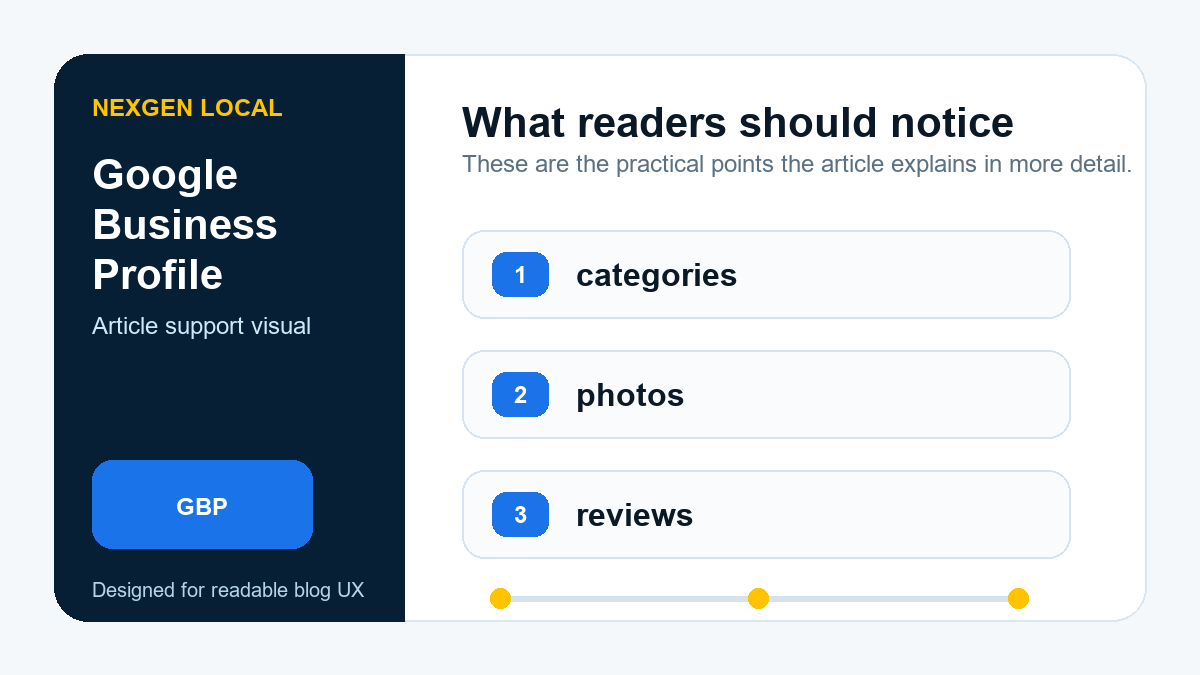
For any business serving a specific geographic area, a Google Business Profile (GBP) is no longer optional—it’s the single most critical piece of your digital footprint. Previously known as “Google My Business” (the name changed in late 2021), your GBP is a dynamic, free-to-use mini-website that lives directly on Google’s search results and maps. When optimized correctly, it delivers unparalleled return on effort for local marketing.
Think about how you search for local services. You type “plumber near me” or “best coffee shop in Orlando” and Google presents the “map pack”—a block of three featured businesses with their location, reviews, and hours. Getting into this highly-visible block can transform your business, and it’s driven almost entirely by the quality of your GBP listing. But it’s more than just map visibility. Your profile is often the very first interaction a potential customer has with your brand. It allows them to:
- Find You Instantly: Your address, map pin, and service area are displayed prominently.
- See Social Proof: Star ratings and customer reviews build immediate trust and credibility.
- Contact You Directly: Customers can call, message, or visit your website with a single click, right from the search results page.
Ignoring your GBP is like having a storefront with no sign on the door. It’s the highest-leverage asset for local search engine optimization because it’s what Google’s algorithm prioritizes for users with local intent. A complete, active, and well-reviewed profile signals to Google that you are a legitimate, trustworthy, and relevant answer to a searcher’s needs.
How to Claim and Verify Your GBP Listing in 2026
The first step in a successful google business profile setup is claiming and verifying ownership of your listing. Google needs to confirm that you are the legitimate owner of the business at the specified address. In 2026, the verification process has evolved significantly.
Here’s how to do it:
- Search for Your Business: Go to Google Maps and search for your exact business name and address.
- Initiate the Claim: If a listing already exists, click the “Own this business?” or “Claim this business” link. If it doesn’t, you’ll be prompted to “Add your business to Google.”
- Complete the Verification Process: This is the most crucial step. Google wants proof you operate where you say you do. While the famous postcard-in-the-mail method still exists for some business types, it’s increasingly rare. The most common methods in 2026 are:
- Video Verification: This is now the most frequent method. Google will ask you to record a continuous video that shows your location (signage, address), your business equipment (e.g., tools of the trade, POS system), and proof of management (e.g., unlocking the door with a key, accessing an employee-only area).
- Phone or Email Verification: Some businesses may be eligible for instant verification via a code sent to the business’s registered phone number or email address.
- Postcard Verification: If prompted, Google will mail a postcard with a verification code to your business address. This can take 5-10 business days. Once you receive it, you log back in and enter the code.
The verification process can sometimes be frustrating, but it’s a necessary hurdle to prevent spam and fake listings. For a more detailed guide on navigating the current verification landscape, see our post on how to verify your Google Business Profile listing.
Critical Profile Fields to Fill Out Completely
Once verified, the real work begins. An empty or partially-filled profile will not rank. Your goal is 100% completion. Think of every field as another signal to Google about what you do and where you do it.
- Business Name, Address, Phone (NAP): Ensure this is 100% consistent with your website and other online directories. Any variation can confuse Google and hurt your ranking.
- Categories: This is arguably the most important ranking factor.
- Primary Category: Choose the ONE category that best describes your core business. This has the most weight. Be specific (e.g., “Family Law Attorney” is better than “Lawyer”).
- Secondary Categories: Add all other relevant categories that describe your services. You can add up to nine. Use them all if they apply.
- Service Area: If you’re a Service Area Business (SAB) like a plumber or electrician, define the specific cities, counties, or zip codes you serve. Don’t overreach; keep it realistic.
- Hours: List your regular hours, and be diligent about updating them for holidays or special events. Google prioritizes accuracy.
- Services: Don’t just list services; build them out. For each service you add, write a brief (150-300 word) description that includes relevant keywords. This is a powerful way to tell Google exactly what you offer. If you need help with this, our Google Business Profile management service can handle it for you.
- Products: If you sell specific products (even if they are services packaged as products), add them to the Products tab. Include high-quality photos, pricing, and detailed descriptions.
- Attributes: These are tags that quickly tell customers more about your business. Examples include “Veteran-led,” “Women-led,” “Online appointments,” or “Wheelchair accessible entrance.” Browse the full list and select every single one that applies to you.
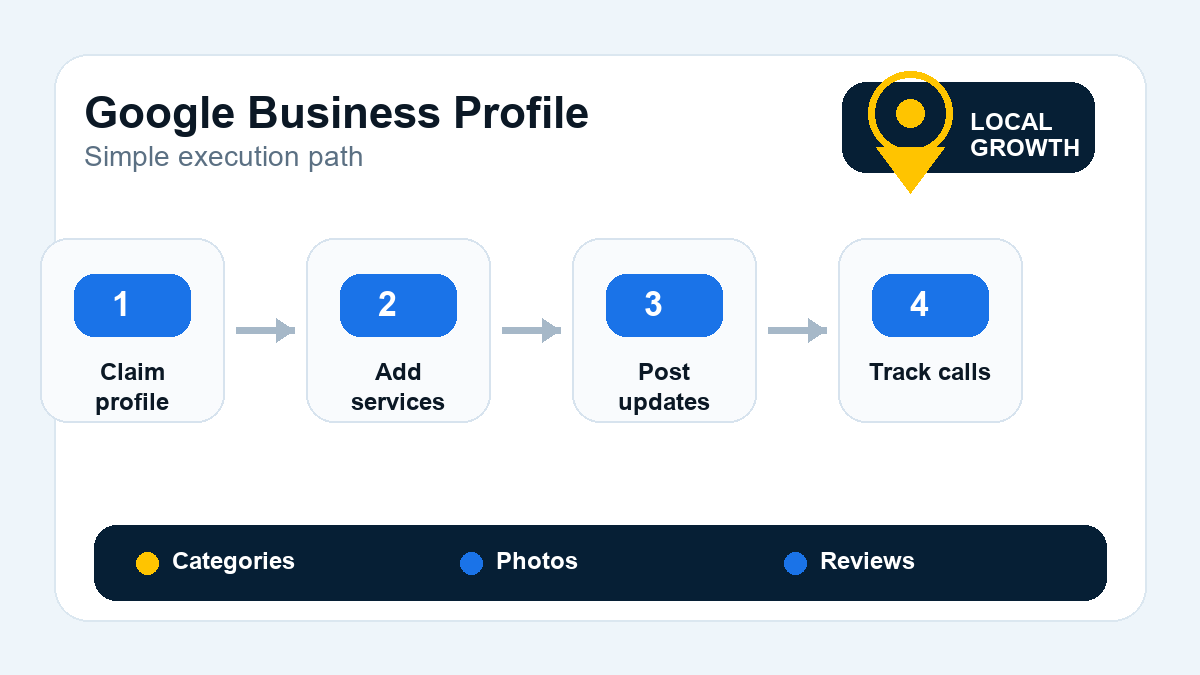
Photos + Video: What to Upload and How Often
A picture is worth a thousand words, and on GBP, it’s worth a thousand clicks. Listings with a robust photo and video library get significantly more engagement. It shows your business is active and gives customers a real look inside.
What to Upload:
- Logo & Cover Photo: Ensure these are high-resolution and represent your brand professionally. Ideal size for a cover photo is around 1080 x 608 pixels.
- Exterior Photos: Show your storefront from different angles, including signage and the parking area, to help customers find you.
- Interior Photos: Showcase your workspace, waiting area, and the general ambiance. Make it look clean and inviting.
- Team Photos: Headshots and group photos of your staff humanize your business and build trust.
- Photos of Your Work: Before-and-after shots, photos of your team on the job, and finished projects are incredibly effective.
- Video: Upload short videos (30-60 seconds) showcasing a walkthrough of your location, a client testimonial, or a quick demonstration of a service. Video is highly engaging and underutilized by most businesses.
Cadence: Aim to add at least one new photo per week. This activity sends a positive signal to Google that your business is active and relevant.
Posts: Types, Cadence, and What Actually Drives Engagement
GBP Posts are like free mini-ads that appear directly on your profile. They are a fantastic way to communicate offers, events, and updates. While they only stay “live” in the main panel for seven days, older posts are still visible when a user clicks into the Posts section.
- Types of Posts:
- Offers: Promote sales, discounts, or special packages. You can set a start and end date and even include coupon codes.
- What’s New (Updates): Share general news, blog posts, or highlight a specific service. This is the most versatile post type.
- Events: Promote upcoming webinars, workshops, or in-store events.
- Cadence: For optimal results, we recommend publishing at least one new post per week. Consistency is key.
- Driving Engagement: A post is only effective if it grabs attention. Always include a high-quality image or short video. Write a concise, compelling headline and description. Most importantly, always include a Call to Action (CTA) button like “Learn More,” “Call Now,” or “Book.” Link “Learn More” posts to relevant pages on your website.
Reviews: How to Ask, How to Respond, How to Handle Negative Reviews
Reviews are the lifeblood of local SEO. They are a top-three ranking factor and the primary way customers decide between you and a competitor. Many of our clients see dramatic improvements in leads just by improving their review strategy, as shown in our digital marketing case studies.
How to Ask for Reviews:
- The best time to ask is immediately after a successful job or positive interaction.
- Make it easy. Use a tool to generate a direct link to your GBP review form and send it via email or text.
- Never incentivize reviews with discounts or gifts—this is against Google’s policy. Simply ask honestly for feedback on their experience.
How to Respond to Reviews:
- Respond to all reviews, both positive and negative.
- For positive reviews, thank the customer by name and mention the service they used. This reinforces your services and shows you’re engaged.
- For negative reviews, remain professional and empathetic. Never get into an argument. Acknowledge their issue, apologize for their poor experience, and offer to take the conversation offline to resolve it. A thoughtful response to a bad review can often win over more customers than a dozen 5-star reviews.
Q&A Section (Most Businesses Ignore It—That’s a Mistake)
The Questions & Answers section on your GBP is a publicly-sourced FAQ. Anyone can ask a question, and anyone can answer it. Most businesses ignore this, which is a huge missed opportunity. If you don’t answer the questions about your own business, a random stranger (or worse, a competitor) might.
Proactively populate this section yourself. Brainstorm 10-15 common questions your customers ask and post them to your profile. Then, log in as the owner and answer them definitively. This allows you to control the narrative, address common concerns upfront, and strategically include important keywords.
Tracking GBP Performance: Insights, UTMs, and Call Tracking
You can’t improve what you don’t measure. A proper google business profile setup includes a plan for tracking results.
- GBP Insights: The “Performance” tab in your GBP dashboard provides a wealth of data. It shows how many people found you via search vs. maps, the search queries they used, and actions they took (website clicks, calls, direction requests). Review this monthly to understand your audience.
- UTM-Tagged Website Clicks: To see what happens *after* someone clicks your website link, use Google’s URL Campaign Builder to add UTM tracking parameters. This allows you to see in Google Analytics how much traffic, and how many leads or sales, are coming directly from your profile.
- Call Tracking: While GBP tracks the number of clicks on your call button, it doesn’t tell you how many of those calls were qualified leads. Using a dedicated call tracking number can give you full visibility into call volume, duration, and even recordings for quality control.
Frequently Asked Questions
How long does Google Business Profile verification take?
It varies. Email or phone verification can be instant. Video verification is typically reviewed within 24-48 hours. The traditional postcard method is the slowest, usually taking 5 to 10 business days for the card to arrive by mail.
Can I have a GBP listing for multiple locations?
Yes, absolutely. If you have multiple distinct physical locations with their own addresses and staff (not just P.O. boxes), each one is eligible for its own verified GBP listing. They can all be managed from a single dashboard.
What if my Google Business Profile listing was suspended?
A suspension usually happens due to a violation of Google’s guidelines, such as keyword stuffing the business name, using a P.O. box as an address, or suspicious review activity. You must first identify and correct the violation, then submit a reinstatement request form through Google’s help center. Do not create a new listing.
How often should I post on my GBP?
We recommend a minimum of one post per week to maintain an “active” signal for Google’s algorithm and keep customers informed. During busy seasons or promotions, increasing the frequency to 2-3 times per week can be beneficial.
Do customer reviews really affect my ranking?
Yes, significantly. The quantity, quality (average star rating), and velocity (frequency) of your reviews are major local SEO ranking factors. A steady stream of positive reviews signals to Google that your business is a trusted and popular choice in your area.
A complete and active Google Business Profile is your single most powerful tool for attracting local customers in 2026. While the initial google business profile setup takes time, the payoff in visibility, calls, and foot traffic is unmatched. If you’d rather have a team of experts handle your profile optimization and ongoing management, give us a call at 407-307-1995 or contact us online for a free consultation.
Action checklist
Need your Google Business Profile cleaned up?
We can audit your listing, categories, reviews, posts, photos, and tracking setup.
How to Verify Your Google Business Profile Listing
Google Business Profile
As of 2026, the first step in managing your local online presence is verifying your Google Business Profile (formerly Google My Business) to ensure all your information is accurate. The most common methods include online verification through your account, receiving a postcard with a verification code, or phone and text message verification. Google has also expanded video verification, where you may be asked to record a short video showing your location, equipment, and proof of business. If you…
Quick answer
Verification is the first trust step for Google Business Profile, and accuracy matters before you start posting, asking for reviews, or tracking calls.
Choose method
This is one of the core pieces that makes GBP verification work as a practical business strategy.
Match business info
This is one of the core pieces that makes GBP verification work as a practical business strategy.
Before You Verify
Regularly reviewing your Google Business Profile is crucial for accuracy and building trust with potential customers. This aligns with Google’s E-E-A-T (Experience, Expertise, Authoritativeness, and Trustworthiness) framework, which values authentic business information. If you receive a negative review that violates Google’s policies, you can flag it for removal. The review process can take several days or weeks, and you can check the status of a reported review in your GBP dashboard.
You can also add multiple users to help manage the profile and choose to receive notifications for important events, such as when your business receives a new review or a customer posts a photo. Make sure to monitor these notifications regularly to stay engaged.
Another good idea is to upload photos of your team and satisfied customers (with their permission). This allows potential customers to visualize their experience and can increase their trust and engagement with your brand.
If your business is expanding, you can add more than one location through your dashboard. For each location, make sure you enter a unique phone number and the correct website URL. You can also select a primary business category, which is a critical factor in determining which searches your listing appears for.
Getting a steady stream of positive reviews is one of the most powerful features of your Google Business Profile. Google provides a direct link you can share with customers to make leaving a review easy—include it in your email signature and post-service follow-ups. Remember that offering incentives for reviews is against Google’s policies and can result in penalties.
While Google is by far the largest review site, it is worth monitoring other relevant review sites to get a full picture of your online reputation. A verified and well-managed Google Business Profile page is the best way to increase your chances of obtaining positive reviews and leveraging them to win new business.
Verification Steps
Google has made it very easy to gather positive feedback. Your Google Business Profile dashboard includes a shareable link that customers can click to leave a review. It is a best practice to include this review link in your email signature and other customer communications to encourage more customers to leave feedback.
Photos are a critical, constantly updated part of your profile. Both you and your customers can upload images, creating an authentic, real-time view of your business. In 2026, Google’s algorithm prioritizes high-quality, well-lit photos that genuinely represent what your business is all about. Avoid significant alterations or an overuse of filters. Consistently adding new photos signals that your business is active.
Adding a business address to your Google Business Profile makes it easier for local customers to find you. If you are a Service Area Business (SAB) without a physical storefront, you can hide your address and specify the areas you serve instead. Verification is key; Google will often send a verification postcard to the address you provide to confirm your business operates there. Ensure this is received and the code is entered correctly.
Within your GBP dashboard, the ‘Services’ section allows you to add and describe what you offer. Be specific and use the keywords your customers would use to search for you. This information can help your business appear in more relevant local searches. For many service-based businesses, a well-optimized GBP service list is a critical first step before considering Google’s Local Services Ads (LSAs), which have expanded to most industries through 2025 and offer a ‘Google Guaranteed’ badge.
The most effective way of getting reviews is to provide excellent service and make a clear, polite request for feedback. It is proven that people are more likely to write a review when they feel good about their experience with your business.
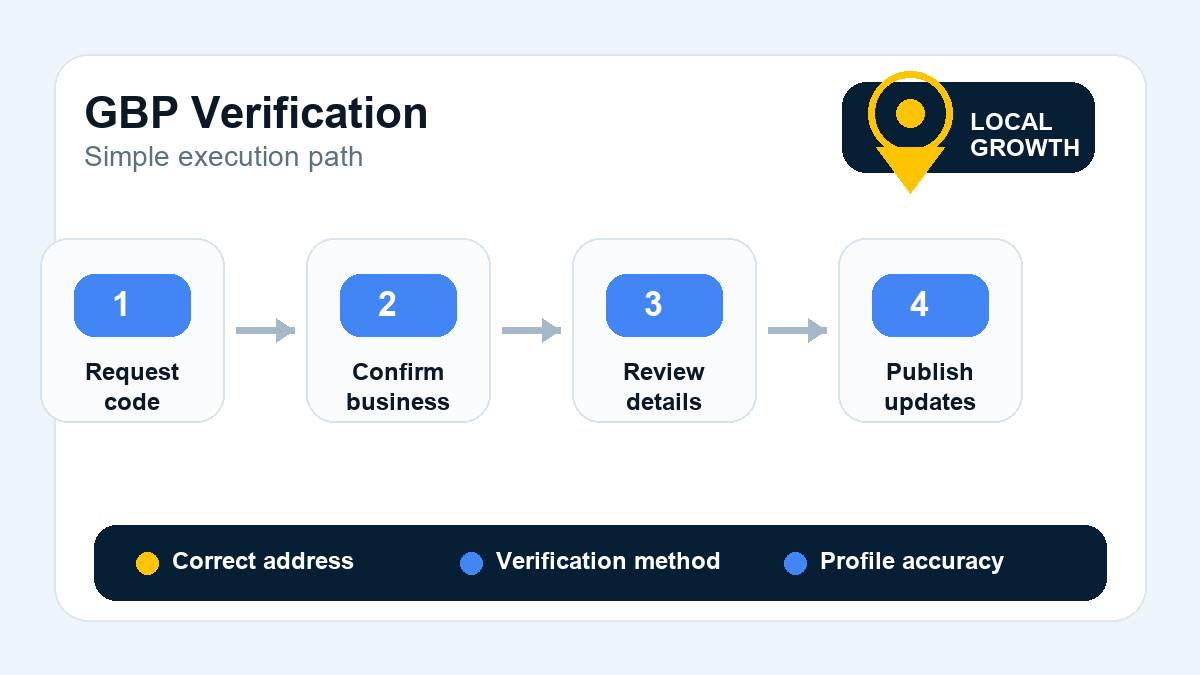
After Approval
Once your Google Business Profile is verified and approved, you can optimize it. Add relevant keywords to your description naturally, but don’t overdo it, as keyword stuffing can result in a penalty. Ensure your business name, address, website, and contact information are complete and spelled correctly. Avoid using abbreviations in your name or address.
The process for uploading photos is straightforward. When uploading your own images, rename the files with relevant keywords before you upload (e.g., “chiropractor-downtown-orlando-office.jpg”). You should also add a description. While geo-tagging photos no longer provides a significant direct ranking boost, it remains a good practice for organizing assets.
Lastly, make sure that you include a complete business description. The description should be as helpful and relevant as possible, following Google’s guidelines on how to best represent your business. You should also include a high-quality version of your business logo as your main profile photo to help your listing stand out.
Note that Google has restrictions on what you can include in service descriptions. You cannot include phone numbers, URLs, gibberish, or vulgar language. Keeping your service information accurate and up-to-date helps potential customers choose you over a competitor.
It is also critical to reply to negative reviews. This shows that you care about your customers and want to fix any problems they have. Responding to a negative review shows that you are willing to take responsibility and make things right. You can also flag and report any negative reviews that are unfair, inaccurate, or fake. However, be careful not to get too personal in your public responses.
Action checklist
Need help verifying or fixing a listing?
Nexgen can help clean up the profile and prepare it for local visibility.