

Data as a Service
Data as a Service for MSPs in Daytona Beach FL is a narrow search, which is exactly why the page has to be useful. A MSP in Daytona Beach is not looking for a broad marketing definition. They need to understand what to build, what to measure, and how the strategy should fit the local market.
Quick answer
Data as a Service for MSPs in Daytona Beach FL should be built as a focused local asset, not a generic marketing article. The page needs city context, industry proof, a conversion path, and tracking that shows whether the traffic becomes qualified conversations.
In this expanded guide
Primary keyword
Data as a Service for MSPs in Daytona Beach FL
Best-fit intent
A local business owner or manager comparing whether Data as a Service can create better leads, better follow-up, or better search visibility for MSPs in Daytona Beach.
Why the Daytona Beach market changes the strategy
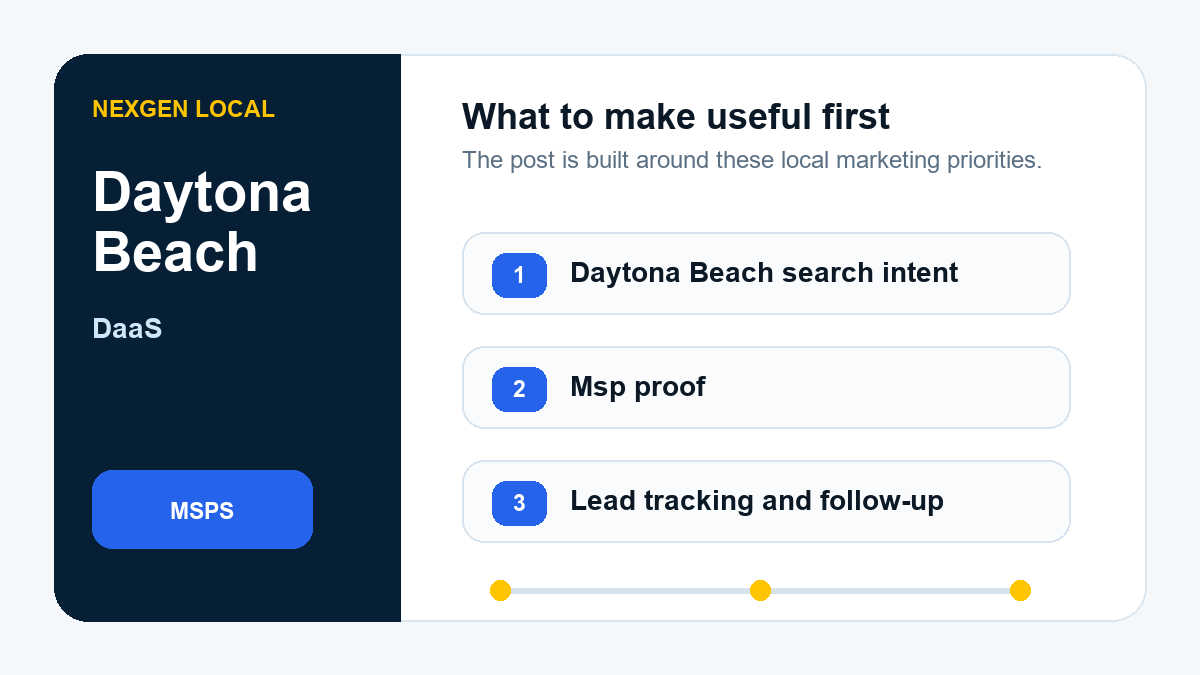
Daytona Beach content should reflect beachside demand, Ormond Beach, Port Orange, events, tourism, coastal properties, and storm-exposed neighborhoods.
Event traffic, tourism cycles, coastal wear, and storm planning create spikes that should be tracked separately from normal demand. That matters because local search is not just a list of keywords. The same phrase can mean a quick emergency call, a research-stage project, a bid request, or a high-trust consultation depending on the neighborhood, service line, and buyer type.
For MSPs, a useful page should make the local fit obvious. It should mention the service area in plain language, explain who the offer is for, show proof that matches the work, and give the visitor one clear next step. When a page only swaps in a city name, it may technically target the keyword, but it usually fails to answer the buyer’s real question.
What Daytona Beach MSPs need to prove
B2b buyers research quietly and need technical clarity before they book a consult. In Daytona Beach, that pain point becomes more specific because the market includes beachside areas, Ormond Beach, Port Orange, and event-driven demand. The page should reduce doubt before the visitor calls, clicks, or fills out a form.
MSP buyers research quietly and compare risk, responsiveness, and technical fit before booking a consultation.
A cybersecurity lead should receive a different offer than a general managed IT lead, with a checklist or risk review that feels useful before sales follow-up.
Useful proof for this audience can include Industry pages, security language, service-level explanations, case-study style content, and lead-source tracking for booked consults.. These details are not decoration. They help real visitors decide whether the company understands their job, and they help search engines connect the page to the right entity, service, and local context.
The Data as a Service plan for this keyword
Data as a Service works when the business stops guessing which segments are worth attention and starts organizing lead, market, and job data into decisions.
For Data as a Service for MSPs in Daytona Beach FL, the strategy should start with one primary intent and one conversion path. The campaign can still support secondary questions, but the main page should not drift into every possible marketing topic. A focused article is easier to optimize, easier to measure, and easier to improve after Search Console data starts showing real queries.
Use language that reflects managed IT, cybersecurity, or backup and recovery when those are the jobs the business actually wants.
Reference beachside areas, Ormond Beach, Port Orange, and event-driven demand, service-area fit, project types, photos, reviews, or process details that help a Daytona Beach buyer trust the next step.
Separate calls, forms, booked appointments, disqualified leads, and follow-up notes so the page is judged by qualified opportunities instead of traffic alone.
What to build first
The first version should be practical enough that a business owner can see the work. For MSPs, the strongest page usually combines local explanation, industry proof, a clear call-to-action, and a measurement plan. That gives the content a reason to exist beyond keyword coverage.
| Build area | What to add | How to measure it |
|---|---|---|
| Lead source cleanup | Normalize forms, calls, campaigns, and offline notes so every lead can be traced back to a useful source. | Track source quality, close-rate patterns, service-line demand, local segments, and conversion gaps for Daytona Beach MSPs. |
| Segment scoring | Score opportunities by service line, city, property type, margin potential, and fit instead of treating every inquiry the same. | Track source quality, close-rate patterns, service-line demand, local segments, and conversion gaps for Daytona Beach MSPs. |
| Decision reporting | Turn the data into weekly actions: expand what works, fix weak pages, and cut waste from bad-fit channels. | Track source quality, close-rate patterns, service-line demand, local segments, and conversion gaps for Daytona Beach MSPs. |
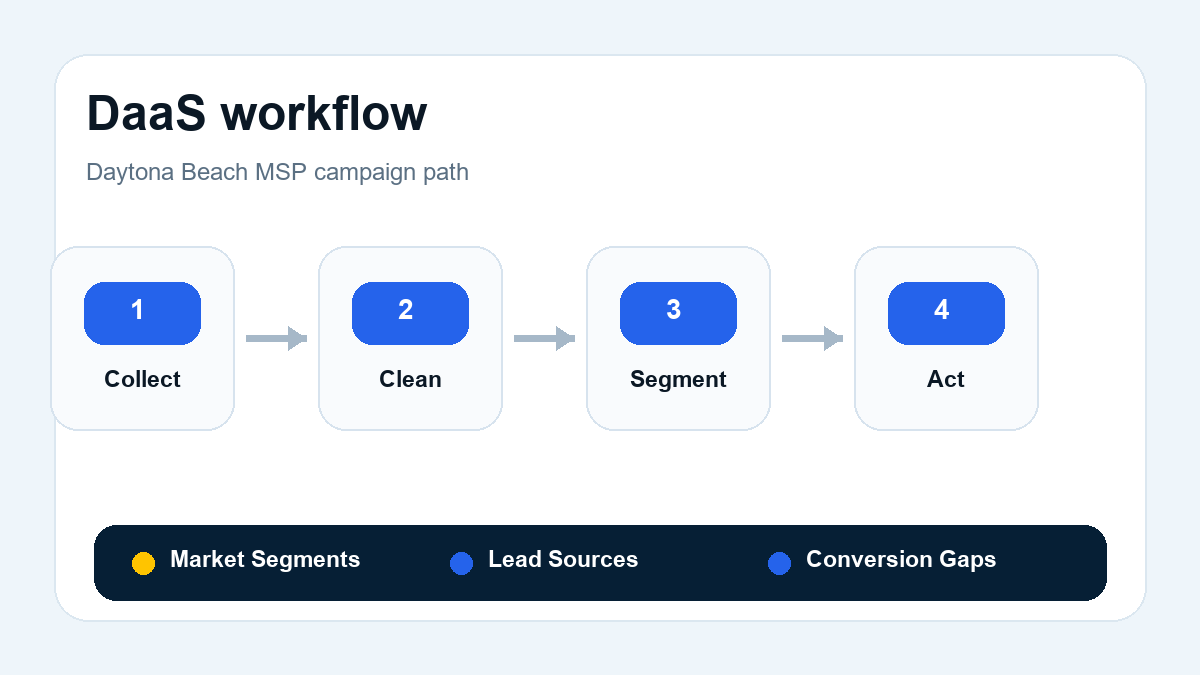
A small but complete build is better than a large campaign with no feedback loop. Start with one page or offer, connect it to the parent Data as a Service service, support it with proof for the MSPs audience, and point local readers toward the Daytona Beach service area. Then use call and form data to decide what deserves expansion.
Local examples to make the content stronger
A stronger Daytona Beach page can include a short section for neighborhoods or service zones, a short explanation of seasonal demand, and a practical note about how buyers compare providers. For this post, the local examples should connect Atlantic Coast context with MSPs buying behavior.
For example, a MSP serving Daytona Beach might need one message for urgent searchers, another for research-stage buyers, and another for high-value projects. The content should not pretend all leads are equal. It should explain how the business qualifies opportunities, what proof matters most, and what happens after the visitor takes action.
That is also where Data as a Service becomes more than a marketing label. The service should help the business decide what to publish, what to promote, what to track, and what to stop doing. If a keyword gets impressions but no qualified action, the answer may be stronger proof, a clearer offer, better routing, or a more specific page.
Internal links and topical authority
This page should not sit alone. It supports the parent Data as a Service page, reinforces the MSPs industry section, and connects back to the Daytona Beach service area. Those internal links help the article pass relevance back to the pages that matter most for Nexgen’s core SEO.
Internal links should be useful to the reader, not forced into every sentence. The best pattern is simple: link up to the parent service, link sideways to related Florida posts, and link forward to a clear conversion action such as a strategy review or contact page.
Frequently asked questions
How can Data as a Service help MSPs in Daytona Beach?
Data as a Service helps a MSP in Daytona Beach connect local intent to a clearer conversion path. The goal is to show the right proof, route the right inquiries, and measure lead quality instead of only counting traffic.
What should a Daytona Beach MSP build first?
Start with one priority service, one primary page or offer, call and form tracking, and proof that matches beachside areas, Ormond Beach, Port Orange, and event-driven demand. After the first data comes in, expand into related services, nearby neighborhoods, or supporting blog content.
How long should MSPs track this before scaling?
A useful test should run long enough to collect impressions, clicks, calls, forms, booked appointments, and disqualified lead notes. The decision to expand should come from lead quality and conversion data, not from traffic volume alone.
What makes this different from a generic Florida marketing page?
This page connects Data as a Service, MSPs, and Daytona Beach search behavior in one place. It uses local context, industry proof, internal links, and a tracking plan so the page can support both users and core service SEO.
Author and review note
About this guide: This article is published under Bill Gilmore’s Nexgen Local Marketing author profile and reviewed against Nexgen’s local search, paid media, conversion tracking, and content-quality checklist. It avoids unsupported ranking, lead, or revenue promises and focuses on practical steps a Florida business can verify.
Tracking, pruning, and improvement plan
After publishing, the page should be monitored in Google Search Console and Bing Webmaster Tools. The most useful early signals are impressions for the target topic, queries that include Daytona Beach, clicks from qualified searches, engagement with the call-to-action, and whether leads mention the service or location the page was built around.
Every quarter, the page should be reviewed. If it earns impressions but no clicks, the title and meta description may need work. If it earns clicks but no qualified actions, the offer, proof, form, or call path may need improvement. If it earns no meaningful impressions after enough time, it should be improved, merged into a stronger article, redirected, or noindexed instead of staying live as weak content.
Need a stronger Florida growth page for MSPs?
Nexgen can review your Daytona Beach market, service mix, page structure, proof assets, and tracking setup before you scale content or ads.
Call 407-307-1995, email info@nexgenlocalmarketing.com, or request a Florida strategy review.