

Video Marketing
Short-Form Video Marketing for Local Businesses in 2026: TikTok, Reels, and YouTube Shorts
Video Marketing
Are you seeing your competitors on TikTok and Reels and wondering if you're missing out? You have a feeling short-form video is important, but the idea of creating a steady stream of content feels overwhelming, and you're not even sure it works for a local service business. This guide cuts through the noise to give you a realistic, actionable plan for using short-form video marketing to attract local customers in 2026, without needing a Hollywood budget or a dance routine.
Quick answer
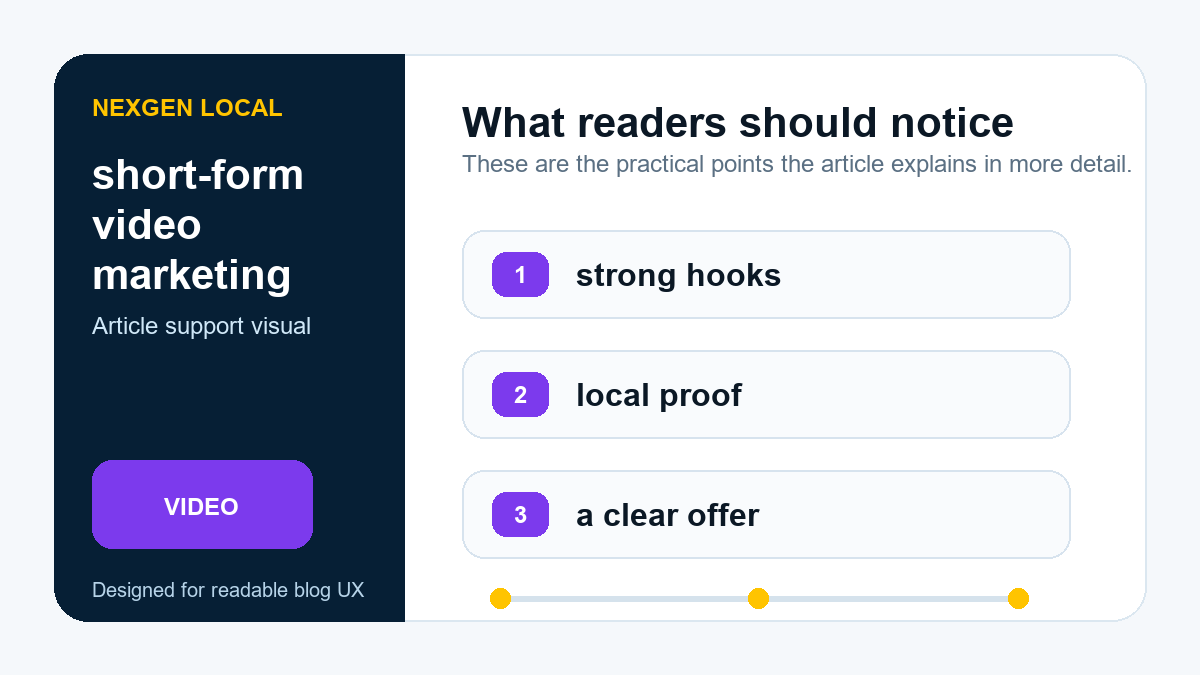
Short-form video works for local businesses when it answers real buyer questions, shows the work, and gets repurposed consistently across platforms.
Show the service
This is one of the core pieces that makes short-form video work as a practical business strategy.
Answer objections
This is one of the core pieces that makes short-form video work as a practical business strategy.
The 2026 Reality: Short-Form Video Dominates Attention
Let’s be direct: the way people discover and connect with local businesses has fundamentally changed. While a strong website and Google Business Profile are still foundational, the battle for top-of-mind awareness is now fought in 15-to-90-second increments on social media. By 2026, the trend that started years ago is now an established reality. Short-form video isn’t just *a* format; for a huge segment of your potential customer base, it’s *the* primary format they consume.
Algorithm shifts across major platforms from 2024 to 2026 have consistently favored authentic, engaging video. Instagram’s pivot to a “video-first” experience is complete, TikTok’s search functionality has become a genuine competitor to Google for discovery, and YouTube Shorts is the platform’s answer to retaining users with shorter attention spans. Attention has fragmented. Instead of searching “plumbers near me” on Google, a homeowner might now see a compelling video on Reels of a local plumber fixing a common leak, save it for later, and remember that company when the need arises.
Despite this, the majority of local businesses are still on the sidelines. They either don’t participate, or they post sporadically without a strategy, assuming it’s a game only for influencers and e-commerce brands. This is a massive opportunity. The bar for entry is lower than you think, and the reward for consistency is a direct line to the eyes and ears of your community.
Platform-by-Platform: TikTok vs. Instagram Reels vs. YouTube Shorts
While often grouped together, the three dominant platforms for short form video marketing local business have distinct nuances in 2026. Choosing where to focus depends on your specific goals and target audience.
-
TikTok:
- Audience: While still dominant with Gen Z and Millennials, the user base has significantly broadened. You’ll find homeowners, professionals, and decision-makers of all ages scrolling. The vibe is less curated and more about authenticity and entertainment.
- Algorithm: TikTok’s algorithm is famously powerful at interest-based discovery. It can take a brand-new account with zero followers and show its video to thousands of relevant local users if the content is engaging. It’s less about who you know and more about the quality of the video itself.
- Ad Platform: The ad platform is robust, offering sophisticated targeting options, including location-based campaigns that are perfect for local businesses. However, ad creative needs to feel native to the platform to be effective.
- Search & Discoverability: “TikTok SEO” is a real and powerful strategy. Users increasingly use TikTok’s search bar like a mini-Google to find reviews, tutorials, and local recommendations. Optimizing your captions and on-screen text for search is critical.
-
Instagram Reels:
- Audience: Generally skews slightly older than TikTok, with a strong Millennial and Gen X presence. Users often have a higher purchase intent, and the platform is more integrated with established business profiles and shopping features.
- Algorithm: The algorithm still favors connections and your existing audience more than TikTok’s does, but it heavily prioritizes Reels content in feeds and the Explore page. High-quality, visually appealing content tends to perform best.
- Ad Platform: Seamlessly integrated with Meta’s powerful Ads Manager. You can easily promote a Reel to a highly specific local audience based on demographics, interests, and behaviors. It’s arguably the most mature ad platform of the three for granular local targeting. This is a core part of our social media marketing services.
- Search & Discoverability: Instagram’s search is more hashtag and keyword-driven. Using a mix of broad and hyper-local hashtags is key to being discovered by users in your service area.
-
YouTube Shorts:
- Audience: The audience is vast and diverse, mirroring YouTube’s overall user base. A key advantage is that these users are already in a “video mindset” when they open the app.
- Algorithm: The Shorts algorithm is designed to pull viewers into a continuous feed. A major benefit is that a popular Short can drive subscribers and traffic to your main, longer-form YouTube channel, creating a powerful content ecosystem.
- Ad Platform: Leverages the Google Ads ecosystem, which is powerful but can be more complex. Your Shorts can appear as ads within the Shorts feed, offering another touchpoint with potential customers.
- Search & Discoverability: This is Shorts’ superpower. Your videos are indexed by Google, the world’s largest search engine. A well-titled Short answering a common question (e.g., “How to Reset a Garbage Disposal”) can appear in both YouTube search and Google search results for years, providing long-term value.
What Works for Local Service Businesses
E-commerce brands can succeed with flashy product showcases and trend-chasing. Local service businesses need a different playbook. Your goal is to build trust, demonstrate expertise, and create a human connection. Forget viral dances; focus on value and authenticity.
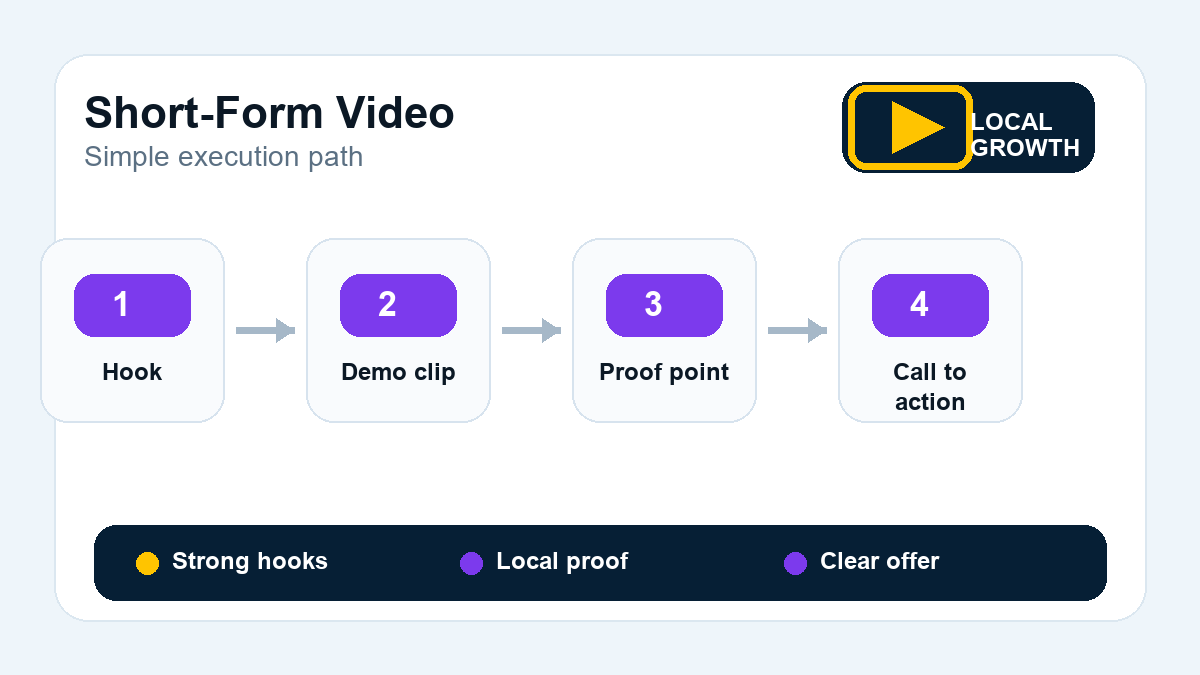
- Demonstration Videos: Don’t just tell people you’re a great painter; show them your crisp cut-in lines in a 30-second time-lapse. If you’re a landscaper, show the process of turning a messy yard into a pristine oasis. These videos prove your skill without a hard sell.
- Behind-the-Scenes (BTS): Show your team loading up the truck for the day, cleaning the equipment, or having a morning meeting. This humanizes your business and builds a sense of familiarity and trust. People buy from people they feel they know.
- Before & After: This is the single most powerful format for any business that creates a visible transformation. Roofing, pressure washing, auto detailing, landscaping, home organization—the visual payoff is immense and instantly communicates the value you provide. We’ve seen clients achieve fantastic results with this strategy, as noted in some of our case studies.
- Customer Question Q&A: Take common questions you get on the phone or via email and answer them in a short video. “How much does a new AC unit cost?” “What’s the difference between SEO and SEM?” “Is pressure washing safe for my roof?” This positions you as the expert and pre-qualifies customers.
- Fast Tips: Share quick, valuable advice related to your industry. A plumber could show how to fix a running toilet. An electrician could explain what to do when a breaker trips. This content gets saved and shared, extending your reach far beyond a direct sales pitch.
Production: How Much is Enough?
The fear of needing expensive equipment stops many business owners before they start. Here’s the 2026 truth: your phone is enough. Modern smartphone cameras are more than capable of producing high-quality video for TikTok, Reels, and Shorts. The authenticity of phone-shot content often performs better than overly polished, corporate-style video.
However, you can make a huge impact by focusing on three basics:
- Lighting: You don’t need a professional lighting kit. A simple $30 ring light can dramatically improve the quality of indoor shots. When outdoors, simply facing the sun instead of having it behind you makes a world of difference. Good lighting is the #1 differentiator between amateur and professional-looking video.
- Audio: Viewers will tolerate mediocre video quality, but not bad audio. The built-in mic on your phone is okay in a quiet space, but for less than $50 you can get a lavalier microphone that clips onto your shirt. This small investment makes your audio crisp and clear, even with background noise.
- Vertical Framing: These platforms are built for vertical video. Always shoot in a 9:16 aspect ratio. Turning your phone sideways is a rookie mistake that immediately signals you don’t understand the platform. Keep it vertical.
Your goal is not a Netflix-quality production. It’s to be clear, audible, and authentic. For a deeper dive into the fundamentals, check out our guide on how to make the most of video marketing.
Cadence and Consistency: A Realistic Plan
You are not a full-time creator. You’re a business owner. Burning out by trying to post three times a day is a recipe for failure. Consistency is far more important than frequency. The algorithms reward accounts that post regularly over a long period.
Here’s a realistic starting goal: Commit to posting 2-3 videos per week.
This is achievable. The key is to “batch” your content creation. Dedicate two hours on a Monday morning to shoot 3-4 simple videos. This could be a few Q&A’s, a quick tour of a job site, and a before/after. Then, throughout the week, you just need a few minutes each day to post them. This approach removes the daily pressure of “What should I post today?” and makes the process manageable.
Captions, Hashtags, and On-Screen Text: 2026 Best Practices
A great video can fall flat without the right optimization. Each element plays a role in discovery and engagement.
- On-Screen Text: This is non-negotiable. The majority of users watch videos with the sound off. Use bold, clear on-screen text to state your main point within the first 3 seconds. This is your “hook” to stop their scroll. Use it to summarize key points throughout the video.
- Captions (The Description): Keep it concise. Your caption should add context that isn’t in the video. Ask a question to encourage comments. Most importantly, treat the caption like a mini-blog post for search. Include your focus keywords and related terms naturally. For example, “Here’s how we transformed this Orlando home with a new roof. This architectural shingle is a great choice for Florida weather. #OrlandoRoofer #CentralFloridaRoofing #RoofReplacement”.
- Hashtags: The strategy has evolved. In 2026, a mix of broad and niche/local hashtags is optimal.
- TikTok: 3-5 hashtags. (e.g., #plumbingtips #orlandoflorida #smallbusiness)
- Instagram Reels: 5-10 hashtags. You can use more here. (e.g., #hvaclife #acmaintenance #kissimmeeFL #supportlocal #orlandohome)
- YouTube Shorts: 2-3 hashtags in the description and use the “Tags” section in the video details for more keywords.
Always include a location-specific hashtag to attract a local audience.
Cross-Posting Strategy: Same Video, Multiple Platforms?
Yes, you absolutely should be cross-posting, but with minor edits. The effort to create one video is too high to not leverage it across all three platforms. Here’s the workflow:
- Create and edit your “master” video in a third-party app (like CapCut or even directly on your phone’s editor). Do not add text or music yet.
- Save this clean version.
- Upload this video to each platform (TikTok, Instagram, YouTube Shorts) individually.
- Use each platform’s native text and music features. The algorithms tend to give a slight preference to videos that use their native creative tools. TikTok’s trending sounds are different from Reels’, so this step is important.
- Crucially, when you download a video from TikTok, it has a watermark. Platforms like Instagram have been known to suppress the reach of videos that have a competing platform’s watermark. The “edit once, upload everywhere” workflow avoids this issue entirely.
Measuring What Matters: Views are Vanity
A video with 100,000 views that results in zero leads is a failure. A video with 1,200 hyper-local views that results in two booked appointments is a massive success. You must track the right metrics.
- Vanity Metrics: Views, Likes. Nice to have, but they don’t pay the bills.
- Signal Metrics:
- Watch Time / Completion Rate: Are people watching your whole video? This tells the algorithm your content is engaging and that it should be shown to more people.
- Saves: This is a huge signal. When someone saves your video, they are saying, “This is valuable, and I want to come back to it.” This is a common action for tips, tutorials, and inspiring before/afters.
- Shares: A user sharing your content is a personal endorsement to their network.
- Comments & DMs: Engagement is great, but direct messages are leads. When someone takes the time to slide into your DMs to ask a question, they are a warm lead.
How to track booked appointments: This is the most important step. Implement a simple question into your client intake process: “How did you hear about us?” Add “TikTok/Instagram/YouTube” as an option. Over time, you will see a clear correlation between your video efforts and your bottom line. For more complex tracking, you can use dedicated landing pages or special offers mentioned only in your videos, but starting with the simple question is effective and costs nothing.
Paid Promotion: When to Boost vs. Run Dedicated Ads
Organic reach is powerful, but a small ad budget can amplify your results significantly. This is a core component of a holistic short form video marketing local business strategy.
- Boosting Organic Content: Did a video perform unusually well organically? This is a sign that you’ve struck a chord. “Boosting” this post (using the simple “Promote” button on Instagram or TikTok) is a great way to get it in front of more local people who don’t yet follow you. Think of this as pouring gasoline on a fire that’s already burning. A budget of $50-$100 can dramatically expand the reach of a proven video.
- Dedicated Short-Form Ads: This is for more direct-response goals, like driving lead form submissions or calls. Here, you would create a video specifically as an ad, with a clear Call to Action (CTA). You’ll use the full power of Meta Ads Manager or TikTok Ads Manager to build a precise local audience. This is less about brand building and more about immediate lead generation. Budget tiers can start as low as $15-$25 per day to start generating measurable results.
A balanced strategy uses both. Use boosts to amplify your best brand-building content and dedicated ads for your specific, high-intent offers. If you’re unsure where to start, our video marketing team can help build a strategy that fits your budget.
Frequently Asked Questions (FAQ)
Do I need to dance or do silly trends?
Absolutely not. This is a common misconception. For a local service business, your credibility comes from your expertise, not your entertainment value. Focus on the value-driven content types listed above: demos, tips, and before-and-afters. Authenticity and expertise will win over trying to be something you’re not.
Can I outsource my video creation?
Yes, and for many busy owners, this is the most sustainable path. You can hire a local videographer, a marketing agency, or a content creator. A hybrid approach often works best: you capture the raw video clips on your phone from job sites (since you’re the one there), and you send them to a professional editor who can package them into compelling short-form videos. This saves you time while ensuring a polished final product. Our team at Nexgen Local Marketing offers exactly these kinds of flexible video marketing packages.
How does this work for “boring” industries like HVAC, plumbing, or legal?
There’s no such thing as a boring industry, only boring content. These “unsexy” industries are often the best performers in short-form video because the content is so practical and needed. An HVAC tech can show how to clean a filter. A lawyer can explain a complex legal concept in simple terms. A plumber can show the gunk they just cleared from a drain (surprisingly effective!). The key is to answer the questions your customers are already asking and to show the real-world problems you solve.
How long should a short-form video be in 2026?
While platforms allow for longer videos (up to 3-10 minutes in some cases), the sweet spot for maximum engagement is still between 15 and 45 seconds. You need to hook the viewer in the first 3 seconds and deliver your core message quickly. If a topic requires more depth, you can create a multi-part series, prompting users to follow for Part 2.
I’m over 50. Is it worth my time to invest in this?
Yes, 100%. Your age and experience are an asset, not a liability. On platforms saturated with young creators, a seasoned professional stands out. Your experience brings a level of authority and trust that younger competitors can’t match. You’re not trying to be a teenage influencer; you’re a trusted local expert sharing your knowledge. Your target customers (homeowners, other business owners) are on these platforms, and they will resonate with your authenticity.
Getting started with short-form video doesn’t have to be complicated. By focusing on authentic content that demonstrates your expertise and solves customer problems, you can build a powerful engine for local awareness and lead generation. The key is to start small, stay consistent, and measure what truly matters for your business growth.
If you’re ready to make short-form video a real growth driver for your business but aren’t sure where to begin, our team can help. Give us a call at 407-307-1995 to discuss a practical, effective video strategy that fits your local business.
Action checklist
Need a repeatable local video system?
We can turn your services, FAQs, and proof points into a short-form content plan.
How to Make the Most of Video Marketing
Video Marketing
Updated for 2026 by Bill Gilmore , Digital Marketing Lead at Nexgen Local Marketing.
Quick answer
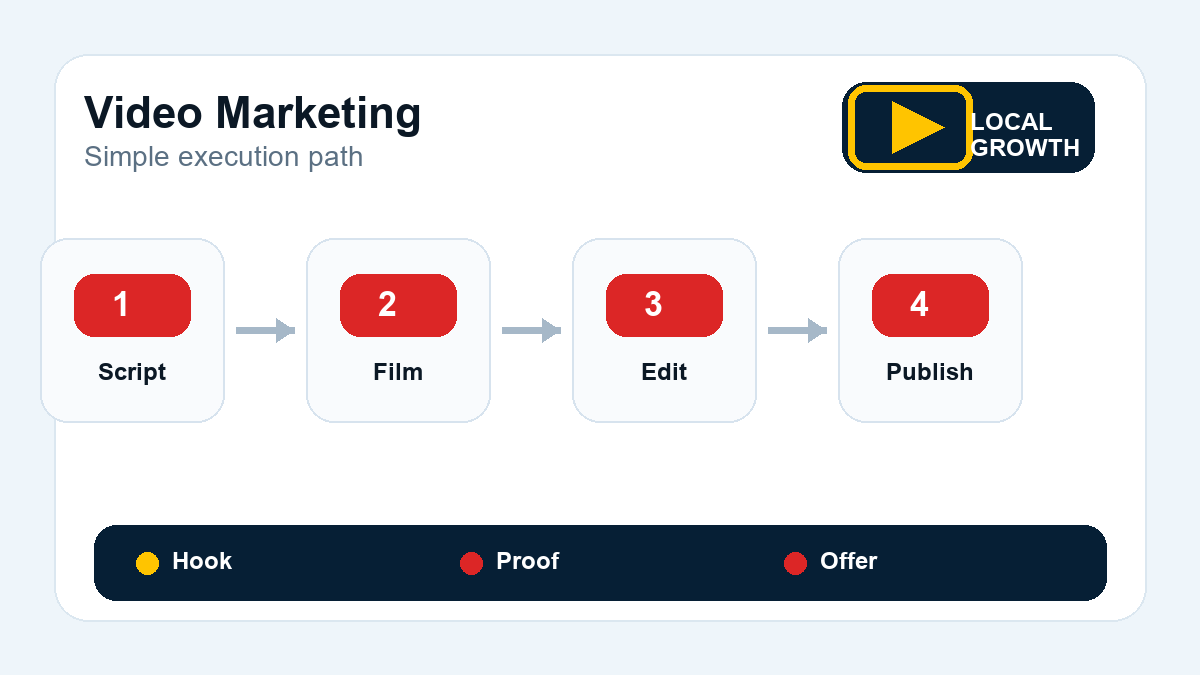
Video marketing works when each asset has a clear job: explain, prove, answer, compare, or convert.
Clear purpose
This is one of the core pieces that makes video marketing work as a practical business strategy.
Strong hook
This is one of the core pieces that makes video marketing work as a practical business strategy.
Choose The Right Video Type
In order to make the most of video marketing in 2026, you must plan your approach and determine which type of video to create. Different types of videos have their own pros and cons. You must also decide whether your videos should be educational, informative, or both. Here are some tips to help you choose the best type of video for your needs. High information retention rate To maximize the effectiveness of your video marketing campaigns, you need to make sure that your viewers retain information. Luckily, there are several ways to measure this. To begin, look at industry benchmarks. The data will tell you what your audience is consuming and for how long. For example, with the rise of short-form content on platforms like YouTube Shorts and TikTok, a viewer might engage deeply for 60 seconds, while longer educational content can hold attention for many minutes.
Video content can stimulate your customers’ visual and audio senses, which will help them retain information. This is a great way to build customer loyalty. It’s also an excellent way to educate and empower customers. Using videos that tell a story will often resonate with customers on an emotional level. Videos that spark an emotional response from customers are also more likely to be shared.
Using video to communicate with your customers is a great way to increase conversions. It can also help your SEO, and can send a stronger brand message. It’s worth checking out your competitors’ email lists to see which ones are using video. If you see that they’re using it, you might want to do the same.
Another way to improve the effectiveness of your video content is to add a call-to-action at the end. You can use a short, simple logo to mark the end of the video. This will allow your calls-to-action or email collector to appear right after the video. For longer videos, consider creating shorter 30- to 60-second cuts for social media. This will result in higher engagement and more bang for your buck.
Video remains the most popular type of content consumed online today. A vast majority of internet users prefer video content over non-video content, with the average person watching many hours of online video per week. As of 2026, online video consumption continues to grow, with the average person watching well over 100 minutes per day.
Research shows that video content can boost customer engagement and sales. Moreover, nearly all marketers plan to continue using video content in their advertising campaigns. Studies have shown that videos are the most popular type of content on social media sites. In fact, YouTube alone has grown to over 2.7 billion users, not including the massive audiences on TikTok and Instagram Reels. Multi-sensory experience A multi-sensory experience is a powerful sales tool that strengthens consumer-brand connections and improves customer retention. Research shows that consumers remember a store with a memorable sensory experience more often than one that fails to engage their senses. In addition to improving retention, multi-sensory marketing campaigns strengthen emotional connections between brands and consumers.
This is an approach to marketing that targets the customer’s five senses, creating a unique experience that engages their minds. Unlike traditional marketing methods that target the visual sense, sensory marketing uses all five senses to create a lasting impression that reflects the brand’s personality. When used correctly, it can significantly increase brand recall.
Another great example of how brands can engage with consumers is through touch marketing. In stores, shoppers can feel the texture of products and try them out before purchasing them. For example, Starbucks allows customers to smell their coffee, and Costco offers samples to try out their products. A Retail Dive survey showed that more than half of consumers go to brick-and-mortar stores to touch and feel products. By replicating this experience on the web through descriptive video, brands can improve their customer’s confidence in their purchases.
Multi-sensory experience marketing can lead to more engaging conversations and a greater chance for conversion. It has proven to be an effective method for brand retention, and it can help you stand out in the crowd. By using all five senses, consumers are more likely to be captivated and become loyal to your brand.
Brands that are memorable are often built by tapping into their audience’s emotions. This is why the Coca-Cola brand can make consumers feel a sense of taste or smell. It is a proven strategy that can increase sales. It is important to understand the brand before choosing the senses to engage.
The best video marketing strategy takes advantage of the power of motion. By engaging the viewer through motion and sound, video allows the brand to tell a story that appeals to multiple senses. Combined with other marketing materials, video creates an emotional experience that can be memorable. Human connection In video marketing, it is important to create an emotional connection between your audience and your brand. People are more likely to purchase a product if they can relate to the brand’s human side. In video marketing, you can introduce yourself, show your work, and provide testimonials. This will strengthen your brand’s authority.
The strongest way to create a connection with an audience is to include a human face in your video. A human face, eye contact, and stories will engage the viewer and help them connect on an emotional level. If you’re having trouble creating a video, you can find a company that specializes in this type of video marketing.
Whether you’re creating a video to promote your brand or to help a customer with a problem, you’ll want to connect with your audience on a human level. It will go a long way in securing repeat business. A human-to-human connection will make your video stand out from the crowd, and will make your audience feel like you know them personally.
The human face will encourage an emotional response, especially if the video includes the brand’s CEO or team members. Faces have a special place in the human brain, with neural circuits dedicated to responding to them. This is why video messages from a key company figure are often more memorable than a generic text-based message.
People connect to brands on an emotional level and are more likely to buy from companies that show an emotional connection. Emotional marketing can not only increase sales, but also help a business grow and reach new people. By creating an emotional connection with your customers, you will be on your way to success in video marketing. SEO impact Adding video to your website can have a direct impact on your SEO rankings. Search engines like Google give higher priority to websites with high-quality, engaging video content. Video encourages visitors to stay on a page for longer, which reduces bounce rates. This “dwell time” signals to search engine algorithms that your page provides value.
Video content also benefits local search. It is shared across platforms like YouTube and Facebook, which can increase its visibility and traffic. The popularity of video content is only expected to increase. People like watching videos and are likely to remember them if they see them. In addition, video production has become more affordable for small businesses, making it an increasingly important aspect of SEO.
Video content should contain keywords relevant to your business. Including keywords in your video’s title, description, and even the video file name is an effective SEO strategy. People watch videos on smaller screens, so it’s important to optimize for these screens. Using structured data (metadata) for your videos is another way to improve their search engine rankings and visibility.
A video’s SEO impact can be significant. Videos signal to search engines that you have quality content that adheres to frameworks like Google’s E-E-A-T (Experience, Expertise, Authoritativeness, and Trustworthiness). These signals also result in higher click rates, which can improve your ranking in search results. Videos are more likely to be watched by potential customers than articles. A strong SEO strategy can lead to a surge in your traffic. In addition, video content boosts backlinks, which are a critical element of positioning on the web.
Creating videos that appeal to consumers is a key to success. Make sure to measure their performance so you can optimize your videos for the best results. Once you have done this, you’ll be able to determine which videos are performing the best and which ones need more work. Using web analytics to track the performance of your videos can give you a good idea of how well they affect your site.
When implementing video marketing, keep in mind the length of your video and its content. With the dominance of short-form video, creating content under 90 seconds is key for platforms like TikTok, Instagram Reels, and YouTube Shorts. These short, engaging videos can capture attention quickly, boost on-page engagement, and indirectly increase your organic ranking.
Make Production Sustainable
Turn Videos Into Leads
Action checklist
Want more useful video assets?
Nexgen can help build a video plan tied to search, social, and lead generation.