

Pay Per Click Marketing
PPC for Jacksonville Smart Home Installers: What to Build First
Pay Per Click Marketing
PPC for smart home installers in Jacksonville FL is a narrow search, which is exactly why the page has to be useful. A smart home installer in Jacksonville is not looking for a broad marketing definition. They need to understand what to build, what to measure, and how the strategy should fit the local market.
Quick answer
PPC for smart home installers in Jacksonville FL should be built as a focused local asset, not a generic marketing article. The page needs city context, industry proof, a conversion path, and tracking that shows whether the traffic becomes qualified conversations.
In this expanded guide
Primary keyword
PPC for smart home installers in Jacksonville FL
Best-fit intent
A local business owner or manager comparing whether PPC can create better leads, better follow-up, or better search visibility for smart home installers in Jacksonville.
Why the Jacksonville market changes the strategy
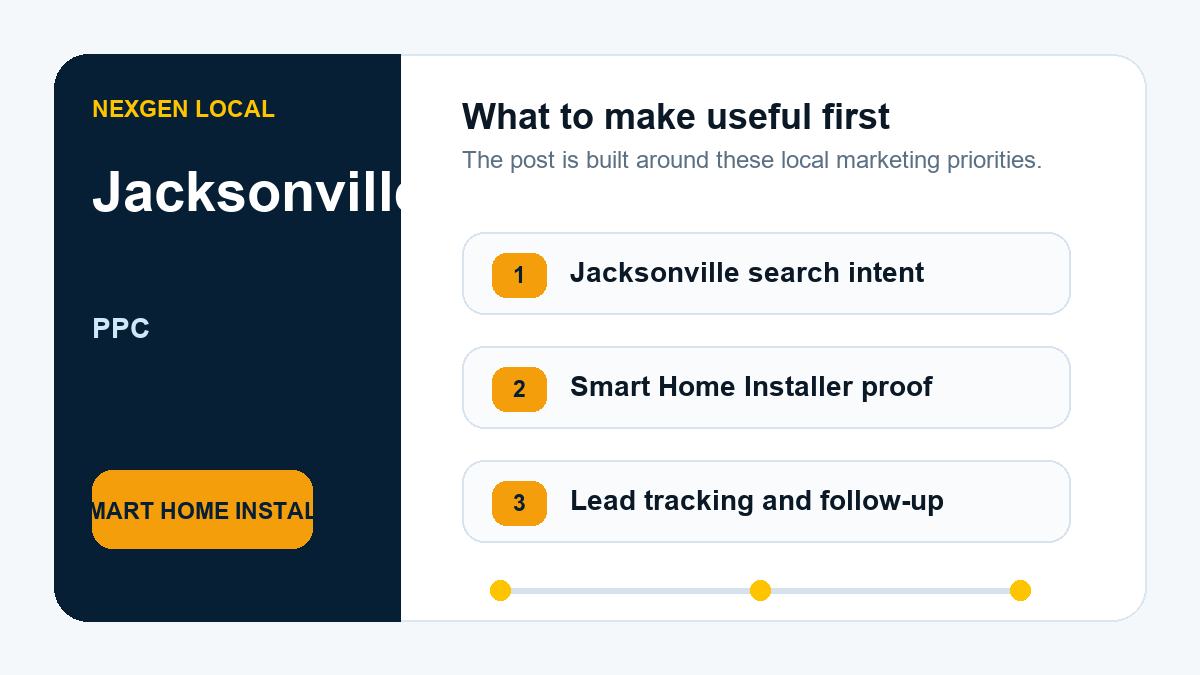
Jacksonville covers a large service radius, so content has to separate Riverside, Southside, Mandarin, the Beaches, and port or logistics corridor intent.
Large geography, port activity, military-adjacent movement, and storm-season planning create several different search patterns in one market. That matters because local search is not just a list of keywords. The same phrase can mean a quick emergency call, a research-stage project, a bid request, or a high-trust consultation depending on the neighborhood, service line, and buyer type.
For smart home installers, a useful page should make the local fit obvious. It should mention the service area in plain language, explain who the offer is for, show proof that matches the work, and give the visitor one clear next step. When a page only swaps in a city name, it may technically target the keyword, but it usually fails to answer the buyer’s real question.
What Jacksonville smart home installers need to prove
Customers need confidence that the installer can connect devices into one reliable system. In Jacksonville, that pain point becomes more specific because the market includes Riverside, Southside, the Beaches, Mandarin, and the port/logistics corridor. The page should reduce doubt before the visitor calls, clicks, or fills out a form.
Smart home buyers need confidence that devices, security, lighting, audio, and automation will work as one system.
A whole-home automation lead should capture existing devices, desired rooms, network concerns, budget range, and whether the project is new construction or retrofit.
Useful proof for this audience can include System diagrams, product compatibility pages, project examples, consultation forms, and troubleshooting or upgrade FAQs.. These details are not decoration. They help real visitors decide whether the company understands their job, and they help search engines connect the page to the right entity, service, and local context.
The PPC plan for this keyword
PPC only works when search intent, landing page proof, and lead tracking are managed as one system.
For PPC for smart home installers in Jacksonville FL, the strategy should start with one primary intent and one conversion path. The campaign can still support secondary questions, but the main page should not drift into every possible marketing topic. A focused article is easier to optimize, easier to measure, and easier to improve after Search Console data starts showing real queries.
Use language that reflects lighting control, security systems, or whole-home automation when those are the jobs the business actually wants.
Reference Riverside, Southside, the Beaches, Mandarin, and the port/logistics corridor, service-area fit, project types, photos, reviews, or process details that help a Jacksonville buyer trust the next step.
Separate calls, forms, booked appointments, disqualified leads, and follow-up notes so the page is judged by qualified opportunities instead of traffic alone.
What to build first
The first version should be practical enough that a business owner can see the work. For smart home installers, the strongest page usually combines local explanation, industry proof, a clear call-to-action, and a measurement plan. That gives the content a reason to exist beyond keyword coverage.
| Build area | What to add | How to measure it |
|---|---|---|
| Campaign structure | Separate emergency, research, branded, and high-value service searches so budget is not diluted by mixed intent. | Track cost per qualified lead, call quality, booked appointments, search term quality, and landing page conversion rate for Jacksonville smart home installers. |
| Landing page fit | Match ad copy to the service, city, proof, and call-to-action visitors expect after clicking. | Track cost per qualified lead, call quality, booked appointments, search term quality, and landing page conversion rate for Jacksonville smart home installers. |
| Cost control | Review search terms, call quality, form quality, and booked outcomes before increasing spend. | Track cost per qualified lead, call quality, booked appointments, search term quality, and landing page conversion rate for Jacksonville smart home installers. |
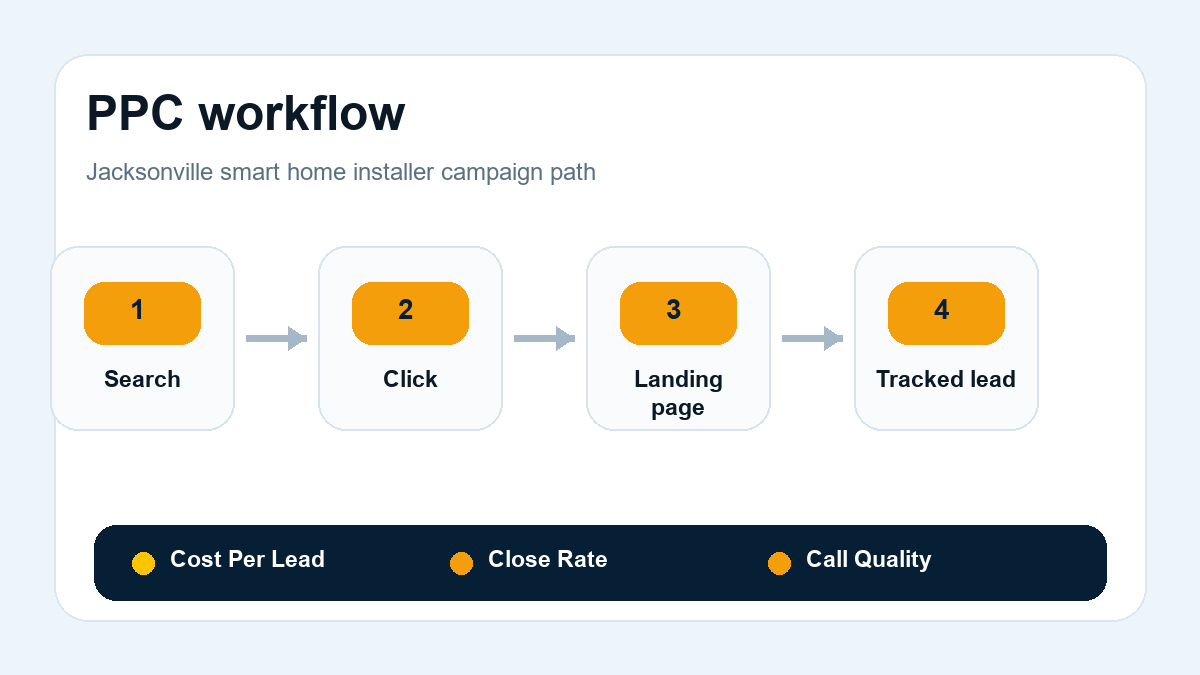
A small but complete build is better than a large campaign with no feedback loop. Start with one page or offer, connect it to the parent PPC service, support it with proof for the Smart Home Installers audience, and point local readers toward the Jacksonville service area. Then use call and form data to decide what deserves expansion.
Local examples to make the content stronger
A stronger Jacksonville page can include a short section for neighborhoods or service zones, a short explanation of seasonal demand, and a practical note about how buyers compare providers. For this post, the local examples should connect Northeast Florida context with smart home installers buying behavior.
For example, a smart home installer serving Jacksonville might need one message for urgent searchers, another for research-stage buyers, and another for high-value projects. The content should not pretend all leads are equal. It should explain how the business qualifies opportunities, what proof matters most, and what happens after the visitor takes action.
That is also where PPC becomes more than a marketing label. The service should help the business decide what to publish, what to promote, what to track, and what to stop doing. If a keyword gets impressions but no qualified action, the answer may be stronger proof, a clearer offer, better routing, or a more specific page.
Internal links and topical authority
This page should not sit alone. It supports the parent PPC page, reinforces the Smart Home Installers industry section, and connects back to the Jacksonville service area. Those internal links help the article pass relevance back to the pages that matter most for Nexgen’s core SEO.
Internal links should be useful to the reader, not forced into every sentence. The best pattern is simple: link up to the parent service, link sideways to related Florida posts, and link forward to a clear conversion action such as a strategy review or contact page.
Frequently asked questions
How can PPC help smart home installers in Jacksonville?
PPC helps a smart home installer in Jacksonville connect local intent to a clearer conversion path. The goal is to show the right proof, route the right inquiries, and measure lead quality instead of only counting traffic.
What should a Jacksonville smart home installer build first?
Start with one priority service, one primary page or offer, call and form tracking, and proof that matches Riverside, Southside, the Beaches, Mandarin, and the port/logistics corridor. After the first data comes in, expand into related services, nearby neighborhoods, or supporting blog content.
How long should smart home installers track this before scaling?
A useful test should run long enough to collect impressions, clicks, calls, forms, booked appointments, and disqualified lead notes. The decision to expand should come from lead quality and conversion data, not from traffic volume alone.
What makes this different from a generic Florida marketing page?
This page connects PPC, smart home installers, and Jacksonville search behavior in one place. It uses local context, industry proof, internal links, and a tracking plan so the page can support both users and core service SEO.
Author and review note
About this guide: This article is published under Suzy White’s Nexgen Local Marketing author profile and reviewed against Nexgen’s local search, paid media, conversion tracking, and content-quality checklist. It avoids unsupported ranking, lead, or revenue promises and focuses on practical steps a Florida business can verify.
Tracking, pruning, and improvement plan
After publishing, the page should be monitored in Google Search Console and Bing Webmaster Tools. The most useful early signals are impressions for the target topic, queries that include Jacksonville, clicks from qualified searches, engagement with the call-to-action, and whether leads mention the service or location the page was built around.
Every quarter, the page should be reviewed. If it earns impressions but no clicks, the title and meta description may need work. If it earns clicks but no qualified actions, the offer, proof, form, or call path may need improvement. If it earns no meaningful impressions after enough time, it should be improved, merged into a stronger article, redirected, or noindexed instead of staying live as weak content.
Need a stronger Florida growth page for smart home installers?
Nexgen can review your Jacksonville market, service mix, page structure, proof assets, and tracking setup before you scale content or ads.
Call 407-307-1995, email info@nexgenlocalmarketing.com, or request a Florida strategy review.
West Palm Beach Commercial Cleaning Companies PPC: A Practical Local Growth Plan
Pay Per Click Marketing
PPC for commercial cleaning companies in West Palm Beach FL is a narrow search, which is exactly why the page has to be useful. A commercial cleaning company in West Palm Beach is not looking for a broad marketing definition. They need to understand what to build, what to measure, and how the strategy should fit the local market.
Quick answer
PPC for commercial cleaning companies in West Palm Beach FL should be built as a focused local asset, not a generic marketing article. The page needs city context, industry proof, a conversion path, and tracking that shows whether the traffic becomes qualified conversations.
In this expanded guide
Primary keyword
PPC for commercial cleaning companies in West Palm Beach FL
Best-fit intent
A local business owner or manager comparing whether PPC can create better leads, better follow-up, or better search visibility for commercial cleaning companies in West Palm Beach.
Why the West Palm Beach market changes the strategy
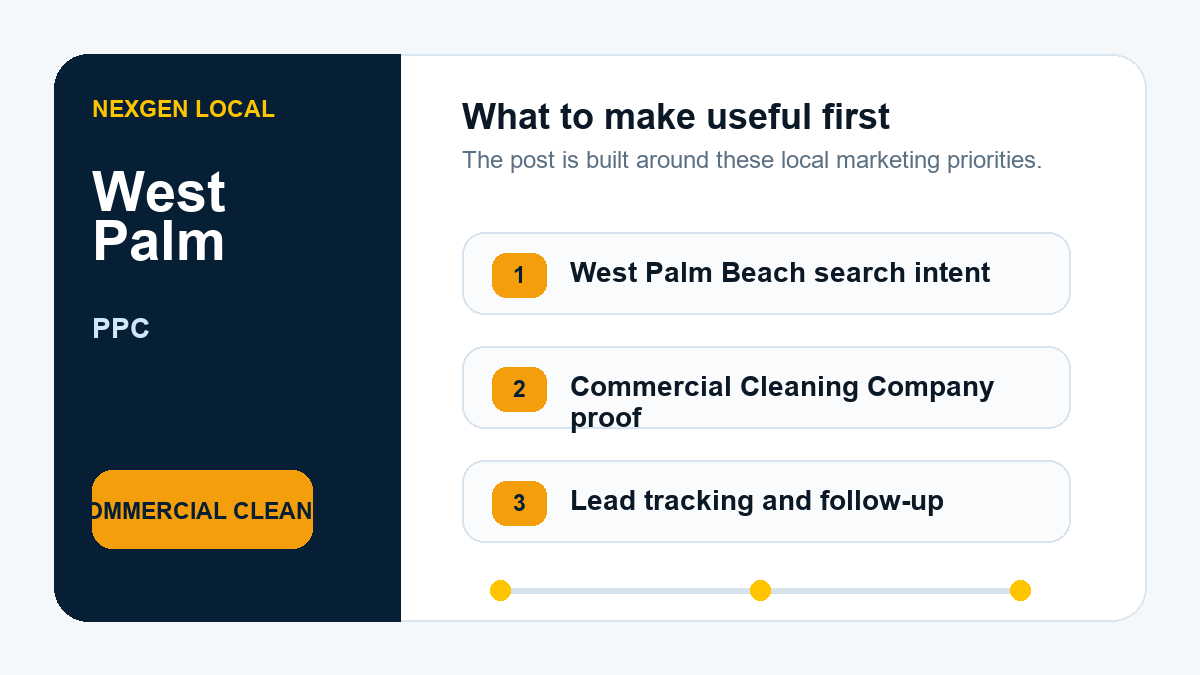
West Palm Beach searches are shaped by downtown demand, seasonal residents, Palm Beach County suburbs, and coastal communities with higher trust expectations.
Seasonal residents, coastal maintenance, and high-value home services make proof, response time, and premium positioning matter. That matters because local search is not just a list of keywords. The same phrase can mean a quick emergency call, a research-stage project, a bid request, or a high-trust consultation depending on the neighborhood, service line, and buyer type.
For commercial cleaning companies, a useful page should make the local fit obvious. It should mention the service area in plain language, explain who the offer is for, show proof that matches the work, and give the visitor one clear next step. When a page only swaps in a city name, it may technically target the keyword, but it usually fails to answer the buyer’s real question.
What West Palm Beach commercial cleaning companies need to prove
Facility managers need proof of reliability, scope, and fit before requesting a bid. In West Palm Beach, that pain point becomes more specific because the market includes downtown West Palm Beach, Palm Beach County suburbs, and coastal communities. The page should reduce doubt before the visitor calls, clicks, or fills out a form.
Commercial cleaning leads come from property managers, office managers, medical offices, construction teams, and facilities with different buying criteria.
A medical office cleaning lead should see scope, schedule, compliance-aware process language, and bid-request fields that capture square footage and frequency.
Useful proof for this audience can include Vertical pages, cleaning checklists, testimonials, schedule examples, property-type forms, and bid tracking by lead source.. These details are not decoration. They help real visitors decide whether the company understands their job, and they help search engines connect the page to the right entity, service, and local context.
The PPC plan for this keyword
PPC only works when search intent, landing page proof, and lead tracking are managed as one system.
For PPC for commercial cleaning companies in West Palm Beach FL, the strategy should start with one primary intent and one conversion path. The campaign can still support secondary questions, but the main page should not drift into every possible marketing topic. A focused article is easier to optimize, easier to measure, and easier to improve after Search Console data starts showing real queries.
Use language that reflects medical office cleaning, janitorial contracts, or post-construction cleanup when those are the jobs the business actually wants.
Reference downtown West Palm Beach, Palm Beach County suburbs, and coastal communities, service-area fit, project types, photos, reviews, or process details that help a West Palm Beach buyer trust the next step.
Separate calls, forms, booked appointments, disqualified leads, and follow-up notes so the page is judged by qualified opportunities instead of traffic alone.
What to build first
The first version should be practical enough that a business owner can see the work. For commercial cleaning companies, the strongest page usually combines local explanation, industry proof, a clear call-to-action, and a measurement plan. That gives the content a reason to exist beyond keyword coverage.
| Build area | What to add | How to measure it |
|---|---|---|
| Campaign structure | Separate emergency, research, branded, and high-value service searches so budget is not diluted by mixed intent. | Track cost per qualified lead, call quality, booked appointments, search term quality, and landing page conversion rate for West Palm Beach commercial cleaning companies. |
| Landing page fit | Match ad copy to the service, city, proof, and call-to-action visitors expect after clicking. | Track cost per qualified lead, call quality, booked appointments, search term quality, and landing page conversion rate for West Palm Beach commercial cleaning companies. |
| Cost control | Review search terms, call quality, form quality, and booked outcomes before increasing spend. | Track cost per qualified lead, call quality, booked appointments, search term quality, and landing page conversion rate for West Palm Beach commercial cleaning companies. |
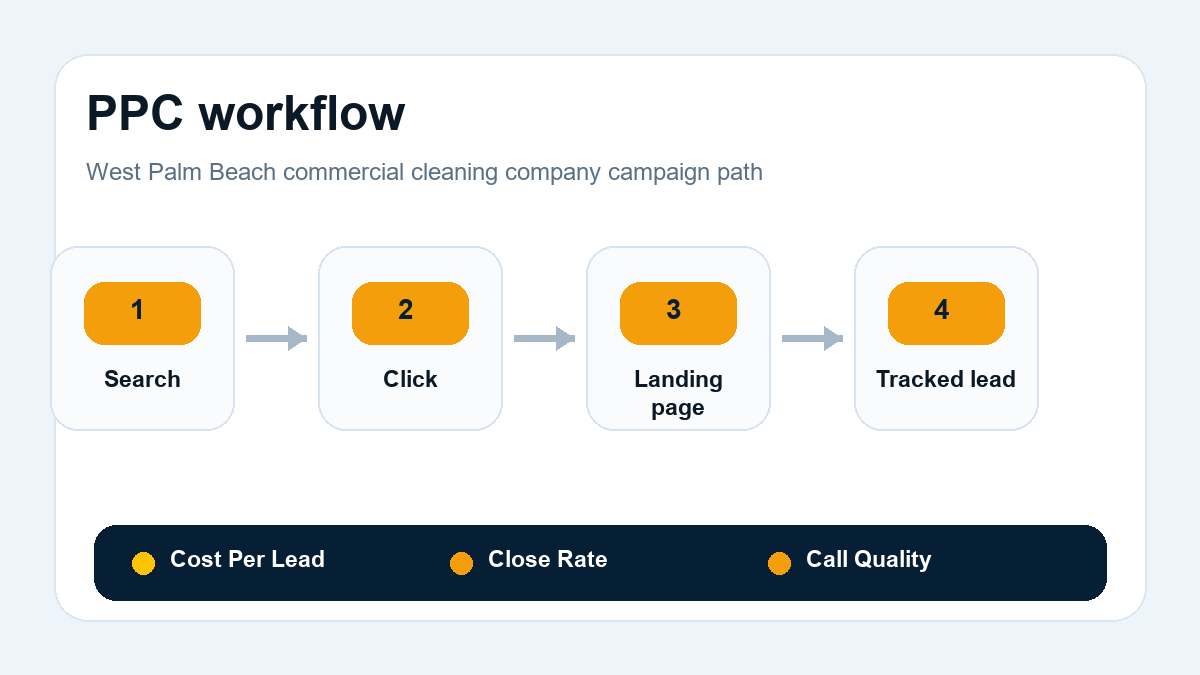
A small but complete build is better than a large campaign with no feedback loop. Start with one page or offer, connect it to the parent PPC service, support it with proof for the Commercial Cleaning Companies audience, and point local readers toward the West Palm Beach service area. Then use call and form data to decide what deserves expansion.
Local examples to make the content stronger
A stronger West Palm Beach page can include a short section for neighborhoods or service zones, a short explanation of seasonal demand, and a practical note about how buyers compare providers. For this post, the local examples should connect Palm Beach County context with commercial cleaning companies buying behavior.
For example, a commercial cleaning company serving West Palm Beach might need one message for urgent searchers, another for research-stage buyers, and another for high-value projects. The content should not pretend all leads are equal. It should explain how the business qualifies opportunities, what proof matters most, and what happens after the visitor takes action.
That is also where PPC becomes more than a marketing label. The service should help the business decide what to publish, what to promote, what to track, and what to stop doing. If a keyword gets impressions but no qualified action, the answer may be stronger proof, a clearer offer, better routing, or a more specific page.
Internal links and topical authority
This page should not sit alone. It supports the parent PPC page, reinforces the Commercial Cleaning Companies industry section, and connects back to the West Palm Beach service area. Those internal links help the article pass relevance back to the pages that matter most for Nexgen’s core SEO.
Internal links should be useful to the reader, not forced into every sentence. The best pattern is simple: link up to the parent service, link sideways to related Florida posts, and link forward to a clear conversion action such as a strategy review or contact page.
Frequently asked questions
How can PPC help commercial cleaning companies in West Palm Beach?
PPC helps a commercial cleaning company in West Palm Beach connect local intent to a clearer conversion path. The goal is to show the right proof, route the right inquiries, and measure lead quality instead of only counting traffic.
What should a West Palm Beach commercial cleaning company build first?
Start with one priority service, one primary page or offer, call and form tracking, and proof that matches downtown West Palm Beach, Palm Beach County suburbs, and coastal communities. After the first data comes in, expand into related services, nearby neighborhoods, or supporting blog content.
How long should commercial cleaning companies track this before scaling?
A useful test should run long enough to collect impressions, clicks, calls, forms, booked appointments, and disqualified lead notes. The decision to expand should come from lead quality and conversion data, not from traffic volume alone.
What makes this different from a generic Florida marketing page?
This page connects PPC, commercial cleaning companies, and West Palm Beach search behavior in one place. It uses local context, industry proof, internal links, and a tracking plan so the page can support both users and core service SEO.
Author and review note
About this guide: This article is published under Suzy White’s Nexgen Local Marketing author profile and reviewed against Nexgen’s local search, paid media, conversion tracking, and content-quality checklist. It avoids unsupported ranking, lead, or revenue promises and focuses on practical steps a Florida business can verify.
Tracking, pruning, and improvement plan
After publishing, the page should be monitored in Google Search Console and Bing Webmaster Tools. The most useful early signals are impressions for the target topic, queries that include West Palm Beach, clicks from qualified searches, engagement with the call-to-action, and whether leads mention the service or location the page was built around.
Every quarter, the page should be reviewed. If it earns impressions but no clicks, the title and meta description may need work. If it earns clicks but no qualified actions, the offer, proof, form, or call path may need improvement. If it earns no meaningful impressions after enough time, it should be improved, merged into a stronger article, redirected, or noindexed instead of staying live as weak content.
Need a stronger Florida growth page for commercial cleaning companies?
Nexgen can review your West Palm Beach market, service mix, page structure, proof assets, and tracking setup before you scale content or ads.
Call 407-307-1995, email info@nexgenlocalmarketing.com, or request a Florida strategy review.
Tampa Plumbing Companies: Turning PPC Into Better Local Leads
Pay Per Click Marketing
PPC for plumbing companies in Tampa FL is a narrow search, which is exactly why the page has to be useful. A plumbing company in Tampa is not looking for a broad marketing definition. They need to understand what to build, what to measure, and how the strategy should fit the local market.
Quick answer
PPC for plumbing companies in Tampa FL should be built as a focused local asset, not a generic marketing article. The page needs city context, industry proof, a conversion path, and tracking that shows whether the traffic becomes qualified conversations.
In this expanded guide
Primary keyword
PPC for plumbing companies in Tampa FL
Best-fit intent
A local business owner or manager comparing whether PPC can create better leads, better follow-up, or better search visibility for plumbing companies in Tampa.
Why the Tampa market changes the strategy
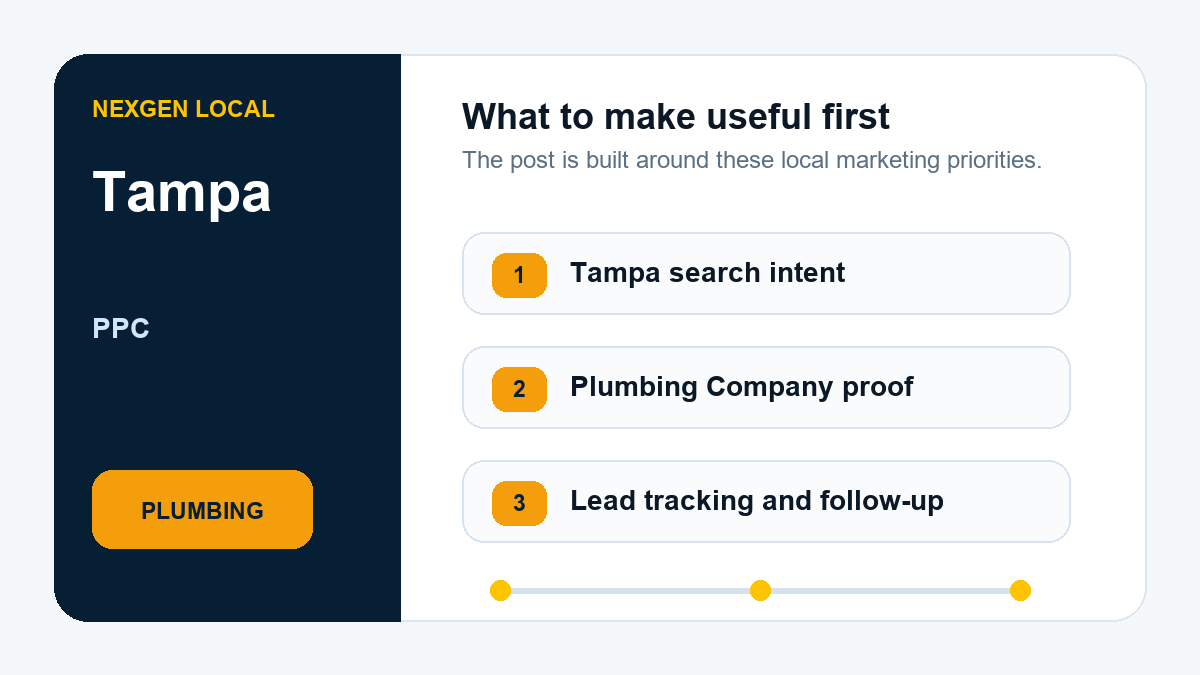
Tampa campaigns need to account for South Tampa, Westshore, Carrollwood, Brandon, and the broader bay-area pattern where homeowners compare several nearby providers.
Summer heat, hurricane planning, and bay-area homeowner demand make speed, reviews, and clear service areas especially important. That matters because local search is not just a list of keywords. The same phrase can mean a quick emergency call, a research-stage project, a bid request, or a high-trust consultation depending on the neighborhood, service line, and buyer type.
For plumbing companies, a useful page should make the local fit obvious. It should mention the service area in plain language, explain who the offer is for, show proof that matches the work, and give the visitor one clear next step. When a page only swaps in a city name, it may technically target the keyword, but it usually fails to answer the buyer’s real question.
What Tampa plumbing companies need to prove
Urgent searches need trust fast, especially when water damage is already happening. In Tampa, that pain point becomes more specific because the market includes South Tampa, Westshore, Carrollwood, Brandon, and the wider Tampa Bay market. The page should reduce doubt before the visitor calls, clicks, or fills out a form.
Plumbing buyers often search under stress, so the page has to answer trust, response, and service-fit questions immediately.
A leak repair or water heater replacement page should route mobile visitors to a call action while still giving enough detail for research-stage homeowners.
Useful proof for this audience can include License notes where appropriate, repair photos, emergency pages, neighborhood reviews, and forms that capture the type of plumbing issue.. These details are not decoration. They help real visitors decide whether the company understands their job, and they help search engines connect the page to the right entity, service, and local context.
The PPC plan for this keyword
PPC only works when search intent, landing page proof, and lead tracking are managed as one system.
For PPC for plumbing companies in Tampa FL, the strategy should start with one primary intent and one conversion path. The campaign can still support secondary questions, but the main page should not drift into every possible marketing topic. A focused article is easier to optimize, easier to measure, and easier to improve after Search Console data starts showing real queries.
Use language that reflects leak repair, repiping, or water heater replacement when those are the jobs the business actually wants.
Reference South Tampa, Westshore, Carrollwood, Brandon, and the wider Tampa Bay market, service-area fit, project types, photos, reviews, or process details that help a Tampa buyer trust the next step.
Separate calls, forms, booked appointments, disqualified leads, and follow-up notes so the page is judged by qualified opportunities instead of traffic alone.
What to build first
The first version should be practical enough that a business owner can see the work. For plumbing companies, the strongest page usually combines local explanation, industry proof, a clear call-to-action, and a measurement plan. That gives the content a reason to exist beyond keyword coverage.
| Build area | What to add | How to measure it |
|---|---|---|
| Campaign structure | Separate emergency, research, branded, and high-value service searches so budget is not diluted by mixed intent. | Track cost per qualified lead, call quality, booked appointments, search term quality, and landing page conversion rate for Tampa plumbing companies. |
| Landing page fit | Match ad copy to the service, city, proof, and call-to-action visitors expect after clicking. | Track cost per qualified lead, call quality, booked appointments, search term quality, and landing page conversion rate for Tampa plumbing companies. |
| Cost control | Review search terms, call quality, form quality, and booked outcomes before increasing spend. | Track cost per qualified lead, call quality, booked appointments, search term quality, and landing page conversion rate for Tampa plumbing companies. |
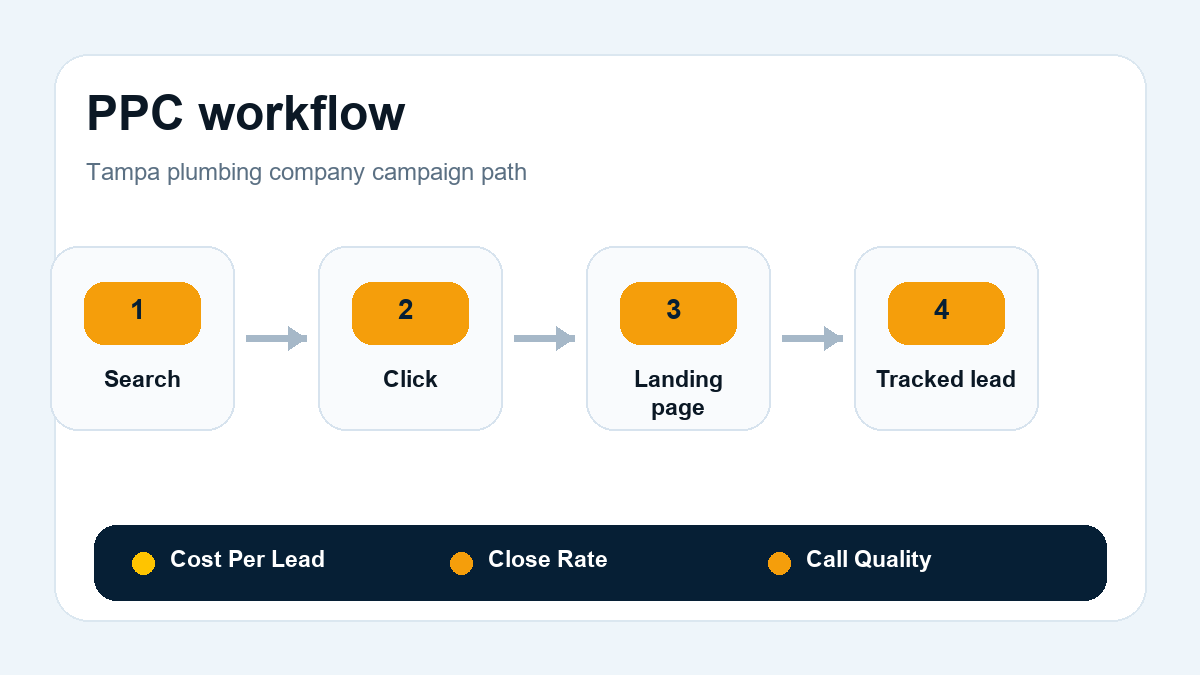
A small but complete build is better than a large campaign with no feedback loop. Start with one page or offer, connect it to the parent PPC service, support it with proof for the Plumbing Companies audience, and point local readers toward the Tampa service area. Then use call and form data to decide what deserves expansion.
Local examples to make the content stronger
A stronger Tampa page can include a short section for neighborhoods or service zones, a short explanation of seasonal demand, and a practical note about how buyers compare providers. For this post, the local examples should connect Tampa Bay context with plumbing companies buying behavior.
For example, a plumbing company serving Tampa might need one message for urgent searchers, another for research-stage buyers, and another for high-value projects. The content should not pretend all leads are equal. It should explain how the business qualifies opportunities, what proof matters most, and what happens after the visitor takes action.
That is also where PPC becomes more than a marketing label. The service should help the business decide what to publish, what to promote, what to track, and what to stop doing. If a keyword gets impressions but no qualified action, the answer may be stronger proof, a clearer offer, better routing, or a more specific page.
Internal links and topical authority
This page should not sit alone. It supports the parent PPC page, reinforces the Plumbing Companies industry section, and connects back to the Tampa service area. Those internal links help the article pass relevance back to the pages that matter most for Nexgen’s core SEO.
Internal links should be useful to the reader, not forced into every sentence. The best pattern is simple: link up to the parent service, link sideways to related Florida posts, and link forward to a clear conversion action such as a strategy review or contact page.
Frequently asked questions
How can PPC help plumbing companies in Tampa?
PPC helps a plumbing company in Tampa connect local intent to a clearer conversion path. The goal is to show the right proof, route the right inquiries, and measure lead quality instead of only counting traffic.
What should a Tampa plumbing company build first?
Start with one priority service, one primary page or offer, call and form tracking, and proof that matches South Tampa, Westshore, Carrollwood, Brandon, and the wider Tampa Bay market. After the first data comes in, expand into related services, nearby neighborhoods, or supporting blog content.
How long should plumbing companies track this before scaling?
A useful test should run long enough to collect impressions, clicks, calls, forms, booked appointments, and disqualified lead notes. The decision to expand should come from lead quality and conversion data, not from traffic volume alone.
What makes this different from a generic Florida marketing page?
This page connects PPC, plumbing companies, and Tampa search behavior in one place. It uses local context, industry proof, internal links, and a tracking plan so the page can support both users and core service SEO.
Author and review note
About this guide: This article is published under Bill Gilmore’s Nexgen Local Marketing author profile and reviewed against Nexgen’s local search, paid media, conversion tracking, and content-quality checklist. It avoids unsupported ranking, lead, or revenue promises and focuses on practical steps a Florida business can verify.
Tracking, pruning, and improvement plan
After publishing, the page should be monitored in Google Search Console and Bing Webmaster Tools. The most useful early signals are impressions for the target topic, queries that include Tampa, clicks from qualified searches, engagement with the call-to-action, and whether leads mention the service or location the page was built around.
Every quarter, the page should be reviewed. If it earns impressions but no clicks, the title and meta description may need work. If it earns clicks but no qualified actions, the offer, proof, form, or call path may need improvement. If it earns no meaningful impressions after enough time, it should be improved, merged into a stronger article, redirected, or noindexed instead of staying live as weak content.
Need a stronger Florida growth page for plumbing companies?
Nexgen can review your Tampa market, service mix, page structure, proof assets, and tracking setup before you scale content or ads.
Call 407-307-1995, email info@nexgenlocalmarketing.com, or request a Florida strategy review.
How Outdoor Kitchen Builders in Miami Can Use PPC in 2026
Pay Per Click Marketing
PPC for outdoor kitchen builders in Miami FL is a narrow search, which is exactly why the page has to be useful. A outdoor kitchen builder in Miami is not looking for a broad marketing definition. They need to understand what to build, what to measure, and how the strategy should fit the local market.
Quick answer
PPC for outdoor kitchen builders in Miami FL should be built as a focused local asset, not a generic marketing article. The page needs city context, industry proof, a conversion path, and tracking that shows whether the traffic becomes qualified conversations.
In this expanded guide
Primary keyword
PPC for outdoor kitchen builders in Miami FL
Best-fit intent
A local business owner or manager comparing whether PPC can create better leads, better follow-up, or better search visibility for outdoor kitchen builders in Miami.
Why the Miami market changes the strategy
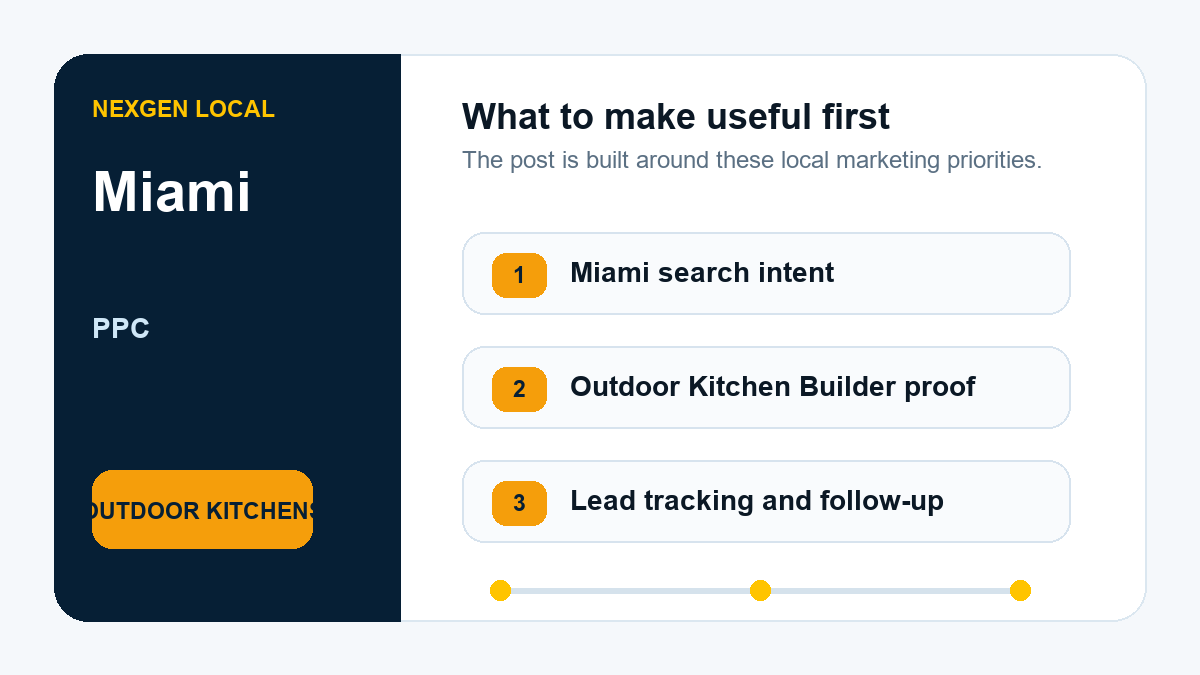
Miami searches can change by neighborhood: Brickell buyers behave differently from Doral business owners, Miami Beach condo managers, and Coral Gables homeowners.
Seasonality can include winter visitor demand, rainy-season service issues, luxury-property maintenance, and bilingual search paths. That matters because local search is not just a list of keywords. The same phrase can mean a quick emergency call, a research-stage project, a bid request, or a high-trust consultation depending on the neighborhood, service line, and buyer type.
For outdoor kitchen builders, a useful page should make the local fit obvious. It should mention the service area in plain language, explain who the offer is for, show proof that matches the work, and give the visitor one clear next step. When a page only swaps in a city name, it may technically target the keyword, but it usually fails to answer the buyer’s real question.
What Miami outdoor kitchen builders need to prove
Buyers are visual and project-specific, so generic remodeling content rarely carries the sale. In Miami, that pain point becomes more specific because the market includes Brickell, Coral Gables, Miami Beach, Doral, and high-rise condo corridors. The page should reduce doubt before the visitor calls, clicks, or fills out a form.
Outdoor kitchen buyers are visual, high-intent, and project-specific, so the page has to help them picture scope and next steps.
A custom grill island inquiry should capture budget range, timeline, neighborhood, covered patio needs, and whether design help is required.
Useful proof for this audience can include Project galleries, material pages, design process, neighborhood examples, consultation CTAs, and photo-led service pages.. These details are not decoration. They help real visitors decide whether the company understands their job, and they help search engines connect the page to the right entity, service, and local context.
The PPC plan for this keyword
PPC only works when search intent, landing page proof, and lead tracking are managed as one system.
For PPC for outdoor kitchen builders in Miami FL, the strategy should start with one primary intent and one conversion path. The campaign can still support secondary questions, but the main page should not drift into every possible marketing topic. A focused article is easier to optimize, easier to measure, and easier to improve after Search Console data starts showing real queries.
Use language that reflects custom grills, covered patios, or outdoor living upgrades when those are the jobs the business actually wants.
Reference Brickell, Coral Gables, Miami Beach, Doral, and high-rise condo corridors, service-area fit, project types, photos, reviews, or process details that help a Miami buyer trust the next step.
Separate calls, forms, booked appointments, disqualified leads, and follow-up notes so the page is judged by qualified opportunities instead of traffic alone.
What to build first
The first version should be practical enough that a business owner can see the work. For outdoor kitchen builders, the strongest page usually combines local explanation, industry proof, a clear call-to-action, and a measurement plan. That gives the content a reason to exist beyond keyword coverage.
| Build area | What to add | How to measure it |
|---|---|---|
| Campaign structure | Separate emergency, research, branded, and high-value service searches so budget is not diluted by mixed intent. | Track cost per qualified lead, call quality, booked appointments, search term quality, and landing page conversion rate for Miami outdoor kitchen builders. |
| Landing page fit | Match ad copy to the service, city, proof, and call-to-action visitors expect after clicking. | Track cost per qualified lead, call quality, booked appointments, search term quality, and landing page conversion rate for Miami outdoor kitchen builders. |
| Cost control | Review search terms, call quality, form quality, and booked outcomes before increasing spend. | Track cost per qualified lead, call quality, booked appointments, search term quality, and landing page conversion rate for Miami outdoor kitchen builders. |
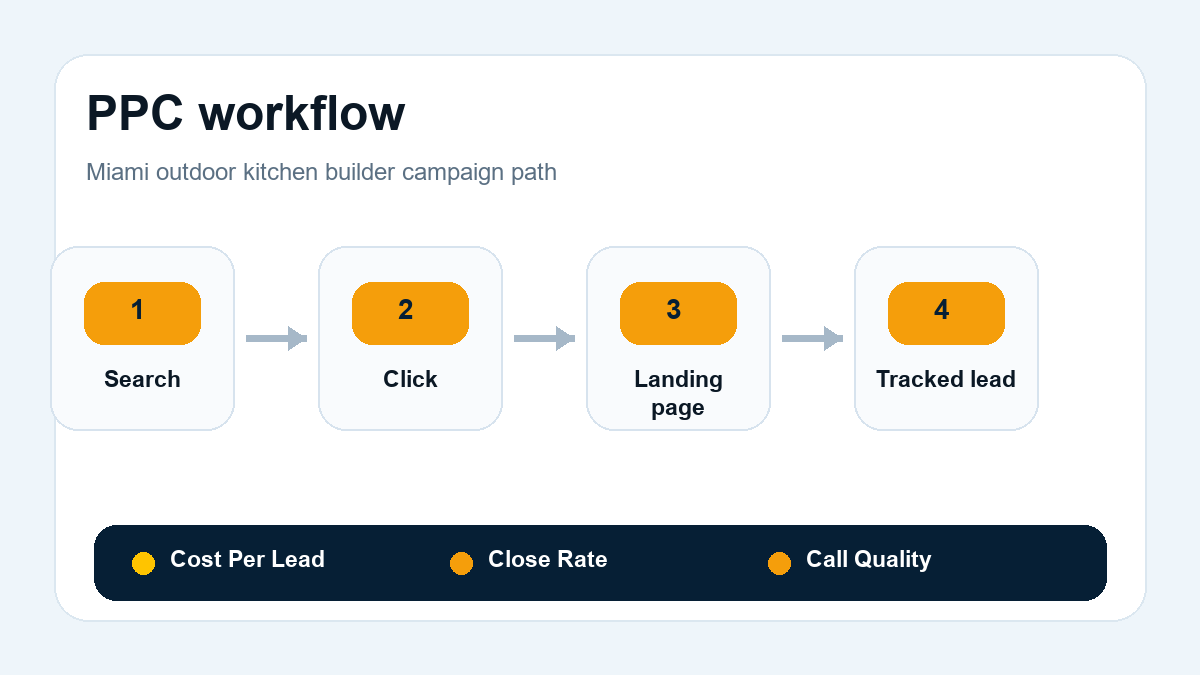
A small but complete build is better than a large campaign with no feedback loop. Start with one page or offer, connect it to the parent PPC service, support it with proof for the Outdoor Kitchen Builders audience, and point local readers toward the Miami service area. Then use call and form data to decide what deserves expansion.
Local examples to make the content stronger
A stronger Miami page can include a short section for neighborhoods or service zones, a short explanation of seasonal demand, and a practical note about how buyers compare providers. For this post, the local examples should connect South Florida context with outdoor kitchen builders buying behavior.
For example, a outdoor kitchen builder serving Miami might need one message for urgent searchers, another for research-stage buyers, and another for high-value projects. The content should not pretend all leads are equal. It should explain how the business qualifies opportunities, what proof matters most, and what happens after the visitor takes action.
That is also where PPC becomes more than a marketing label. The service should help the business decide what to publish, what to promote, what to track, and what to stop doing. If a keyword gets impressions but no qualified action, the answer may be stronger proof, a clearer offer, better routing, or a more specific page.
Internal links and topical authority
This page should not sit alone. It supports the parent PPC page, reinforces the Outdoor Kitchen Builders industry section, and connects back to the Miami service area. Those internal links help the article pass relevance back to the pages that matter most for Nexgen’s core SEO.
Internal links should be useful to the reader, not forced into every sentence. The best pattern is simple: link up to the parent service, link sideways to related Florida posts, and link forward to a clear conversion action such as a strategy review or contact page.
Frequently asked questions
How can PPC help outdoor kitchen builders in Miami?
PPC helps a outdoor kitchen builder in Miami connect local intent to a clearer conversion path. The goal is to show the right proof, route the right inquiries, and measure lead quality instead of only counting traffic.
What should a Miami outdoor kitchen builder build first?
Start with one priority service, one primary page or offer, call and form tracking, and proof that matches Brickell, Coral Gables, Miami Beach, Doral, and high-rise condo corridors. After the first data comes in, expand into related services, nearby neighborhoods, or supporting blog content.
How long should outdoor kitchen builders track this before scaling?
A useful test should run long enough to collect impressions, clicks, calls, forms, booked appointments, and disqualified lead notes. The decision to expand should come from lead quality and conversion data, not from traffic volume alone.
What makes this different from a generic Florida marketing page?
This page connects PPC, outdoor kitchen builders, and Miami search behavior in one place. It uses local context, industry proof, internal links, and a tracking plan so the page can support both users and core service SEO.
Author and review note
About this guide: This article is published under Suzy White’s Nexgen Local Marketing author profile and reviewed against Nexgen’s local search, paid media, conversion tracking, and content-quality checklist. It avoids unsupported ranking, lead, or revenue promises and focuses on practical steps a Florida business can verify.
Tracking, pruning, and improvement plan
After publishing, the page should be monitored in Google Search Console and Bing Webmaster Tools. The most useful early signals are impressions for the target topic, queries that include Miami, clicks from qualified searches, engagement with the call-to-action, and whether leads mention the service or location the page was built around.
Every quarter, the page should be reviewed. If it earns impressions but no clicks, the title and meta description may need work. If it earns clicks but no qualified actions, the offer, proof, form, or call path may need improvement. If it earns no meaningful impressions after enough time, it should be improved, merged into a stronger article, redirected, or noindexed instead of staying live as weak content.
Need a stronger Florida growth page for outdoor kitchen builders?
Nexgen can review your Miami market, service mix, page structure, proof assets, and tracking setup before you scale content or ads.
Call 407-307-1995, email info@nexgenlocalmarketing.com, or request a Florida strategy review.
A Florida-Focused PPC Playbook for Orlando Maritime Businesses
Pay Per Click Marketing
PPC for maritime businesses in Orlando FL is a narrow search, which is exactly why the page has to be useful. A maritime business in Orlando is not looking for a broad marketing definition. They need to understand what to build, what to measure, and how the strategy should fit the local market.
Quick answer
PPC for maritime businesses in Orlando FL should be built as a focused local asset, not a generic marketing article. The page needs city context, industry proof, a conversion path, and tracking that shows whether the traffic becomes qualified conversations.
In this expanded guide
Primary keyword
PPC for maritime businesses in Orlando FL
Best-fit intent
A local business owner or manager comparing whether PPC can create better leads, better follow-up, or better search visibility for maritime businesses in Orlando.
Why the Orlando market changes the strategy
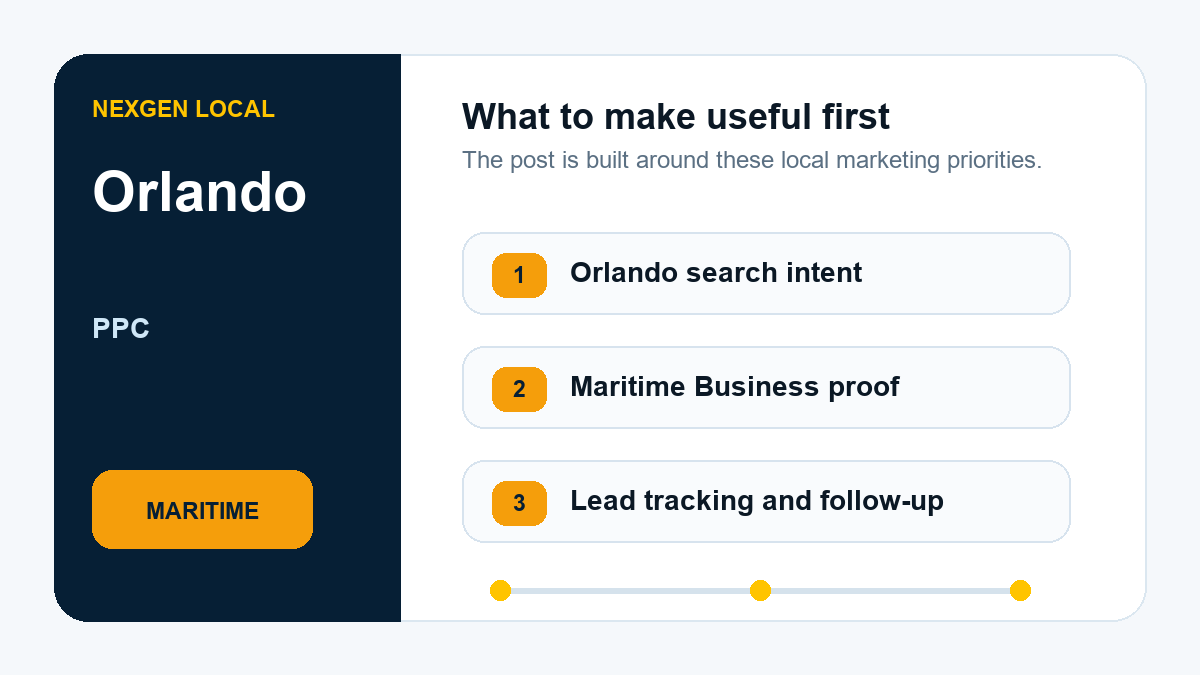
Orlando demand often splits between tourism corridors, Lake Nona growth, Winter Park searches, and contractors serving suburbs across Central Florida.
Seasonality often comes from travel cycles, summer storms, convention traffic, and families moving across Central Florida suburbs. That matters because local search is not just a list of keywords. The same phrase can mean a quick emergency call, a research-stage project, a bid request, or a high-trust consultation depending on the neighborhood, service line, and buyer type.
For maritime businesses, a useful page should make the local fit obvious. It should mention the service area in plain language, explain who the offer is for, show proof that matches the work, and give the visitor one clear next step. When a page only swaps in a city name, it may technically target the keyword, but it usually fails to answer the buyer’s real question.
What Orlando maritime businesses need to prove
High-value customers search narrowly and expect proof that a provider understands waterfront work. In Orlando, that pain point becomes more specific because the market includes theme-park corridors, Lake Nona, Winter Park, and surrounding suburbs. The page should reduce doubt before the visitor calls, clicks, or fills out a form.
Maritime buyers search narrowly by service, vessel type, marina area, and proof of waterfront experience.
A yacht maintenance or boat detailing lead should see marina-area coverage, vessel-specific service details, and a quote path that captures boat size and location.
Useful proof for this audience can include Service photos, vessel-specific pages, marina coverage, request-a-quote forms, maintenance packages, and review themes from boat owners.. These details are not decoration. They help real visitors decide whether the company understands their job, and they help search engines connect the page to the right entity, service, and local context.
The PPC plan for this keyword
PPC only works when search intent, landing page proof, and lead tracking are managed as one system.
For PPC for maritime businesses in Orlando FL, the strategy should start with one primary intent and one conversion path. The campaign can still support secondary questions, but the main page should not drift into every possible marketing topic. A focused article is easier to optimize, easier to measure, and easier to improve after Search Console data starts showing real queries.
Use language that reflects boat detailing, marina services, or yacht maintenance when those are the jobs the business actually wants.
Reference theme-park corridors, Lake Nona, Winter Park, and surrounding suburbs, service-area fit, project types, photos, reviews, or process details that help a Orlando buyer trust the next step.
Separate calls, forms, booked appointments, disqualified leads, and follow-up notes so the page is judged by qualified opportunities instead of traffic alone.
What to build first
The first version should be practical enough that a business owner can see the work. For maritime businesses, the strongest page usually combines local explanation, industry proof, a clear call-to-action, and a measurement plan. That gives the content a reason to exist beyond keyword coverage.
| Build area | What to add | How to measure it |
|---|---|---|
| Campaign structure | Separate emergency, research, branded, and high-value service searches so budget is not diluted by mixed intent. | Track cost per qualified lead, call quality, booked appointments, search term quality, and landing page conversion rate for Orlando maritime businesses. |
| Landing page fit | Match ad copy to the service, city, proof, and call-to-action visitors expect after clicking. | Track cost per qualified lead, call quality, booked appointments, search term quality, and landing page conversion rate for Orlando maritime businesses. |
| Cost control | Review search terms, call quality, form quality, and booked outcomes before increasing spend. | Track cost per qualified lead, call quality, booked appointments, search term quality, and landing page conversion rate for Orlando maritime businesses. |
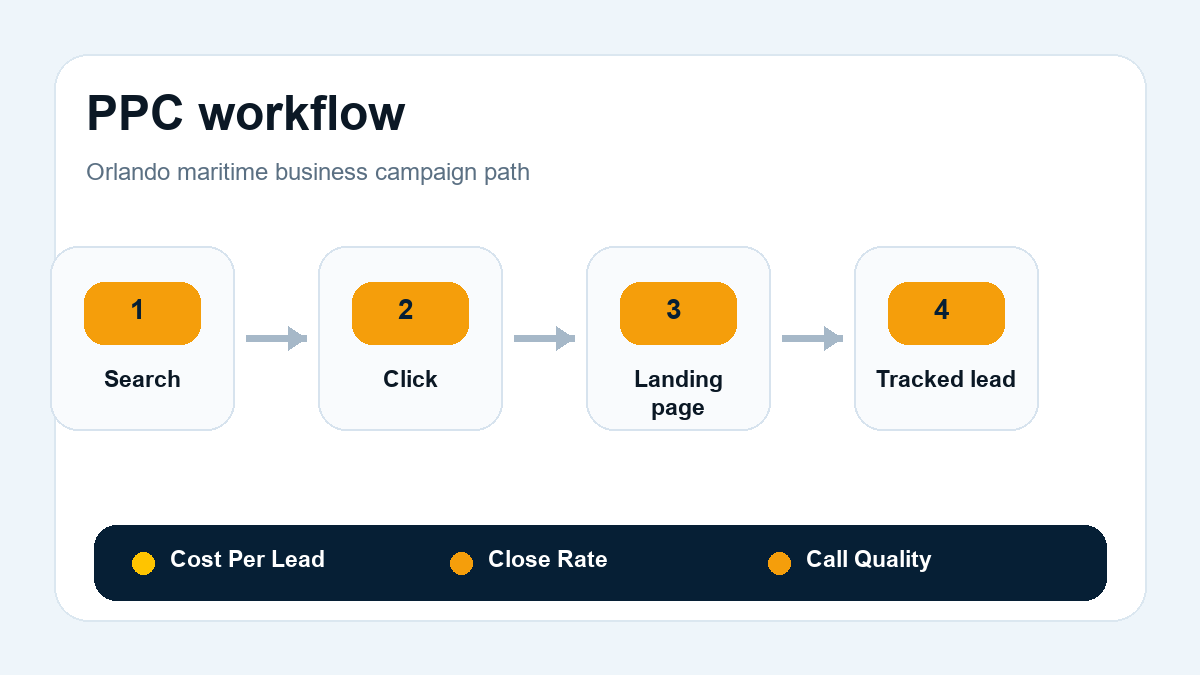
A small but complete build is better than a large campaign with no feedback loop. Start with one page or offer, connect it to the parent PPC service, support it with proof for the Maritime Businesses audience, and point local readers toward the Orlando service area. Then use call and form data to decide what deserves expansion.
Local examples to make the content stronger
A stronger Orlando page can include a short section for neighborhoods or service zones, a short explanation of seasonal demand, and a practical note about how buyers compare providers. For this post, the local examples should connect Central Florida context with maritime businesses buying behavior.
For example, a maritime business serving Orlando might need one message for urgent searchers, another for research-stage buyers, and another for high-value projects. The content should not pretend all leads are equal. It should explain how the business qualifies opportunities, what proof matters most, and what happens after the visitor takes action.
That is also where PPC becomes more than a marketing label. The service should help the business decide what to publish, what to promote, what to track, and what to stop doing. If a keyword gets impressions but no qualified action, the answer may be stronger proof, a clearer offer, better routing, or a more specific page.
Internal links and topical authority
This page should not sit alone. It supports the parent PPC page, reinforces the Maritime Businesses industry section, and connects back to the Orlando service area. Those internal links help the article pass relevance back to the pages that matter most for Nexgen’s core SEO.
Internal links should be useful to the reader, not forced into every sentence. The best pattern is simple: link up to the parent service, link sideways to related Florida posts, and link forward to a clear conversion action such as a strategy review or contact page.
Frequently asked questions
How can PPC help maritime businesses in Orlando?
PPC helps a maritime business in Orlando connect local intent to a clearer conversion path. The goal is to show the right proof, route the right inquiries, and measure lead quality instead of only counting traffic.
What should a Orlando maritime business build first?
Start with one priority service, one primary page or offer, call and form tracking, and proof that matches theme-park corridors, Lake Nona, Winter Park, and surrounding suburbs. After the first data comes in, expand into related services, nearby neighborhoods, or supporting blog content.
How long should maritime businesses track this before scaling?
A useful test should run long enough to collect impressions, clicks, calls, forms, booked appointments, and disqualified lead notes. The decision to expand should come from lead quality and conversion data, not from traffic volume alone.
What makes this different from a generic Florida marketing page?
This page connects PPC, maritime businesses, and Orlando search behavior in one place. It uses local context, industry proof, internal links, and a tracking plan so the page can support both users and core service SEO.
Author and review note
About this guide: This article is published under Suzy White’s Nexgen Local Marketing author profile and reviewed against Nexgen’s local search, paid media, conversion tracking, and content-quality checklist. It avoids unsupported ranking, lead, or revenue promises and focuses on practical steps a Florida business can verify.
Tracking, pruning, and improvement plan
After publishing, the page should be monitored in Google Search Console and Bing Webmaster Tools. The most useful early signals are impressions for the target topic, queries that include Orlando, clicks from qualified searches, engagement with the call-to-action, and whether leads mention the service or location the page was built around.
Every quarter, the page should be reviewed. If it earns impressions but no clicks, the title and meta description may need work. If it earns clicks but no qualified actions, the offer, proof, form, or call path may need improvement. If it earns no meaningful impressions after enough time, it should be improved, merged into a stronger article, redirected, or noindexed instead of staying live as weak content.
Need a stronger Florida growth page for maritime businesses?
Nexgen can review your Orlando market, service mix, page structure, proof assets, and tracking setup before you scale content or ads.
Call 407-307-1995, email info@nexgenlocalmarketing.com, or request a Florida strategy review.
PPC for Personal Injury and Legal Practices: When the Math Works in 2026
Pay Per Click Marketing
You’ve seen the numbers and heard the stories: truck accident keywords costing hundreds of dollars for a single click. Is it possible to generate a positive return on investment with numbers like that? This post breaks down the precise math and strategic requirements needed to make PPC for personal injury law firms not just viable, but incredibly profitable in 2026.
Quick answer
Personal injury PPC can work in 2026, but only when the case value, intake speed, close rate, and tracking system support the cost per click.
Case value first
This is one of the core pieces that makes legal PPC work as a practical business strategy.
Tight geography
This is one of the core pieces that makes legal PPC work as a practical business strategy.
The PI Legal PPC Reality in 2026
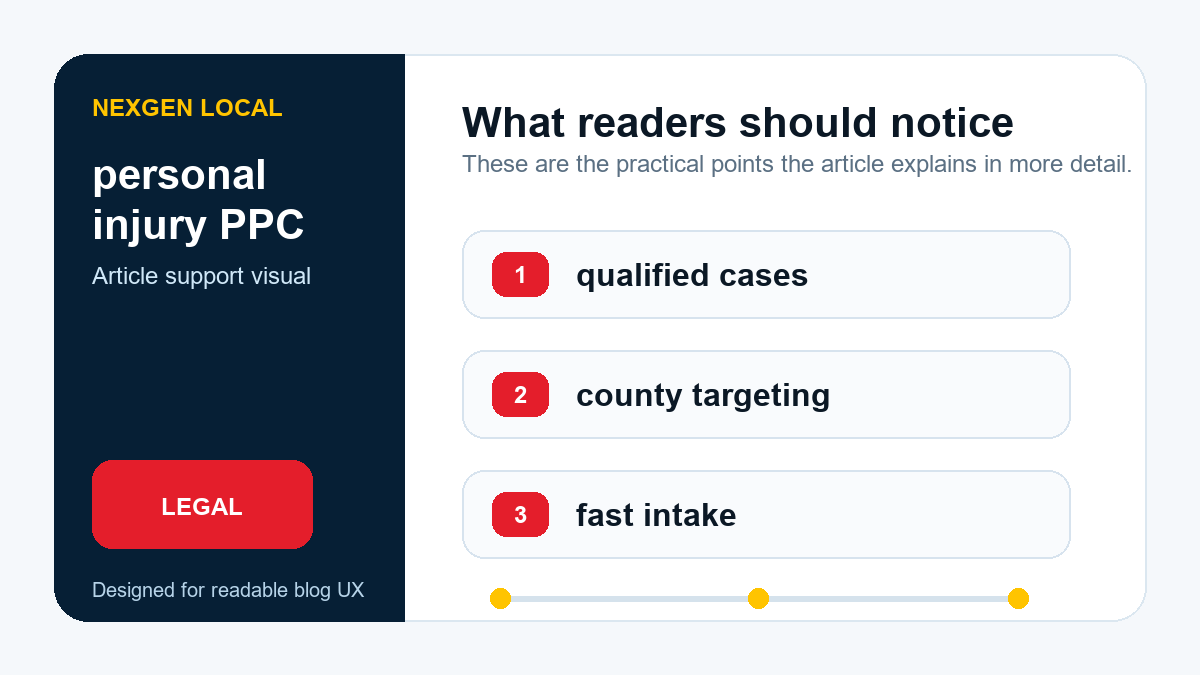
Let’s be direct: pay-per-click advertising in the legal sector, especially for personal injury, operates on a different plane. It hosts the most expensive keywords on the internet. It’s not uncommon to see top-of-page bids for “18-wheeler accident lawyer” or “offshore injury attorney” soar past $200, $300, or even $400. For firms outside this niche, such costs would be unthinkable. But for a PI practice, this is simply the cost of admission for the most direct, high-intent lead generation channel available.
Why does this seemingly insane math work? The value of a single case. A catastrophic truck accident case can settle for seven figures, and even more common auto accident cases can carry values of $50,000 to $250,000 or more. When a single signed client can represent tens or hundreds of thousands of dollars in firm revenue, investing a few thousand dollars on clicks to acquire that case becomes a sound business decision. The key isn’t just spending the money; it’s having a bulletproof system to convert that expensive click into a signed client. This is where most firms fail and where a sophisticated PPC management strategy becomes critical.
Practice-Area Economics: What Is a Case Worth?
Not all legal keywords are created equal, because not all case types are worth the same. Understanding the potential value of a case is the first step in setting a realistic PPC budget and bid strategy. While every case is unique, here are some illustrative value ranges for common practice areas that pursue PPC.
- Truck Accidents: Often the highest value, ranging from $100,000 into the multi-millions, justifying the highest CPCs.
- Medical Malpractice: Highly complex with significant potential damages, cases can be worth $250,000 to over $1,000,000.
- Auto Accidents: The most common PI case type. Value ranges widely from $15,000 for minor injuries to over $200,000 for more serious ones.
- Slip-and-Fall (Premises Liability): These can range from $10,000 to $75,000+, highly dependent on the severity of the injury and the liability of the property owner.
- Workers’ Compensation: Case values are often defined by state statutes but can represent a steady source of firm revenue, typically in the $20,000 to $60,000 range.
- Family Law / Divorce: While not PI, this is another high-CPC area. The value is tied to marital assets, often making the client value significant, but the ROI calculation is different.
- Estate Planning: Lower “case value” in the traditional sense, but high lifetime client value. PPC here is more about volume and efficiency than high-margin single cases.
Your firm’s target practice areas directly inform your approach to PPC for personal injury law firms. You can’t bid for a truck accident keyword with a slip-and-fall budget.
Geographic Targeting Strategy: Radius, Metro, and County
Where you show your ads is as important as what they say. For legal PPC, geographic strategy is paramount and falls into a few key models:
- Tight Radius Targeting: Best for urban firms or those targeting a specific neighborhood. A 5-10 mile radius around your office can capture “near me” searches and clients who prioritize proximity. This is cost-effective but limits volume.
- Metro-Wide Targeting: Targeting an entire Designated Market Area (DMA), like the Orlando or Miami-Fort Lauderdale metro areas. This maximizes reach and volume but requires a larger budget and careful negative keyword management to filter out irrelevant searches from surrounding towns.
- County-Level Targeting: This is a critical strategy for legal practices. Since many cases are filed and tried at the county level, targeting by county ensures your ads are seen by potential clients within the correct jurisdiction. This is especially vital for family law and other practices tied to local courts.
The right strategy often involves a combination of these. For example, a PI firm might target their home county aggressively, the surrounding counties with a smaller budget, and use a tight radius for hyper-local terms like “personal injury lawyer near me.”
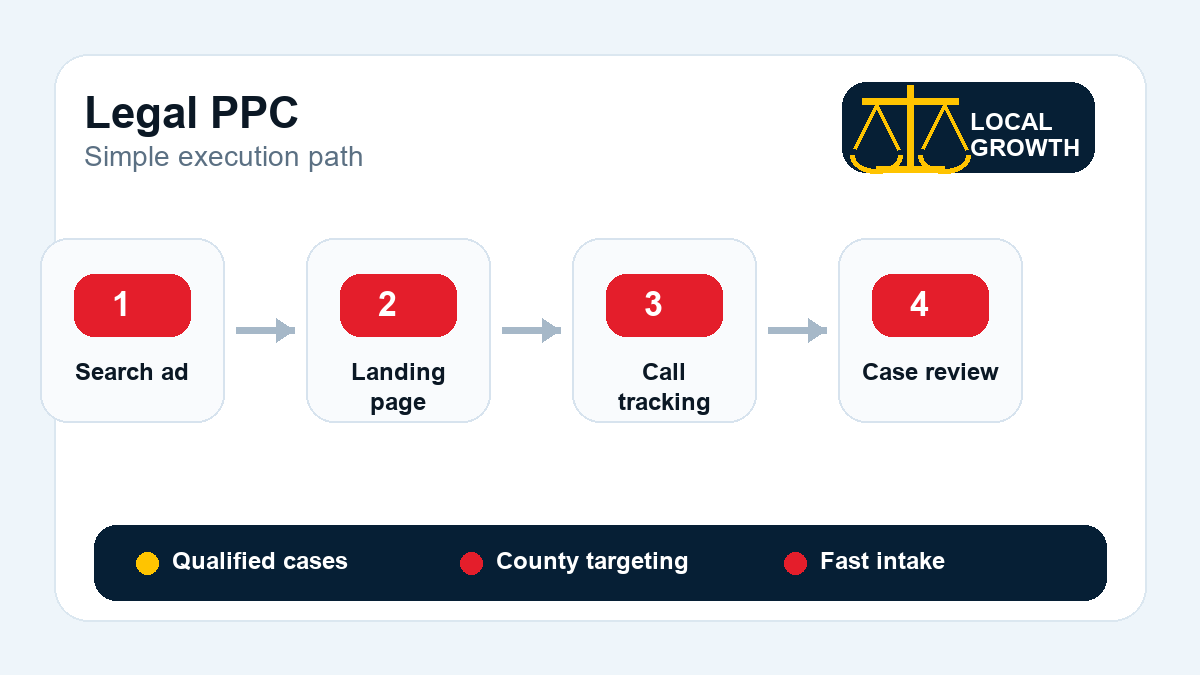
Case-Intake Math: Why a $400 CPC Can Be Profitable
The sticker shock of a high CPC is misleading. The metric that matters is Cost Per Signed Case. Let’s walk through a realistic, albeit simplified, example for a competitive PI keyword.
- Cost-Per-Click (CPC): $400
- Clicks to get one qualified phone call (Conversion Rate): Let’s assume a 10% conversion rate from click-to-call, which is strong for this space. This means you need 10 clicks to get one phone call.
- Cost-Per-Call: 10 clicks x $400/click = $4,000
- Qualified Calls to get one signed case (Intake Qualification Rate): Your intake team is skilled and qualifies 1 in every 4 calls as a potential case worth pursuing.
- Cost-Per-Qualified-Lead: 4 calls x $4,000/call = $16,000
- Qualified Leads to Signed Case (Closing Rate): Your attorneys sign 1 of every 2 qualified leads they meet with.
- Final Cost-Per-Signed-Case: 2 qualified leads x $16,000/lead = $32,000
If that signed case has a conservative value of $150,000, with a standard 33% contingency fee, the firm’s revenue is $50,000. Spending $32,000 to generate $50,000 in revenue is a profitable model. This illustrates why optimizing the conversion rate and the intake process is just as important as managing the CPC. Improving the landing page conversion rate to 12% or the intake team’s qualification rate can dramatically improve the ROI.
Bar Association Advertising Rules and Ethics
Legal advertising is regulated. Running afoul of your state’s Bar Association rules can lead to serious consequences. While rules vary, some common principles apply to PPC:
- You Cannot Guarantee Results: Ad copy like “We guarantee a win” is a major violation. Language must be carefully chosen to avoid making promises.
- Avoid Misleading Claims: Phrases like “the best PI lawyer” are often prohibited unless they are verifiably true through a specific, recognized distinction.
- Dramatizations and Actors: If you use actors or create a dramatization, you must disclose it.
– Disclaimers are Often Required: Many states require ad copy or landing pages to include “This is an advertisement” or similar language.
An agency experienced in lawyer marketing will be well-versed in these nuances, including checking the specific rules for your state (e.g., The Florida Bar vs. The State Bar of California). Ignorance is not a defense, and a compliant campaign is a prerequisite for long-term success.
Landing Pages That Actually Convert Legal Traffic
Sending a $400 click to your homepage is like setting money on fire. You need a dedicated landing page designed for one purpose: conversion. Key elements include:
- Above-the-Fold Trust Signals: The moment the page loads, the user should see reasons to trust you. This includes awards (Super Lawyers, Martindale-Hubbell), “Years of Experience,” “Millions Recovered for Clients,” and professional attorney photos.
- Clear, Empathetic Messaging: The headline should match the ad copy and speak directly to the visitor’s pain point (e.g., “Injured in a Truck Accident? Get the Compensation You Deserve.”).
- Obvious Calls-to-Action (CTAs): Use a combination of a clickable phone number and a simple contact form. For legal, the phone call is often the most valuable lead. Make the number prominent.
- “Free Consultation” Language: This is the standard offer in the legal space. It removes the barrier to entry and financial risk for the potential client.
- Mobile-First Design: The vast majority of these searches happen on a mobile device, often moments after an incident. The page must be flawless on a smartphone, with a large, tap-to-call button.
Check out our case studies to see how we’ve structured campaigns for similar high-value industries.
Call Tracking + Intake-Team Integration
A sophisticated PPC campaign generates calls; a great business process converts them. This requires technology and training. Dynamic Number Insertion (DNI) is a technology that shows a unique tracking phone number on your website based on the advertising source. This allows you to know with 100% certainty which calls came from your Google Ads campaign.
Furthermore, all calls should be recorded for quality assurance. This isn’t about spying; it’s about training. Your intake team or receptionist must be trained to handle the specific nature of a paid lead. These individuals are often in distress, have high expectations, and need to be handled with empathy and efficiency. Is your team asking the right qualifying questions? Are they scheduling the consultation effectively? Reviewing call recordings provides the data needed to optimize this critical part of the funnel.
When NOT to Do Legal PPC
As a responsible agency, we have to be honest: PPC is not for every law firm. It can be a fast way to lose a lot of money if the right conditions aren’t met. You should reconsider investing heavily in Google Ads if:
- You are a true solo practitioner with no intake support. If you are in court all day and can’t answer the phone, you will be wasting money on calls that go to voicemail.
- Your practice areas have low case values. If your average case value doesn’t support a multi-thousand-dollar acquisition cost, the math will never work. This is why PPC for traffic tickets, for example, is a different game entirely.
- You operate in a small, low-competition market. In some rural areas, a strong Google Business Profile and local SEO strategy can generate more than enough leads at a fraction of the cost of PPC.
- You have an unrealistic budget. While budget depends on many factors, a $1,000/month budget for PI keywords in a major metro is simply not enough to gather data, let alone compete. You can learn more about typical costs in our post on what PPC should cost a local business.
Local Services Ads (LSAs) for Attorneys
A major development has been Google’s expansion of Local Services Ads (LSAs) into the legal vertical. These are the “Google Screened” listings that appear at the very top of the search results. Unlike PPC, you pay per lead (a phone call), not per click. For some practice areas like family law or estate planning, LSAs can be a fantastic, cost-effective starting point. For hyper-competitive PI, they are a great supplement to traditional ads, but may not provide the volume a large firm requires. The “Google Screened” badge requires a background check process, adding a layer of trust. The bottom line: it’s a powerful tool that should be part of the overall paid search strategy, but it doesn’t typically replace a well-run traditional Google Ads campaign for firms seeking high volume.
Frequently Asked Questions
What is the minimum monthly budget for legal PPC?
For competitive personal injury in a medium to large city, a test budget should start no lower than $5,000 – $7,500 per month in ad spend. Anything less and you risk not getting enough data to make intelligent decisions. Tier-2 markets or less competitive practice areas might start closer to $3,000, but for PI, you must be prepared to invest.
Can a solo practitioner afford this?
Yes, but only if they have the infrastructure. A solo attorney with a dedicated, trained paralegal or intake specialist to handle calls can absolutely succeed with PPC. A solo attorney who tries to do it all themselves is unlikely to see a positive ROI, as missed calls are a primary source of wasted ad spend.
What about Avvo/FindLaw vs. Google PPC?
Legal directories like Avvo, FindLaw, and Justia are lead aggregators. You pay them a flat fee, and they generate leads from their own SEO and marketing efforts. It can be a good, predictable source of leads. The difference with Google PPC is control. With your own campaign, you control the landing page, the ad copy, the targeting, and you own the data. Directory leads are often less exclusive. A balanced strategy for a large firm often includes both.
How long does it take to get the first signed case from PPC?
This varies greatly, but it’s possible to get calls on day one. A realistic timeline would be to generate your first qualified leads within the first 30 days and aim for your first signed case within 60-90 days. It takes time to gather data, optimize bids, and for a potential client to go through the consultation and signing process.
What if my CPC is higher than my case value?
This should never happen if the campaign is structured correctly. Your CPC is only one part of the equation. If your CPC for a specific keyword is genuinely higher than the total potential value of that case type, you should not be bidding on that keyword. This scenario points to a mismatch between your target practice area and your keyword selection, and the campaign needs an immediate strategic review.
Making the math work for PPC for personal injury law firms requires more than just a large budget; it requires a deep understanding of legal economics, technology, and process. When done correctly, it’s one of the most powerful and scalable client acquisition channels available. If you’re ready to see if a data-driven PPC strategy is right for your firm, contact our team for a no-obligation consultation at 407-307-1995.
Action checklist
Need a PPC model before spending on legal keywords?
We can map the budget, intake path, and conversion math before you commit to an expensive campaign.
PPC Management Cost: What Local Businesses Should Pay in 2026
Pay Per Click Marketing
PPC can bring in new leads quickly, but the price only makes sense when you understand both parts of the cost: the ad budget paid to the platform and the management fee paid to the agency. This guide shows what local businesses should expect in 2026, where the money goes, and how to judge whether the numbers can produce a profitable return.
Quick answer: what should a local business budget?
Most local businesses should expect a starting monthly ad spend of $1,500 to $5,000, plus a management fee of roughly $750 to $2,000. Competitive industries such as legal, med spas, HVAC, roofing, and emergency home services often need more budget because the clicks are more expensive and the leads are worth more.
The cheapest agency is not always the safest option. The better question is whether the campaign has clean tracking, strong landing pages, a negative keyword process, and a realistic cost-per-lead model.
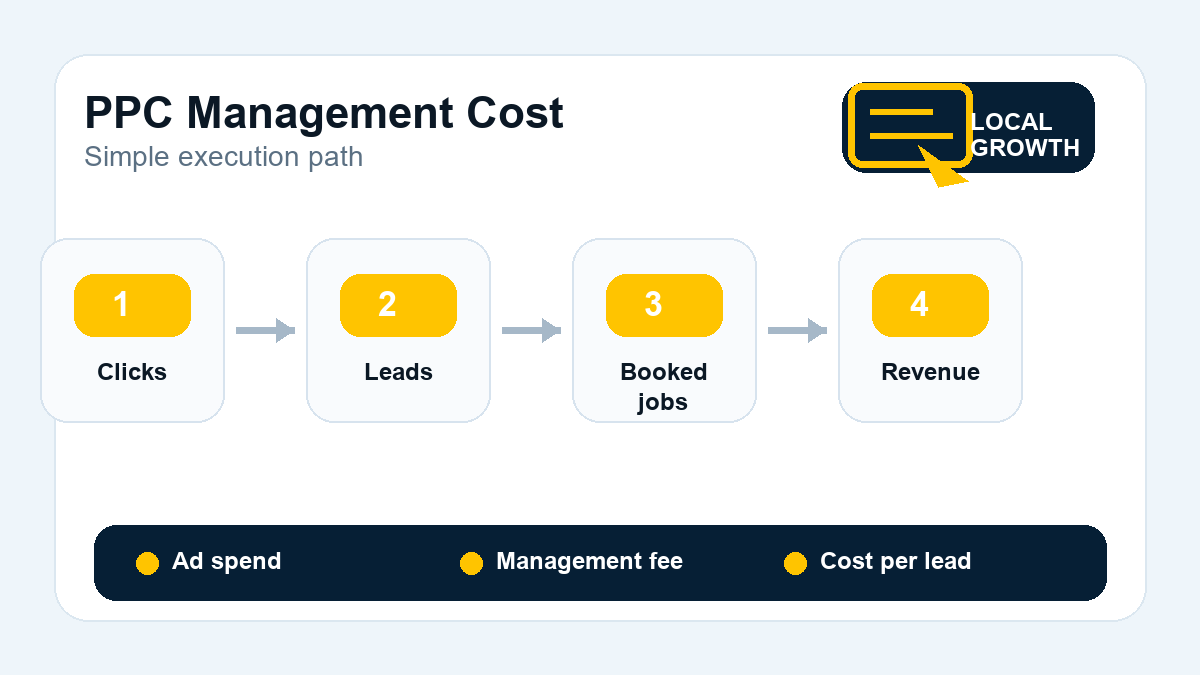
Two costs you are paying: management fee + ad spend
This is the most important PPC pricing concept. When you run campaigns, you are paying two separate costs that do two different jobs.
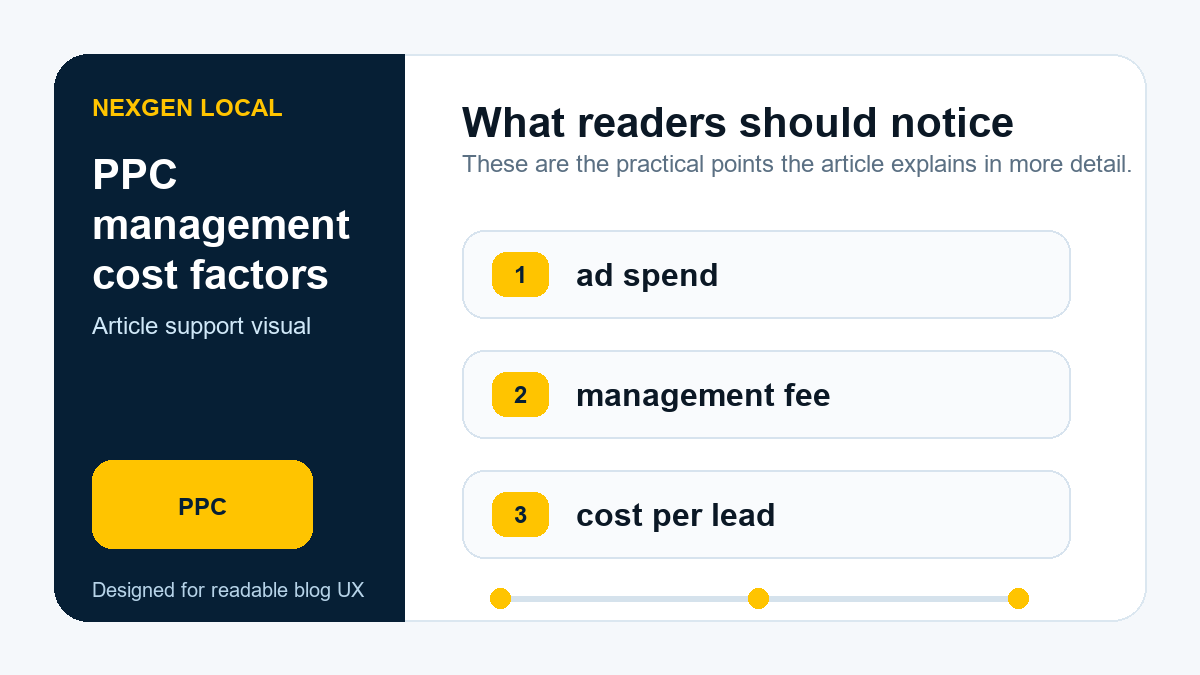
Ad spend
This is paid directly to platforms like Google Ads or Microsoft Ads. Every click spends part of this budget. You set the limit, and the money goes toward placement.
Management fee
This is paid to the agency for the work required to turn paid traffic into leads: campaign structure, keywords, ad copy, landing pages, tracking, and optimization.
A good agency should clearly separate those costs. If a proposal blends everything into one vague number, you cannot tell how much is going to media and how much is going to management.
PPC management fee structures
Agencies typically use one of four pricing models. None is automatically good or bad. The right model depends on your monthly spend, how mature your tracking is, and how much campaign complexity you need.
| Model | Typical Use | Watch For |
|---|---|---|
| Flat monthly fee | Predictable local campaigns with stable monthly budgets. | Make sure the scope includes reporting, landing page feedback, and ongoing optimization. |
| Percentage of ad spend | Larger accounts where more spend usually means more complexity. | The agency should explain how they avoid pushing spend just to increase fees. |
| Pay per lead | High-margin industries with clear lead definitions and strong tracking. | Requires agreement on what counts as a qualified lead. |
| Hybrid or tiered | Partnerships that need a base fee plus performance incentive. | Keep bonus rules simple and tied to business outcomes. |
Typical PPC management fee ranges in 2026
Every agency prices differently, but these ranges are realistic for local businesses that need professional setup, active management, and transparent reporting.
| Business Type | Monthly Ad Spend | Typical Management Fee |
|---|---|---|
| Small local business | $1,500 to $5,000 | $750 to $2,000 per month |
| Mid-market or multi-service business | $5,000 to $25,000 | $2,000 to $5,000 per month or a percentage of spend |
| Multi-location or enterprise | $25,000+ | Often 10% to 15% of ad spend or a higher flat fee |
Typical ad spend ranges by industry
Your ad budget is driven by competition, search intent, and lead value. A roofer, personal injury lawyer, med spa, and accountant can all use PPC, but their click prices and close rates will look very different.
| Industry | Common Monthly Ad Spend | Why It Varies |
|---|---|---|
| Home services | $3,000 to $10,000 | High-intent searches, emergency jobs, seasonal swings, and strong local competition. |
| Healthcare and med spas | $4,000 to $15,000 | Higher lead values, compliance concerns, and competitive appointment-based searches. |
| Legal | $5,000 to $50,000+ | Some practice areas have extremely expensive clicks. Smaller firms may need narrow long-tail campaigns. |
| Retail and ecommerce | $2,500 to $20,000+ | Budgets scale when return on ad spend is proven. |
| Professional services | $3,500 to $12,000 | Lower lead volume, but each qualified lead can be highly valuable. |
Local budget reality
A small budget can work if the market is narrow and the offer is specific. It usually fails when a business tries to target every service, every city, and every keyword with too little spend.
Where does the management fee actually go?
A professional PPC management service is not set-it-and-forget-it. The monthly fee should pay for the work that protects your ad spend from waste and improves lead quality over time.
The ROI math: from click to booked job
PPC should be judged by business math, not cheap clicks alone. A $500 cost per lead can be too expensive for one business and completely acceptable for another if the job value and close rate support it.
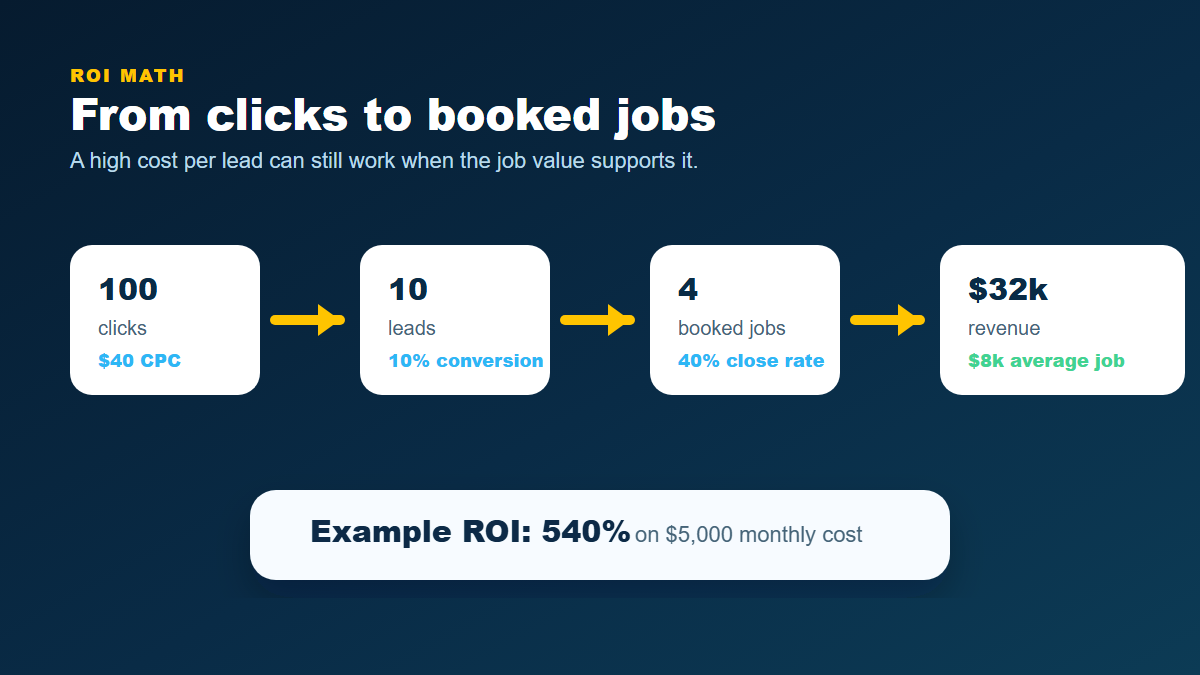
In this example, $5,000 in total monthly PPC cost produces 100 clicks, 10 leads, 4 booked roofing jobs, and $32,000 in revenue. The lesson is not that every campaign will hit that number. The lesson is that PPC management should connect spend to qualified leads, booked work, and revenue.
Need help checking whether PPC math works for your market?
Nexgen can review your offer, target area, budget, conversion path, and tracking setup before you spend heavily on ads.
Red flags when hiring a PPC agency
Use these warning signs to protect your ad budget before you sign a contract.
Local Services Ads vs. traditional Google Ads in 2026
For many local businesses, PPC now includes both Local Services Ads and traditional Search Ads. A strong Search Engine Marketing strategy may use both, but they play different roles.
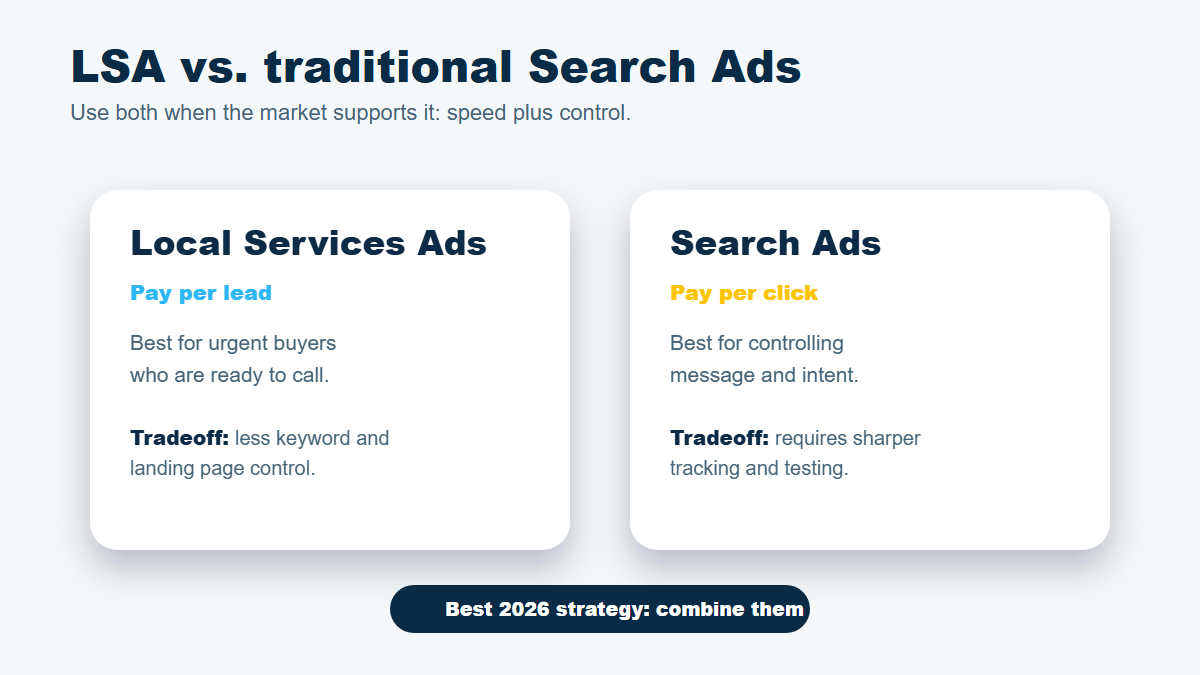
Local Services Ads
Best for eligible local services where the buyer is ready to call now. You pay per lead, but you have less control over keywords and landing page experience.
Traditional Search Ads
Best when you need precise keyword targeting, custom landing pages, stronger messaging, and more control over the conversion path.
Frequently asked questions
What is the minimum monthly budget that makes sense for PPC?
For most local businesses, a minimum ad spend of around $1,500 per month is needed to collect enough data for optimization. In competitive industries, that number can be too low.
How long does it take to see results from PPC?
You can see traffic quickly, but most campaigns need 60 to 90 days to collect data, tune targeting, improve ad copy, and stabilize cost per lead.
What happens if I pause my PPC campaigns?
Your paid lead flow stops. A long pause can also reduce learning momentum, so campaigns often need time to stabilize again when restarted.
Can I run PPC and SEO at the same time?
Yes. PPC can create immediate visibility while SEO builds long-term authority. PPC keyword and conversion data can also help shape your SEO strategy.
What if my industry’s CPCs are too high for my budget?
Then the strategy needs to narrow. You may target fewer services, more specific long-tail keywords, a smaller geography, or use SEO, content, and remarketing while you build toward a larger paid search budget.
Bottom line
PPC management cost is only expensive when it is disconnected from tracking, lead quality, and revenue. A trustworthy agency should explain the management fee, protect the ad spend, and show how the campaign is moving toward profitable leads.
If you want a transparent PPC partner focused on ROI, call Nexgen Local Marketing at 407-307-1995 or request a strategy session.
What You Need to Know About Pay Per Click Marketing
Pay Per Click Marketing
There are several key aspects of Pay Per Click (PPC) marketing to consider in 2026. First, it's crucial to understand the cost-to-performance ratio. This metric provides a clear view of an advertisement's effectiveness and creates a direct link between your spending and the results. Monitoring it is an excellent way to determine your campaign's ROI.
Quick answer
PPC works best when cost, intent, landing page quality, tracking, and optimization are managed as one system.
Intent matters
This is one of the core pieces that makes PPC fundamentals work as a practical business strategy.
Track conversions
This is one of the core pieces that makes PPC fundamentals work as a practical business strategy.
Why PPC Still Works
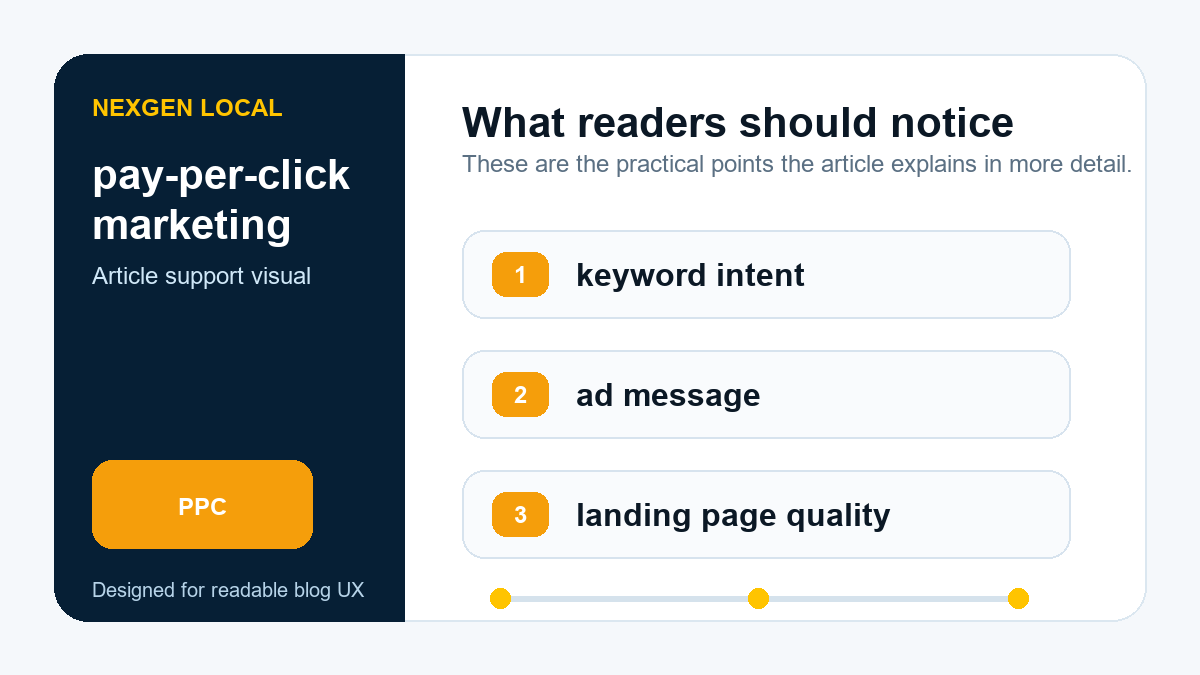
Cost-per-click (CPC) advertising allows businesses to reach a specific market with a small budget. However, the cost of these ads can add up quickly. You will have to choose the right keywords and ensure that they are relevant. Otherwise, your ad could show up when people aren’t looking for what you have to offer.
CPC advertising is a form of digital advertising where the advertiser pays a publisher every time someone clicks on their ad. A small clothing boutique, for example, can run a CPC ad on Facebook to advertise a new dress. This type of advertising is incredibly effective, as you only pay when a user clicks on your ad—you don’t pay if the user just scrolls past it.
Ads are ranked based on their relevance, expected click-through rate, landing page experience, and other factors that contribute to a “Quality Score.” The more relevant your ads are, the lower your cost-per-click can be. Moreover, more relevant ads achieve a higher Quality Score, which allows you to pay less per click and secure better ad positions. You can also improve your ad’s click-through rate by using ad extensions for location, contact numbers, site links, promotions, and more.
Return on investment (ROI) is a way to measure how well your advertising campaign is performing and determine if you are making money. It is the profit you made from your ads minus your costs. To calculate it, you subtract your advertising costs from the revenue generated and then divide that number by the advertising costs.
ROI is the most important metric in any PPC campaign. It tells you whether or not your ads are worth the money and justifies budget allocation for future campaigns. To get your ROI as a percentage, use this formula: (Revenue – Cost) / Cost * 100. For example, if you spent $500 on ads and generated $2,000 in revenue, your ROI would be (($2000 – $500) / $500) * 100, which equals 300%.
What To Set Up First
The cost-per-click is determined by the ad platform, typically through a real-time auction process. Generally, the higher the competition for a keyword, the higher the cost-per-click. However, if your keyword has low search volume or low competition, the cost-per-click will likely be lower.
Cost-per-click advertising is an excellent choice for many businesses because it can be more affordable and scalable than traditional marketing. The cost per click is calculated by dividing the total cost of your ad campaign by the number of clicks it receives. The higher your bid and Quality Score, the higher the chance that your ad will appear in a prominent position.
Creative, compelling ad copy is vital for a high Quality Score. To create attractive and eye-catching ads, you can leverage AI-powered ad creation tools or Google’s own responsive ad formats and Performance Max campaigns, which automate ad testing and optimization.
As a business owner, you will want to measure your ROI consistently and make adjustments as needed. PPC campaigns allow you to easily track your ROI and make changes to improve results. For example, you may need to pause underperforming keywords, adjust your targeting, or tweak your ad copy and landing page to increase the conversion rate. Keeping track of your ROI will help you set realistic expectations.
When looking for the best return on investment (ROI) for your pay-per-click marketing campaign, you need to focus on generating higher revenue while managing your costs. For example, you should consider granular audience targeting when determining how to optimize your ads. The more targeted your audience is, the more relevant and effective your ads will be.
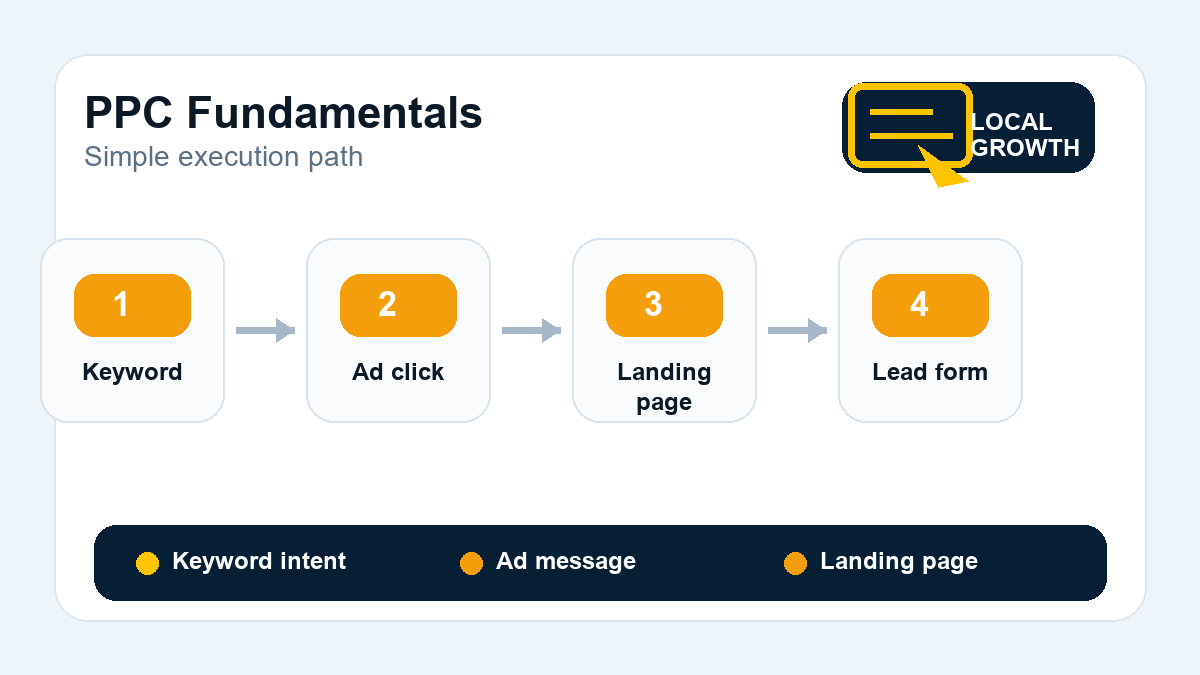
How To Improve Results
There are several advantages of PPC advertising, including its flexibility. PPC advertising gives you more control over your account and helps you target the right type of audience. For example, if you’re a B2B business, you should serve your ads during business hours. You can also monitor your Analytics data to determine which days and times are the most profitable for your campaigns.
Pay Per Click marketing using platforms like Google Ads is an excellent way to advertise your business online. This form of advertising targets customers when they’re actively searching and ready to buy. When properly managed, Google Ads campaigns can produce results almost immediately, and the platform provides deep control over your budget and investment.
For many service-based businesses, Google’s Local Services Ads (LSAs) have become a crucial tool. These ads appear at the very top of search results and operate on a pay-per-lead basis, offering a powerful way to connect with high-intent customers. Instead of broad daily budget pacing, modern campaigns rely on smart bidding strategies that automatically adjust bids to maximize conversions, clicks, or impression share based on your specific goals.
ROI calculations should be done on a regular basis. You should take the time to evaluate your campaign’s performance and calculate its impact on your sales. If a campaign is not generating a positive return, it might be time to refine your strategy or reallocate the budget.
Action checklist
Need your PPC account reviewed?
We can look for wasted spend, tracking gaps, and campaign structure issues.