

Author: Vanessa Bailey
A Florida-Focused Local SEO Playbook for West Palm Beach Roofing Companies
Search Engine Optimization
Local SEO for roofing companies in West Palm Beach FL is a narrow search, which is exactly why the page has to be useful. A roofing company in West Palm Beach is not looking for a broad marketing definition. They need to understand what to build, what to measure, and how the strategy should fit the local market.
Quick answer
Local SEO for roofing companies in West Palm Beach FL should be built as a focused local asset, not a generic marketing article. The page needs city context, industry proof, a conversion path, and tracking that shows whether the traffic becomes qualified conversations.
In this expanded guide
Primary keyword
Local SEO for roofing companies in West Palm Beach FL
Best-fit intent
A local business owner or manager comparing whether Local SEO can create better leads, better follow-up, or better search visibility for roofing companies in West Palm Beach.
Why the West Palm Beach market changes the strategy
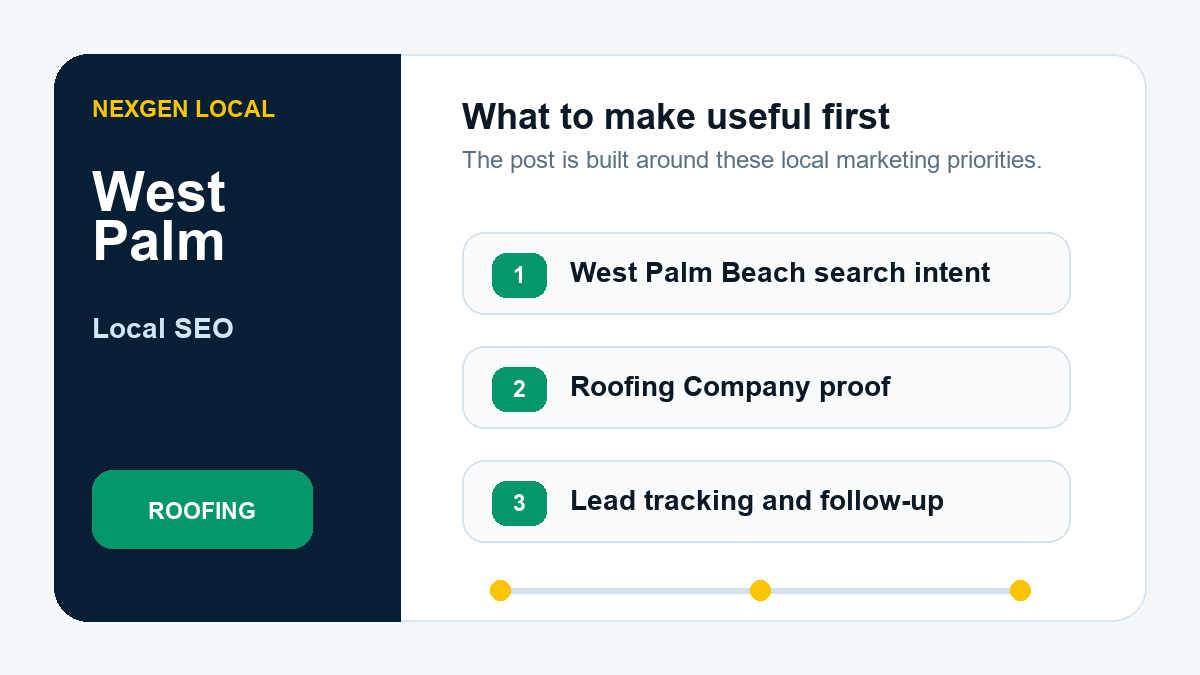
West Palm Beach searches are shaped by downtown demand, seasonal residents, Palm Beach County suburbs, and coastal communities with higher trust expectations.
Seasonal residents, coastal maintenance, and high-value home services make proof, response time, and premium positioning matter. That matters because local search is not just a list of keywords. The same phrase can mean a quick emergency call, a research-stage project, a bid request, or a high-trust consultation depending on the neighborhood, service line, and buyer type.
For roofing companies, a useful page should make the local fit obvious. It should mention the service area in plain language, explain who the offer is for, show proof that matches the work, and give the visitor one clear next step. When a page only swaps in a city name, it may technically target the keyword, but it usually fails to answer the buyer’s real question.
What West Palm Beach roofing companies need to prove
Storm-driven demand can spike quickly, and slow response usually means the job goes elsewhere. In West Palm Beach, that pain point becomes more specific because the market includes downtown West Palm Beach, Palm Beach County suburbs, and coastal communities. The page should reduce doubt before the visitor calls, clicks, or fills out a form.
A roofing page should separate repair, replacement, inspection, and storm-response intent because each visitor is in a different buying moment.
For a roof replacement lead, the page should show roof type, service area, inspection process, financing or estimate language if offered, and the follow-up path after the form is submitted.
Useful proof for this audience can include Project photos, roof-material pages, warranty language, inspection checklists, review themes, and clear emergency-response expectations.. These details are not decoration. They help real visitors decide whether the company understands their job, and they help search engines connect the page to the right entity, service, and local context.
The Local SEO plan for this keyword
Local SEO should connect service intent, local proof, Google Business Profile signals, and service-area pages into one useful search footprint.
For Local SEO for roofing companies in West Palm Beach FL, the strategy should start with one primary intent and one conversion path. The campaign can still support secondary questions, but the main page should not drift into every possible marketing topic. A focused article is easier to optimize, easier to measure, and easier to improve after Search Console data starts showing real queries.
Use language that reflects storm repair, tile roof replacement, or roof inspections when those are the jobs the business actually wants.
Reference downtown West Palm Beach, Palm Beach County suburbs, and coastal communities, service-area fit, project types, photos, reviews, or process details that help a West Palm Beach buyer trust the next step.
Separate calls, forms, booked appointments, disqualified leads, and follow-up notes so the page is judged by qualified opportunities instead of traffic alone.
What to build first
The first version should be practical enough that a business owner can see the work. For roofing companies, the strongest page usually combines local explanation, industry proof, a clear call-to-action, and a measurement plan. That gives the content a reason to exist beyond keyword coverage.
| Build area | What to add | How to measure it |
|---|---|---|
| Page relevance | Build pages around real services, neighborhoods, proof, FAQs, and conversion paths instead of thin location swaps. | Track local impressions, map actions, organic leads, service-area visibility, and page-level engagement for West Palm Beach roofing companies. |
| GBP alignment | Keep categories, services, photos, reviews, posts, and calls consistent with what the website is trying to rank for. | Track local impressions, map actions, organic leads, service-area visibility, and page-level engagement for West Palm Beach roofing companies. |
| Authority building | Use internal links, citations, content updates, and review themes to reinforce the same local topics over time. | Track local impressions, map actions, organic leads, service-area visibility, and page-level engagement for West Palm Beach roofing companies. |
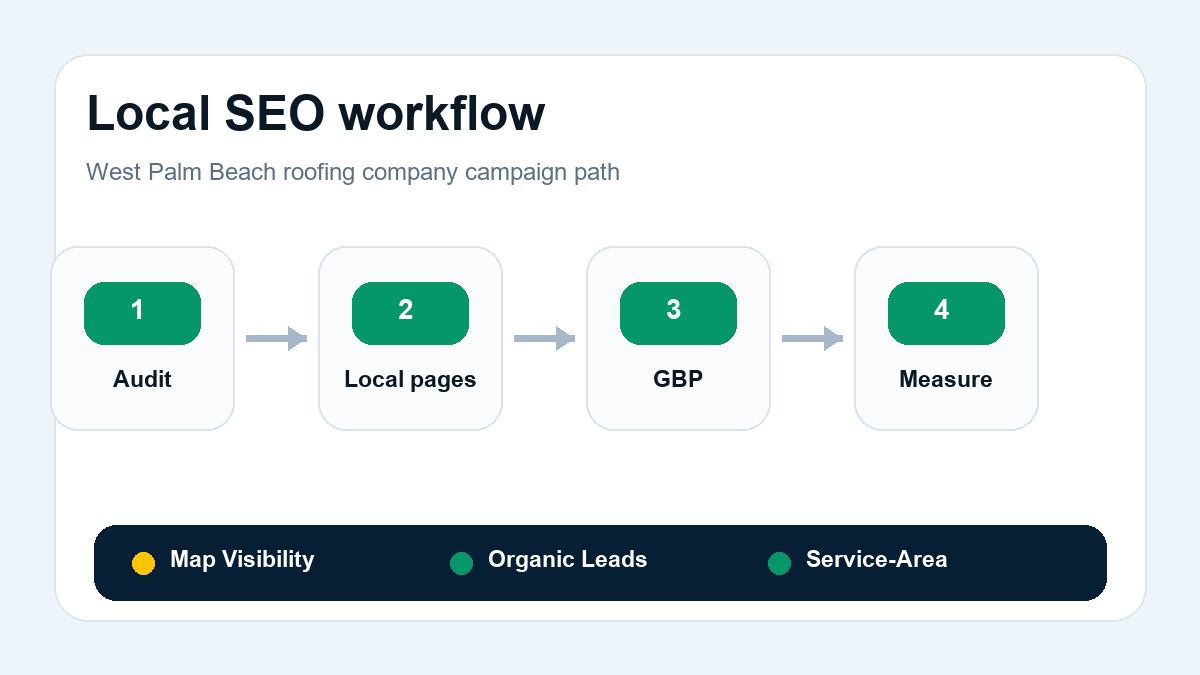
A small but complete build is better than a large campaign with no feedback loop. Start with one page or offer, connect it to the parent Local SEO service, support it with proof for the Roofing Companies audience, and point local readers toward the West Palm Beach service area. Then use call and form data to decide what deserves expansion.
Local examples to make the content stronger
A stronger West Palm Beach page can include a short section for neighborhoods or service zones, a short explanation of seasonal demand, and a practical note about how buyers compare providers. For this post, the local examples should connect Palm Beach County context with roofing companies buying behavior.
For example, a roofing company serving West Palm Beach might need one message for urgent searchers, another for research-stage buyers, and another for high-value projects. The content should not pretend all leads are equal. It should explain how the business qualifies opportunities, what proof matters most, and what happens after the visitor takes action.
That is also where Local SEO becomes more than a marketing label. The service should help the business decide what to publish, what to promote, what to track, and what to stop doing. If a keyword gets impressions but no qualified action, the answer may be stronger proof, a clearer offer, better routing, or a more specific page.
Internal links and topical authority
This page should not sit alone. It supports the parent Local SEO page, reinforces the Roofing Companies industry section, and connects back to the West Palm Beach service area. Those internal links help the article pass relevance back to the pages that matter most for Nexgen’s core SEO.
Internal links should be useful to the reader, not forced into every sentence. The best pattern is simple: link up to the parent service, link sideways to related Florida posts, and link forward to a clear conversion action such as a strategy review or contact page.
Frequently asked questions
How can Local SEO help roofing companies in West Palm Beach?
Local SEO helps a roofing company in West Palm Beach connect local intent to a clearer conversion path. The goal is to show the right proof, route the right inquiries, and measure lead quality instead of only counting traffic.
What should a West Palm Beach roofing company build first?
Start with one priority service, one primary page or offer, call and form tracking, and proof that matches downtown West Palm Beach, Palm Beach County suburbs, and coastal communities. After the first data comes in, expand into related services, nearby neighborhoods, or supporting blog content.
How long should roofing companies track this before scaling?
A useful test should run long enough to collect impressions, clicks, calls, forms, booked appointments, and disqualified lead notes. The decision to expand should come from lead quality and conversion data, not from traffic volume alone.
What makes this different from a generic Florida marketing page?
This page connects Local SEO, roofing companies, and West Palm Beach search behavior in one place. It uses local context, industry proof, internal links, and a tracking plan so the page can support both users and core service SEO.
Author and review note
About this guide: This article is published under Vanessa Bailey’s Nexgen Local Marketing author profile and reviewed against Nexgen’s local search, paid media, conversion tracking, and content-quality checklist. It avoids unsupported ranking, lead, or revenue promises and focuses on practical steps a Florida business can verify.
Tracking, pruning, and improvement plan
After publishing, the page should be monitored in Google Search Console and Bing Webmaster Tools. The most useful early signals are impressions for the target topic, queries that include West Palm Beach, clicks from qualified searches, engagement with the call-to-action, and whether leads mention the service or location the page was built around.
Every quarter, the page should be reviewed. If it earns impressions but no clicks, the title and meta description may need work. If it earns clicks but no qualified actions, the offer, proof, form, or call path may need improvement. If it earns no meaningful impressions after enough time, it should be improved, merged into a stronger article, redirected, or noindexed instead of staying live as weak content.
Need a stronger Florida growth page for roofing companies?
Nexgen can review your West Palm Beach market, service mix, page structure, proof assets, and tracking setup before you scale content or ads.
Call 407-307-1995, email info@nexgenlocalmarketing.com, or request a Florida strategy review.
How HVAC Contractors in Fort Lauderdale Can Use AI Automation in 2026
AI Automation
AI Automation for HVAC contractors in Fort Lauderdale FL is a narrow search, which is exactly why the page has to be useful. A HVAC contractor in Fort Lauderdale is not looking for a broad marketing definition. They need to understand what to build, what to measure, and how the strategy should fit the local market.
Quick answer
AI Automation for HVAC contractors in Fort Lauderdale FL should be built as a focused local asset, not a generic marketing article. The page needs city context, industry proof, a conversion path, and tracking that shows whether the traffic becomes qualified conversations.
In this expanded guide
Primary keyword
AI Automation for HVAC contractors in Fort Lauderdale FL
Best-fit intent
A local business owner or manager comparing whether AI Automation can create better leads, better follow-up, or better search visibility for HVAC contractors in Fort Lauderdale.
Why the Fort Lauderdale market changes the strategy
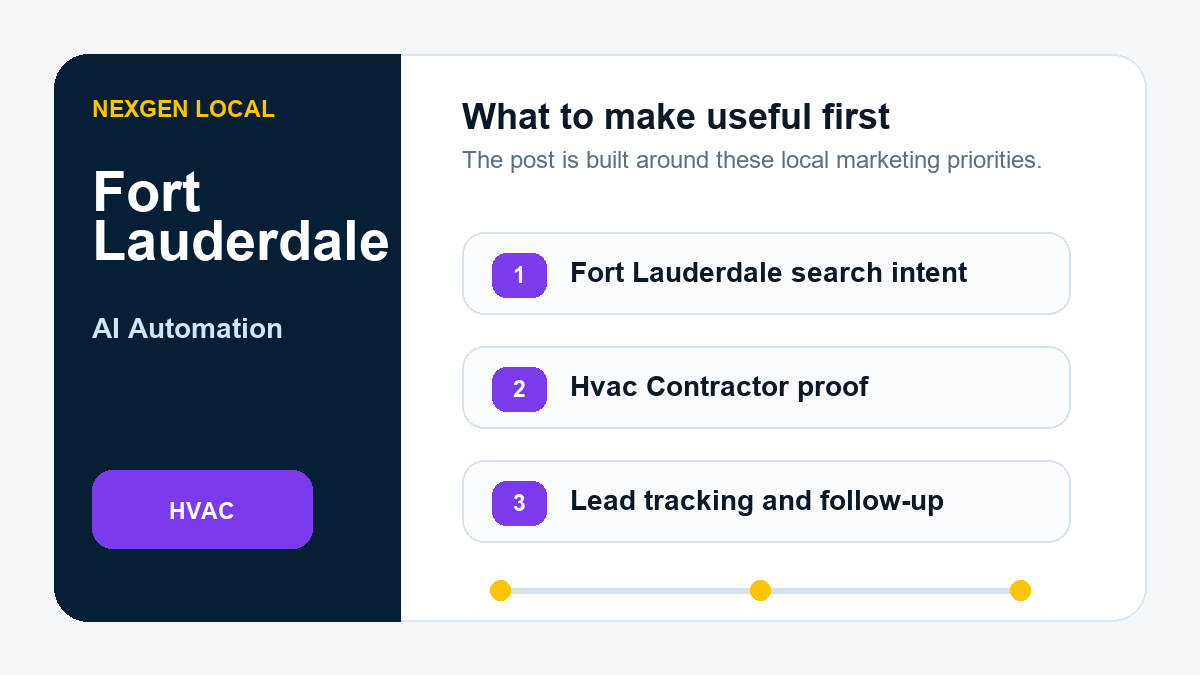
Fort Lauderdale brings a mix of Las Olas business traffic, Broward suburbs, waterfront properties, marina activity, and service calls tied to coastal living.
Marine activity, waterfront maintenance, rainy-season issues, and seasonal property ownership create narrow but valuable search intent. That matters because local search is not just a list of keywords. The same phrase can mean a quick emergency call, a research-stage project, a bid request, or a high-trust consultation depending on the neighborhood, service line, and buyer type.
For HVAC contractors, a useful page should make the local fit obvious. It should mention the service area in plain language, explain who the offer is for, show proof that matches the work, and give the visitor one clear next step. When a page only swaps in a city name, it may technically target the keyword, but it usually fails to answer the buyer’s real question.
What Fort Lauderdale HVAC contractors need to prove
Emergency intent is high, but customers often call the first credible option that answers. In Fort Lauderdale, that pain point becomes more specific because the market includes Las Olas, Victoria Park, waterfront neighborhoods, and Broward County suburbs. The page should reduce doubt before the visitor calls, clicks, or fills out a form.
HVAC intent often becomes urgent when the AC fails, but maintenance, replacement, and commercial service searches need different landing paths.
A high-value AC replacement lead should see financing language, system-type pages, service radius, technician credibility, and a fast quote or call path.
Useful proof for this audience can include Response-time messaging, technician photos, maintenance plans, financing notes, emergency service pages, and call tracking by service line.. These details are not decoration. They help real visitors decide whether the company understands their job, and they help search engines connect the page to the right entity, service, and local context.
The AI Automation plan for this keyword
The job of AI automation is not to replace the sales process. It is to remove delays between inquiry, qualification, routing, and follow-up.
For AI Automation for HVAC contractors in Fort Lauderdale FL, the strategy should start with one primary intent and one conversion path. The campaign can still support secondary questions, but the main page should not drift into every possible marketing topic. A focused article is easier to optimize, easier to measure, and easier to improve after Search Console data starts showing real queries.
Use language that reflects AC repair, seasonal tune-ups, or commercial maintenance when those are the jobs the business actually wants.
Reference Las Olas, Victoria Park, waterfront neighborhoods, and Broward County suburbs, service-area fit, project types, photos, reviews, or process details that help a Fort Lauderdale buyer trust the next step.
Separate calls, forms, booked appointments, disqualified leads, and follow-up notes so the page is judged by qualified opportunities instead of traffic alone.
What to build first
The first version should be practical enough that a business owner can see the work. For HVAC contractors, the strongest page usually combines local explanation, industry proof, a clear call-to-action, and a measurement plan. That gives the content a reason to exist beyond keyword coverage.
| Build area | What to add | How to measure it |
|---|---|---|
| Lead capture | Use forms, chat, call notes, and CRM fields to capture the actual service need, location, urgency, and next step. | Track response speed, qualified lead rate, missed-call recovery, booked appointments, and handoff completion for Fort Lauderdale HVAC contractors. |
| Qualification | Route poor-fit requests away from the sales calendar and push qualified prospects toward booking, quoting, or consultation. | Track response speed, qualified lead rate, missed-call recovery, booked appointments, and handoff completion for Fort Lauderdale HVAC contractors. |
| Follow-up | Trigger same-day reminders, missed-call replies, quote follow-ups, and no-show recovery without making the process feel robotic. | Track response speed, qualified lead rate, missed-call recovery, booked appointments, and handoff completion for Fort Lauderdale HVAC contractors. |
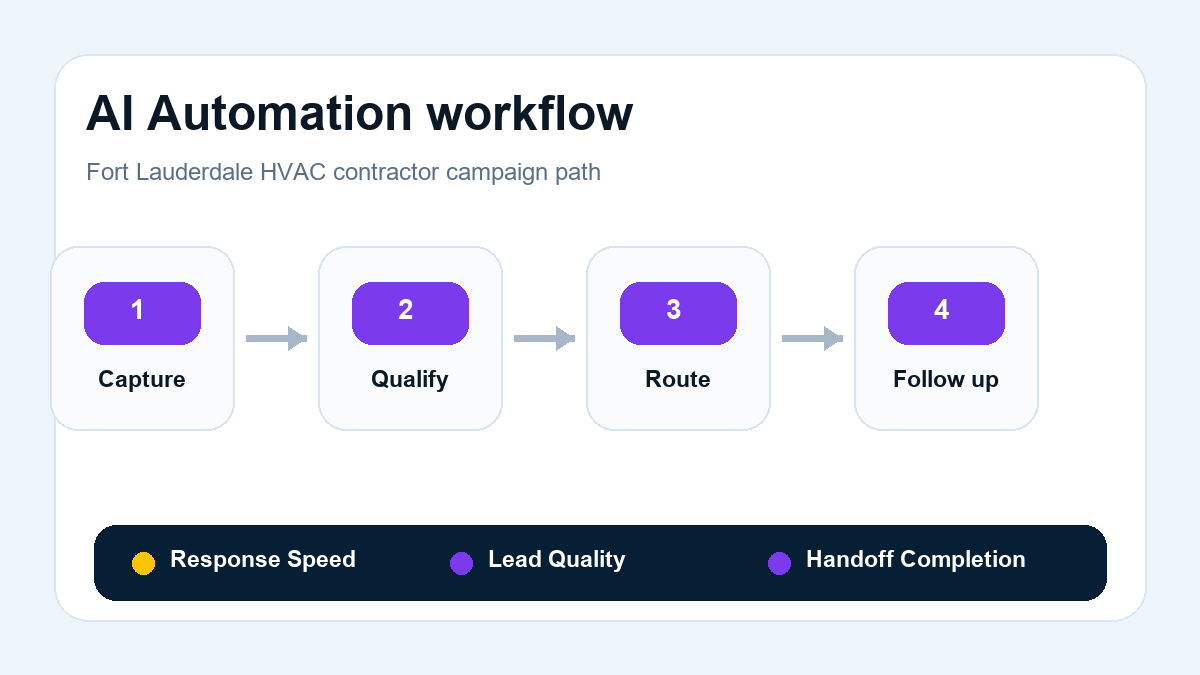
A small but complete build is better than a large campaign with no feedback loop. Start with one page or offer, connect it to the parent AI Automation service, support it with proof for the HVAC Contractors audience, and point local readers toward the Fort Lauderdale service area. Then use call and form data to decide what deserves expansion.
Local examples to make the content stronger
A stronger Fort Lauderdale page can include a short section for neighborhoods or service zones, a short explanation of seasonal demand, and a practical note about how buyers compare providers. For this post, the local examples should connect South Florida context with HVAC contractors buying behavior.
For example, a HVAC contractor serving Fort Lauderdale might need one message for urgent searchers, another for research-stage buyers, and another for high-value projects. The content should not pretend all leads are equal. It should explain how the business qualifies opportunities, what proof matters most, and what happens after the visitor takes action.
That is also where AI Automation becomes more than a marketing label. The service should help the business decide what to publish, what to promote, what to track, and what to stop doing. If a keyword gets impressions but no qualified action, the answer may be stronger proof, a clearer offer, better routing, or a more specific page.
Internal links and topical authority
This page should not sit alone. It supports the parent AI Automation page, reinforces the HVAC Contractors industry section, and connects back to the Fort Lauderdale service area. Those internal links help the article pass relevance back to the pages that matter most for Nexgen’s core SEO.
Internal links should be useful to the reader, not forced into every sentence. The best pattern is simple: link up to the parent service, link sideways to related Florida posts, and link forward to a clear conversion action such as a strategy review or contact page.
Frequently asked questions
How can AI Automation help HVAC contractors in Fort Lauderdale?
AI Automation helps a HVAC contractor in Fort Lauderdale connect local intent to a clearer conversion path. The goal is to show the right proof, route the right inquiries, and measure lead quality instead of only counting traffic.
What should a Fort Lauderdale HVAC contractor build first?
Start with one priority service, one primary page or offer, call and form tracking, and proof that matches Las Olas, Victoria Park, waterfront neighborhoods, and Broward County suburbs. After the first data comes in, expand into related services, nearby neighborhoods, or supporting blog content.
How long should HVAC contractors track this before scaling?
A useful test should run long enough to collect impressions, clicks, calls, forms, booked appointments, and disqualified lead notes. The decision to expand should come from lead quality and conversion data, not from traffic volume alone.
What makes this different from a generic Florida marketing page?
This page connects AI Automation, HVAC contractors, and Fort Lauderdale search behavior in one place. It uses local context, industry proof, internal links, and a tracking plan so the page can support both users and core service SEO.
Author and review note
About this guide: This article is published under Vanessa Bailey’s Nexgen Local Marketing author profile and reviewed against Nexgen’s local search, paid media, conversion tracking, and content-quality checklist. It avoids unsupported ranking, lead, or revenue promises and focuses on practical steps a Florida business can verify.
Tracking, pruning, and improvement plan
After publishing, the page should be monitored in Google Search Console and Bing Webmaster Tools. The most useful early signals are impressions for the target topic, queries that include Fort Lauderdale, clicks from qualified searches, engagement with the call-to-action, and whether leads mention the service or location the page was built around.
Every quarter, the page should be reviewed. If it earns impressions but no clicks, the title and meta description may need work. If it earns clicks but no qualified actions, the offer, proof, form, or call path may need improvement. If it earns no meaningful impressions after enough time, it should be improved, merged into a stronger article, redirected, or noindexed instead of staying live as weak content.
Need a stronger Florida growth page for HVAC contractors?
Nexgen can review your Fort Lauderdale market, service mix, page structure, proof assets, and tracking setup before you scale content or ads.
Call 407-307-1995, email info@nexgenlocalmarketing.com, or request a Florida strategy review.
Local SEO for Fort Lauderdale MSPs: What to Build First
Search Engine Optimization
Local SEO for MSPs in Fort Lauderdale FL is a narrow search, which is exactly why the page has to be useful. A MSP in Fort Lauderdale is not looking for a broad marketing definition. They need to understand what to build, what to measure, and how the strategy should fit the local market.
Quick answer
Local SEO for MSPs in Fort Lauderdale FL should be built as a focused local asset, not a generic marketing article. The page needs city context, industry proof, a conversion path, and tracking that shows whether the traffic becomes qualified conversations.
In this expanded guide
Primary keyword
Local SEO for MSPs in Fort Lauderdale FL
Best-fit intent
A local business owner or manager comparing whether Local SEO can create better leads, better follow-up, or better search visibility for MSPs in Fort Lauderdale.
Why the Fort Lauderdale market changes the strategy
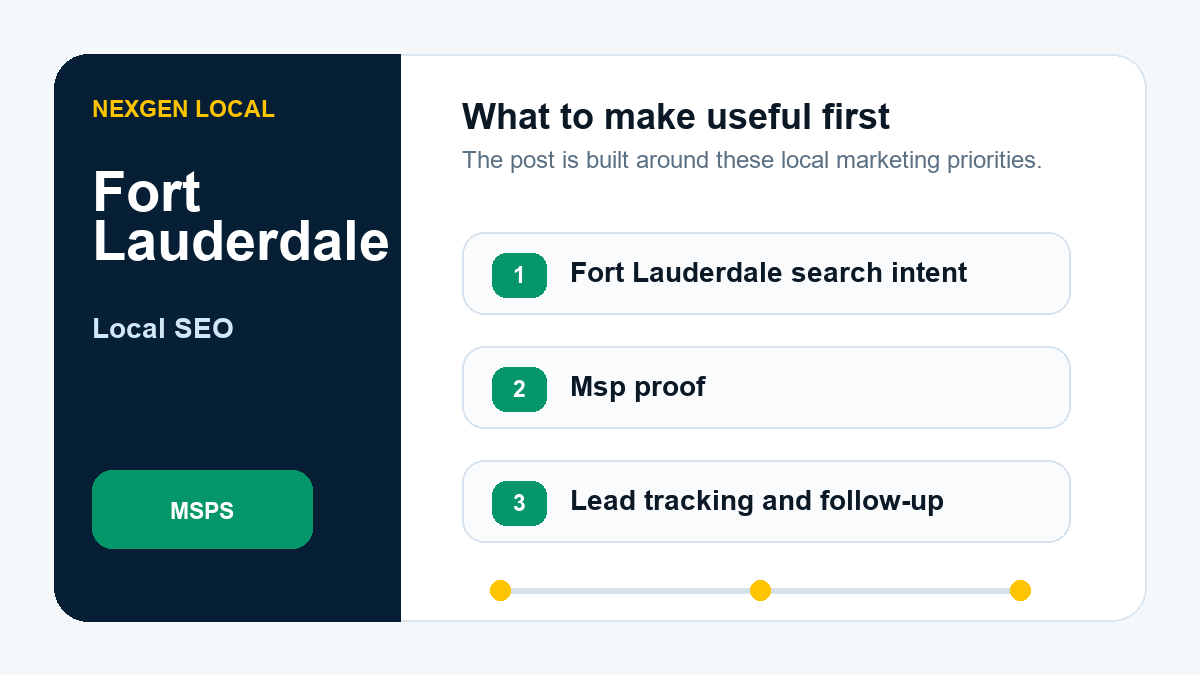
Fort Lauderdale brings a mix of Las Olas business traffic, Broward suburbs, waterfront properties, marina activity, and service calls tied to coastal living.
Marine activity, waterfront maintenance, rainy-season issues, and seasonal property ownership create narrow but valuable search intent. That matters because local search is not just a list of keywords. The same phrase can mean a quick emergency call, a research-stage project, a bid request, or a high-trust consultation depending on the neighborhood, service line, and buyer type.
For MSPs, a useful page should make the local fit obvious. It should mention the service area in plain language, explain who the offer is for, show proof that matches the work, and give the visitor one clear next step. When a page only swaps in a city name, it may technically target the keyword, but it usually fails to answer the buyer’s real question.
What Fort Lauderdale MSPs need to prove
B2b buyers research quietly and need technical clarity before they book a consult. In Fort Lauderdale, that pain point becomes more specific because the market includes Las Olas, Victoria Park, waterfront neighborhoods, and Broward County suburbs. The page should reduce doubt before the visitor calls, clicks, or fills out a form.
MSP buyers research quietly and compare risk, responsiveness, and technical fit before booking a consultation.
A cybersecurity lead should receive a different offer than a general managed IT lead, with a checklist or risk review that feels useful before sales follow-up.
Useful proof for this audience can include Industry pages, security language, service-level explanations, case-study style content, and lead-source tracking for booked consults.. These details are not decoration. They help real visitors decide whether the company understands their job, and they help search engines connect the page to the right entity, service, and local context.
The Local SEO plan for this keyword
Local SEO should connect service intent, local proof, Google Business Profile signals, and service-area pages into one useful search footprint.
For Local SEO for MSPs in Fort Lauderdale FL, the strategy should start with one primary intent and one conversion path. The campaign can still support secondary questions, but the main page should not drift into every possible marketing topic. A focused article is easier to optimize, easier to measure, and easier to improve after Search Console data starts showing real queries.
Use language that reflects managed IT, cybersecurity, or backup and recovery when those are the jobs the business actually wants.
Reference Las Olas, Victoria Park, waterfront neighborhoods, and Broward County suburbs, service-area fit, project types, photos, reviews, or process details that help a Fort Lauderdale buyer trust the next step.
Separate calls, forms, booked appointments, disqualified leads, and follow-up notes so the page is judged by qualified opportunities instead of traffic alone.
What to build first
The first version should be practical enough that a business owner can see the work. For MSPs, the strongest page usually combines local explanation, industry proof, a clear call-to-action, and a measurement plan. That gives the content a reason to exist beyond keyword coverage.
| Build area | What to add | How to measure it |
|---|---|---|
| Page relevance | Build pages around real services, neighborhoods, proof, FAQs, and conversion paths instead of thin location swaps. | Track local impressions, map actions, organic leads, service-area visibility, and page-level engagement for Fort Lauderdale MSPs. |
| GBP alignment | Keep categories, services, photos, reviews, posts, and calls consistent with what the website is trying to rank for. | Track local impressions, map actions, organic leads, service-area visibility, and page-level engagement for Fort Lauderdale MSPs. |
| Authority building | Use internal links, citations, content updates, and review themes to reinforce the same local topics over time. | Track local impressions, map actions, organic leads, service-area visibility, and page-level engagement for Fort Lauderdale MSPs. |
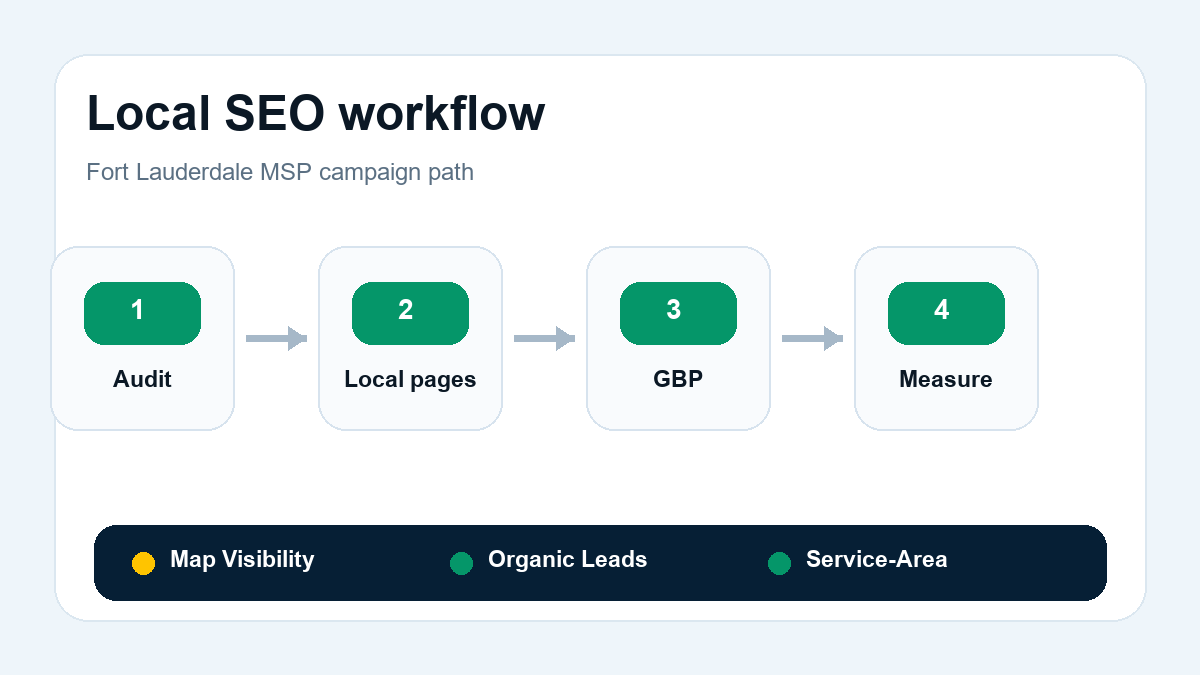
A small but complete build is better than a large campaign with no feedback loop. Start with one page or offer, connect it to the parent Local SEO service, support it with proof for the MSPs audience, and point local readers toward the Fort Lauderdale service area. Then use call and form data to decide what deserves expansion.
Local examples to make the content stronger
A stronger Fort Lauderdale page can include a short section for neighborhoods or service zones, a short explanation of seasonal demand, and a practical note about how buyers compare providers. For this post, the local examples should connect South Florida context with MSPs buying behavior.
For example, a MSP serving Fort Lauderdale might need one message for urgent searchers, another for research-stage buyers, and another for high-value projects. The content should not pretend all leads are equal. It should explain how the business qualifies opportunities, what proof matters most, and what happens after the visitor takes action.
That is also where Local SEO becomes more than a marketing label. The service should help the business decide what to publish, what to promote, what to track, and what to stop doing. If a keyword gets impressions but no qualified action, the answer may be stronger proof, a clearer offer, better routing, or a more specific page.
Internal links and topical authority
This page should not sit alone. It supports the parent Local SEO page, reinforces the MSPs industry section, and connects back to the Fort Lauderdale service area. Those internal links help the article pass relevance back to the pages that matter most for Nexgen’s core SEO.
Internal links should be useful to the reader, not forced into every sentence. The best pattern is simple: link up to the parent service, link sideways to related Florida posts, and link forward to a clear conversion action such as a strategy review or contact page.
Frequently asked questions
How can Local SEO help MSPs in Fort Lauderdale?
Local SEO helps a MSP in Fort Lauderdale connect local intent to a clearer conversion path. The goal is to show the right proof, route the right inquiries, and measure lead quality instead of only counting traffic.
What should a Fort Lauderdale MSP build first?
Start with one priority service, one primary page or offer, call and form tracking, and proof that matches Las Olas, Victoria Park, waterfront neighborhoods, and Broward County suburbs. After the first data comes in, expand into related services, nearby neighborhoods, or supporting blog content.
How long should MSPs track this before scaling?
A useful test should run long enough to collect impressions, clicks, calls, forms, booked appointments, and disqualified lead notes. The decision to expand should come from lead quality and conversion data, not from traffic volume alone.
What makes this different from a generic Florida marketing page?
This page connects Local SEO, MSPs, and Fort Lauderdale search behavior in one place. It uses local context, industry proof, internal links, and a tracking plan so the page can support both users and core service SEO.
Author and review note
About this guide: This article is published under Vanessa Bailey’s Nexgen Local Marketing author profile and reviewed against Nexgen’s local search, paid media, conversion tracking, and content-quality checklist. It avoids unsupported ranking, lead, or revenue promises and focuses on practical steps a Florida business can verify.
Tracking, pruning, and improvement plan
After publishing, the page should be monitored in Google Search Console and Bing Webmaster Tools. The most useful early signals are impressions for the target topic, queries that include Fort Lauderdale, clicks from qualified searches, engagement with the call-to-action, and whether leads mention the service or location the page was built around.
Every quarter, the page should be reviewed. If it earns impressions but no clicks, the title and meta description may need work. If it earns clicks but no qualified actions, the offer, proof, form, or call path may need improvement. If it earns no meaningful impressions after enough time, it should be improved, merged into a stronger article, redirected, or noindexed instead of staying live as weak content.
Need a stronger Florida growth page for MSPs?
Nexgen can review your Fort Lauderdale market, service mix, page structure, proof assets, and tracking setup before you scale content or ads.
Call 407-307-1995, email info@nexgenlocalmarketing.com, or request a Florida strategy review.
A Florida-Focused AI Automation Playbook for Tampa Property Management and HOA Companies
AI Automation
AI Automation for property management and HOA companies in Tampa FL is a narrow search, which is exactly why the page has to be useful. A property management company in Tampa is not looking for a broad marketing definition. They need to understand what to build, what to measure, and how the strategy should fit the local market.
Quick answer
AI Automation for property management and HOA companies in Tampa FL should be built as a focused local asset, not a generic marketing article. The page needs city context, industry proof, a conversion path, and tracking that shows whether the traffic becomes qualified conversations.
In this expanded guide
Primary keyword
AI Automation for property management and HOA companies in Tampa FL
Best-fit intent
A local business owner or manager comparing whether AI Automation can create better leads, better follow-up, or better search visibility for property management and HOA companies in Tampa.
Why the Tampa market changes the strategy
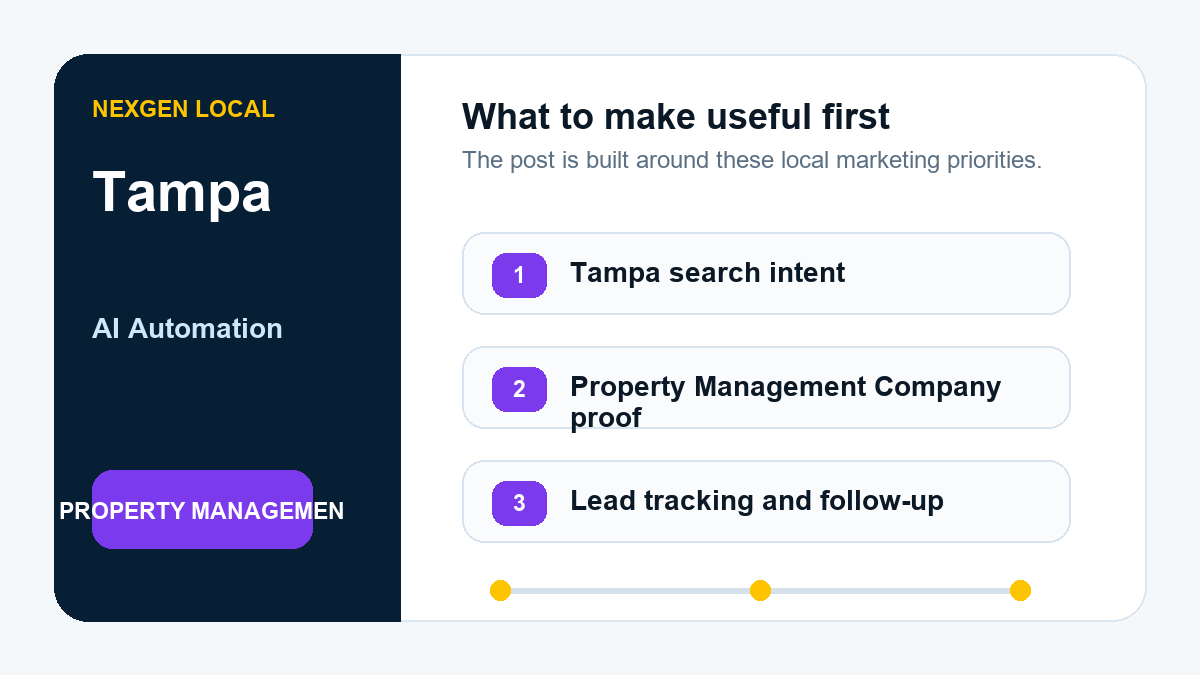
Tampa campaigns need to account for South Tampa, Westshore, Carrollwood, Brandon, and the broader bay-area pattern where homeowners compare several nearby providers.
Summer heat, hurricane planning, and bay-area homeowner demand make speed, reviews, and clear service areas especially important. That matters because local search is not just a list of keywords. The same phrase can mean a quick emergency call, a research-stage project, a bid request, or a high-trust consultation depending on the neighborhood, service line, and buyer type.
For property management and HOA companies, a useful page should make the local fit obvious. It should mention the service area in plain language, explain who the offer is for, show proof that matches the work, and give the visitor one clear next step. When a page only swaps in a city name, it may technically target the keyword, but it usually fails to answer the buyer’s real question.
What Tampa property management and HOA companies need to prove
Boards and owners compare trust, process, and communication before choosing a provider. In Tampa, that pain point becomes more specific because the market includes South Tampa, Westshore, Carrollwood, Brandon, and the wider Tampa Bay market. The page should reduce doubt before the visitor calls, clicks, or fills out a form.
Property management and HOA buyers compare process, communication, vendor coordination, and board trust before requesting a proposal.
An HOA management lead should be segmented by community type, number of units, current pain point, and whether the searcher is a board member or property owner.
Useful proof for this audience can include Community-type pages, board FAQs, maintenance workflows, RFP forms, review strategy, and communication-process explainers.. These details are not decoration. They help real visitors decide whether the company understands their job, and they help search engines connect the page to the right entity, service, and local context.
The AI Automation plan for this keyword
The job of AI automation is not to replace the sales process. It is to remove delays between inquiry, qualification, routing, and follow-up.
For AI Automation for property management and HOA companies in Tampa FL, the strategy should start with one primary intent and one conversion path. The campaign can still support secondary questions, but the main page should not drift into every possible marketing topic. A focused article is easier to optimize, easier to measure, and easier to improve after Search Console data starts showing real queries.
Use language that reflects HOA management, maintenance requests, or vendor coordination when those are the jobs the business actually wants.
Reference South Tampa, Westshore, Carrollwood, Brandon, and the wider Tampa Bay market, service-area fit, project types, photos, reviews, or process details that help a Tampa buyer trust the next step.
Separate calls, forms, booked appointments, disqualified leads, and follow-up notes so the page is judged by qualified opportunities instead of traffic alone.
What to build first
The first version should be practical enough that a business owner can see the work. For property management and HOA companies, the strongest page usually combines local explanation, industry proof, a clear call-to-action, and a measurement plan. That gives the content a reason to exist beyond keyword coverage.
| Build area | What to add | How to measure it |
|---|---|---|
| Lead capture | Use forms, chat, call notes, and CRM fields to capture the actual service need, location, urgency, and next step. | Track response speed, qualified lead rate, missed-call recovery, booked appointments, and handoff completion for Tampa property management and HOA companies. |
| Qualification | Route poor-fit requests away from the sales calendar and push qualified prospects toward booking, quoting, or consultation. | Track response speed, qualified lead rate, missed-call recovery, booked appointments, and handoff completion for Tampa property management and HOA companies. |
| Follow-up | Trigger same-day reminders, missed-call replies, quote follow-ups, and no-show recovery without making the process feel robotic. | Track response speed, qualified lead rate, missed-call recovery, booked appointments, and handoff completion for Tampa property management and HOA companies. |
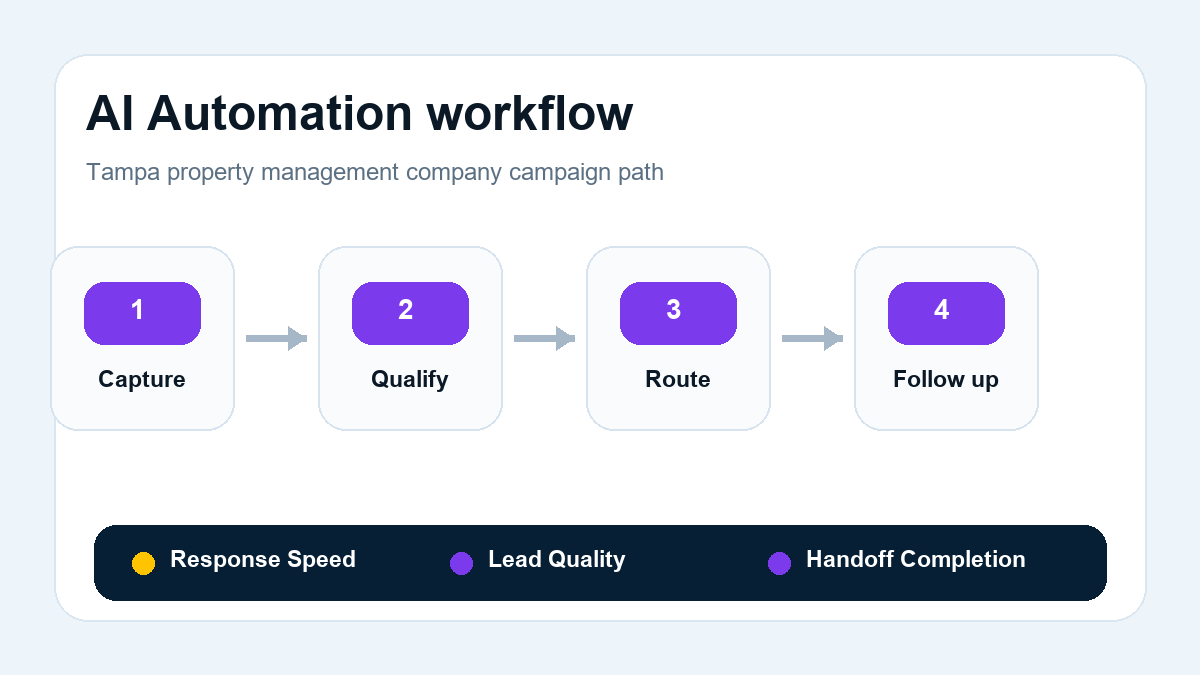
A small but complete build is better than a large campaign with no feedback loop. Start with one page or offer, connect it to the parent AI Automation service, support it with proof for the Property Management and HOA Companies audience, and point local readers toward the Tampa service area. Then use call and form data to decide what deserves expansion.
Local examples to make the content stronger
A stronger Tampa page can include a short section for neighborhoods or service zones, a short explanation of seasonal demand, and a practical note about how buyers compare providers. For this post, the local examples should connect Tampa Bay context with property management and HOA companies buying behavior.
For example, a property management company serving Tampa might need one message for urgent searchers, another for research-stage buyers, and another for high-value projects. The content should not pretend all leads are equal. It should explain how the business qualifies opportunities, what proof matters most, and what happens after the visitor takes action.
That is also where AI Automation becomes more than a marketing label. The service should help the business decide what to publish, what to promote, what to track, and what to stop doing. If a keyword gets impressions but no qualified action, the answer may be stronger proof, a clearer offer, better routing, or a more specific page.
Internal links and topical authority
This page should not sit alone. It supports the parent AI Automation page, reinforces the Property Management and HOA Companies industry section, and connects back to the Tampa service area. Those internal links help the article pass relevance back to the pages that matter most for Nexgen’s core SEO.
Internal links should be useful to the reader, not forced into every sentence. The best pattern is simple: link up to the parent service, link sideways to related Florida posts, and link forward to a clear conversion action such as a strategy review or contact page.
Frequently asked questions
How can AI Automation help property management and HOA companies in Tampa?
AI Automation helps a property management company in Tampa connect local intent to a clearer conversion path. The goal is to show the right proof, route the right inquiries, and measure lead quality instead of only counting traffic.
What should a Tampa property management company build first?
Start with one priority service, one primary page or offer, call and form tracking, and proof that matches South Tampa, Westshore, Carrollwood, Brandon, and the wider Tampa Bay market. After the first data comes in, expand into related services, nearby neighborhoods, or supporting blog content.
How long should property management and HOA companies track this before scaling?
A useful test should run long enough to collect impressions, clicks, calls, forms, booked appointments, and disqualified lead notes. The decision to expand should come from lead quality and conversion data, not from traffic volume alone.
What makes this different from a generic Florida marketing page?
This page connects AI Automation, property management and HOA companies, and Tampa search behavior in one place. It uses local context, industry proof, internal links, and a tracking plan so the page can support both users and core service SEO.
Author and review note
About this guide: This article is published under Vanessa Bailey’s Nexgen Local Marketing author profile and reviewed against Nexgen’s local search, paid media, conversion tracking, and content-quality checklist. It avoids unsupported ranking, lead, or revenue promises and focuses on practical steps a Florida business can verify.
Tracking, pruning, and improvement plan
After publishing, the page should be monitored in Google Search Console and Bing Webmaster Tools. The most useful early signals are impressions for the target topic, queries that include Tampa, clicks from qualified searches, engagement with the call-to-action, and whether leads mention the service or location the page was built around.
Every quarter, the page should be reviewed. If it earns impressions but no clicks, the title and meta description may need work. If it earns clicks but no qualified actions, the offer, proof, form, or call path may need improvement. If it earns no meaningful impressions after enough time, it should be improved, merged into a stronger article, redirected, or noindexed instead of staying live as weak content.
Need a stronger Florida growth page for property management and HOA companies?
Nexgen can review your Tampa market, service mix, page structure, proof assets, and tracking setup before you scale content or ads.
Call 407-307-1995, email info@nexgenlocalmarketing.com, or request a Florida strategy review.
Tampa Med Spas Local SEO: A Practical Local Growth Plan
Search Engine Optimization
Local SEO for med spas in Tampa FL is a narrow search, which is exactly why the page has to be useful. A med spa in Tampa is not looking for a broad marketing definition. They need to understand what to build, what to measure, and how the strategy should fit the local market.
Quick answer
Local SEO for med spas in Tampa FL should be built as a focused local asset, not a generic marketing article. The page needs city context, industry proof, a conversion path, and tracking that shows whether the traffic becomes qualified conversations.
In this expanded guide
Primary keyword
Local SEO for med spas in Tampa FL
Best-fit intent
A local business owner or manager comparing whether Local SEO can create better leads, better follow-up, or better search visibility for med spas in Tampa.
Why the Tampa market changes the strategy
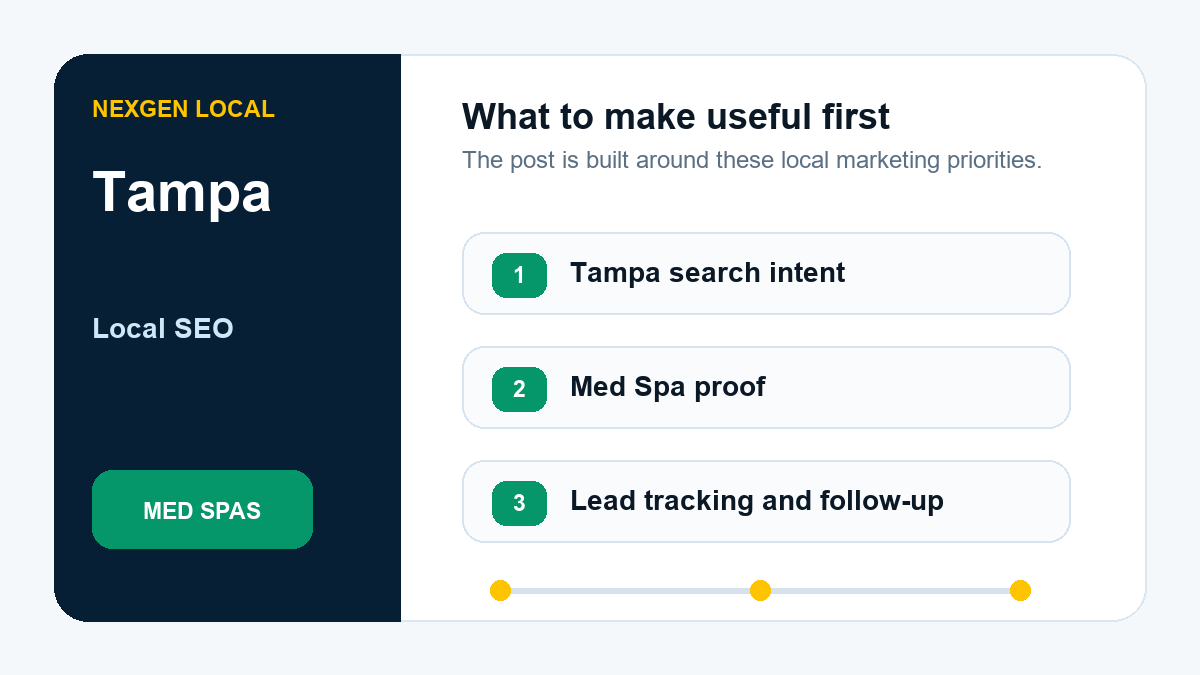
Tampa campaigns need to account for South Tampa, Westshore, Carrollwood, Brandon, and the broader bay-area pattern where homeowners compare several nearby providers.
Summer heat, hurricane planning, and bay-area homeowner demand make speed, reviews, and clear service areas especially important. That matters because local search is not just a list of keywords. The same phrase can mean a quick emergency call, a research-stage project, a bid request, or a high-trust consultation depending on the neighborhood, service line, and buyer type.
For med spas, a useful page should make the local fit obvious. It should mention the service area in plain language, explain who the offer is for, show proof that matches the work, and give the visitor one clear next step. When a page only swaps in a city name, it may technically target the keyword, but it usually fails to answer the buyer’s real question.
What Tampa med spas need to prove
Buyers need trust, clarity, and a simple booking path before they request a consultation. In Tampa, that pain point becomes more specific because the market includes South Tampa, Westshore, Carrollwood, Brandon, and the wider Tampa Bay market. The page should reduce doubt before the visitor calls, clicks, or fills out a form.
Med spa marketing has to build trust before the consultation request, especially when treatments are personal, visual, and comparison-driven.
An injectables campaign should explain consultation flow, provider trust, treatment fit, and booking steps without overpromising outcomes.
Useful proof for this audience can include Treatment pages, provider bios, compliant before-and-after guidance, consultation FAQs, booking flows, and review language tied to experience.. These details are not decoration. They help real visitors decide whether the company understands their job, and they help search engines connect the page to the right entity, service, and local context.
The Local SEO plan for this keyword
Local SEO should connect service intent, local proof, Google Business Profile signals, and service-area pages into one useful search footprint.
For Local SEO for med spas in Tampa FL, the strategy should start with one primary intent and one conversion path. The campaign can still support secondary questions, but the main page should not drift into every possible marketing topic. A focused article is easier to optimize, easier to measure, and easier to improve after Search Console data starts showing real queries.
Use language that reflects injectables, laser treatments, or membership offers when those are the jobs the business actually wants.
Reference South Tampa, Westshore, Carrollwood, Brandon, and the wider Tampa Bay market, service-area fit, project types, photos, reviews, or process details that help a Tampa buyer trust the next step.
Separate calls, forms, booked appointments, disqualified leads, and follow-up notes so the page is judged by qualified opportunities instead of traffic alone.
What to build first
The first version should be practical enough that a business owner can see the work. For med spas, the strongest page usually combines local explanation, industry proof, a clear call-to-action, and a measurement plan. That gives the content a reason to exist beyond keyword coverage.
| Build area | What to add | How to measure it |
|---|---|---|
| Page relevance | Build pages around real services, neighborhoods, proof, FAQs, and conversion paths instead of thin location swaps. | Track local impressions, map actions, organic leads, service-area visibility, and page-level engagement for Tampa med spas. |
| GBP alignment | Keep categories, services, photos, reviews, posts, and calls consistent with what the website is trying to rank for. | Track local impressions, map actions, organic leads, service-area visibility, and page-level engagement for Tampa med spas. |
| Authority building | Use internal links, citations, content updates, and review themes to reinforce the same local topics over time. | Track local impressions, map actions, organic leads, service-area visibility, and page-level engagement for Tampa med spas. |
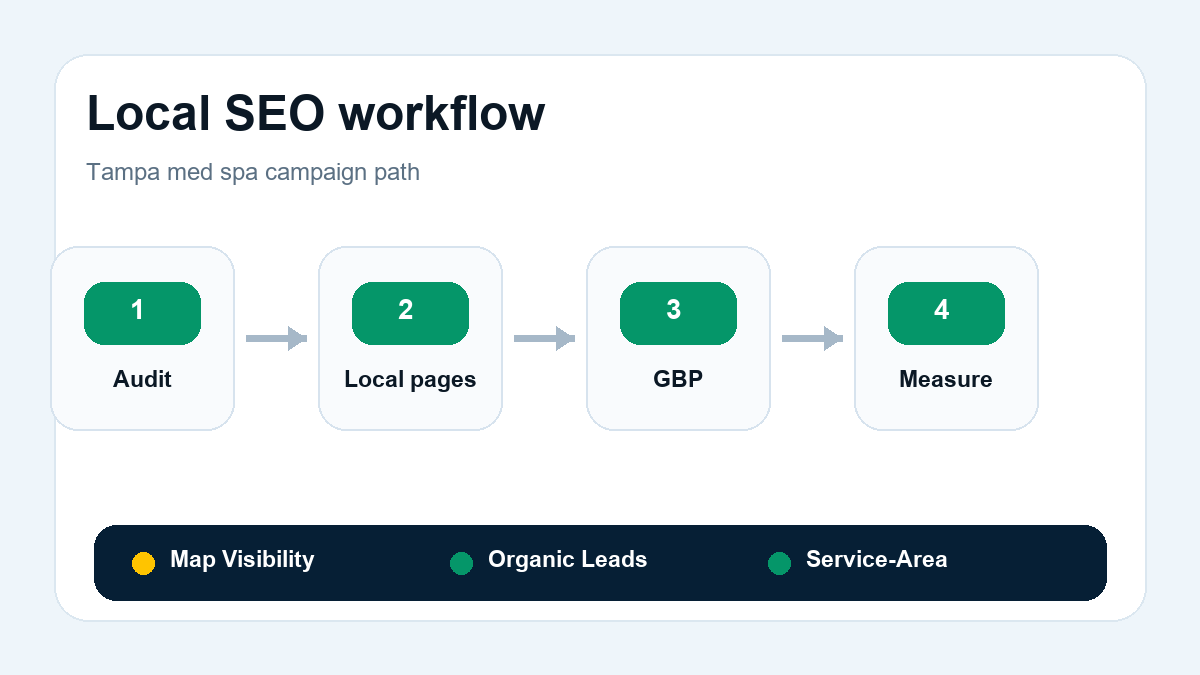
A small but complete build is better than a large campaign with no feedback loop. Start with one page or offer, connect it to the parent Local SEO service, support it with proof for the Med Spas audience, and point local readers toward the Tampa service area. Then use call and form data to decide what deserves expansion.
Local examples to make the content stronger
A stronger Tampa page can include a short section for neighborhoods or service zones, a short explanation of seasonal demand, and a practical note about how buyers compare providers. For this post, the local examples should connect Tampa Bay context with med spas buying behavior.
For example, a med spa serving Tampa might need one message for urgent searchers, another for research-stage buyers, and another for high-value projects. The content should not pretend all leads are equal. It should explain how the business qualifies opportunities, what proof matters most, and what happens after the visitor takes action.
That is also where Local SEO becomes more than a marketing label. The service should help the business decide what to publish, what to promote, what to track, and what to stop doing. If a keyword gets impressions but no qualified action, the answer may be stronger proof, a clearer offer, better routing, or a more specific page.
Internal links and topical authority
This page should not sit alone. It supports the parent Local SEO page, reinforces the Med Spas industry section, and connects back to the Tampa service area. Those internal links help the article pass relevance back to the pages that matter most for Nexgen’s core SEO.
Internal links should be useful to the reader, not forced into every sentence. The best pattern is simple: link up to the parent service, link sideways to related Florida posts, and link forward to a clear conversion action such as a strategy review or contact page.
Frequently asked questions
How can Local SEO help med spas in Tampa?
Local SEO helps a med spa in Tampa connect local intent to a clearer conversion path. The goal is to show the right proof, route the right inquiries, and measure lead quality instead of only counting traffic.
What should a Tampa med spa build first?
Start with one priority service, one primary page or offer, call and form tracking, and proof that matches South Tampa, Westshore, Carrollwood, Brandon, and the wider Tampa Bay market. After the first data comes in, expand into related services, nearby neighborhoods, or supporting blog content.
How long should med spas track this before scaling?
A useful test should run long enough to collect impressions, clicks, calls, forms, booked appointments, and disqualified lead notes. The decision to expand should come from lead quality and conversion data, not from traffic volume alone.
What makes this different from a generic Florida marketing page?
This page connects Local SEO, med spas, and Tampa search behavior in one place. It uses local context, industry proof, internal links, and a tracking plan so the page can support both users and core service SEO.
Author and review note
About this guide: This article is published under Vanessa Bailey’s Nexgen Local Marketing author profile and reviewed against Nexgen’s local search, paid media, conversion tracking, and content-quality checklist. It avoids unsupported ranking, lead, or revenue promises and focuses on practical steps a Florida business can verify.
Tracking, pruning, and improvement plan
After publishing, the page should be monitored in Google Search Console and Bing Webmaster Tools. The most useful early signals are impressions for the target topic, queries that include Tampa, clicks from qualified searches, engagement with the call-to-action, and whether leads mention the service or location the page was built around.
Every quarter, the page should be reviewed. If it earns impressions but no clicks, the title and meta description may need work. If it earns clicks but no qualified actions, the offer, proof, form, or call path may need improvement. If it earns no meaningful impressions after enough time, it should be improved, merged into a stronger article, redirected, or noindexed instead of staying live as weak content.
Need a stronger Florida growth page for med spas?
Nexgen can review your Tampa market, service mix, page structure, proof assets, and tracking setup before you scale content or ads.
Call 407-307-1995, email info@nexgenlocalmarketing.com, or request a Florida strategy review.
AI Automation for Miami Restoration Companies: What to Build First
AI Automation
AI Automation for restoration companies in Miami FL is a narrow search, which is exactly why the page has to be useful. A restoration company in Miami is not looking for a broad marketing definition. They need to understand what to build, what to measure, and how the strategy should fit the local market.
Quick answer
AI Automation for restoration companies in Miami FL should be built as a focused local asset, not a generic marketing article. The page needs city context, industry proof, a conversion path, and tracking that shows whether the traffic becomes qualified conversations.
In this expanded guide
Primary keyword
AI Automation for restoration companies in Miami FL
Best-fit intent
A local business owner or manager comparing whether AI Automation can create better leads, better follow-up, or better search visibility for restoration companies in Miami.
Why the Miami market changes the strategy
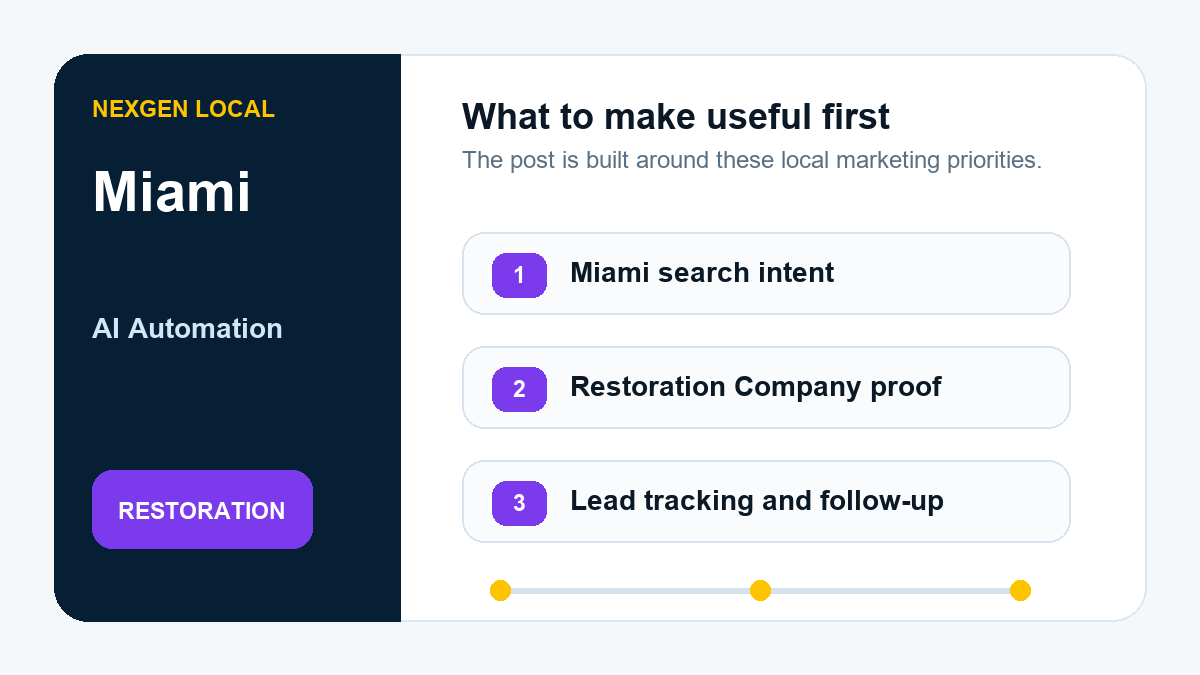
Miami searches can change by neighborhood: Brickell buyers behave differently from Doral business owners, Miami Beach condo managers, and Coral Gables homeowners.
Seasonality can include winter visitor demand, rainy-season service issues, luxury-property maintenance, and bilingual search paths. That matters because local search is not just a list of keywords. The same phrase can mean a quick emergency call, a research-stage project, a bid request, or a high-trust consultation depending on the neighborhood, service line, and buyer type.
For restoration companies, a useful page should make the local fit obvious. It should mention the service area in plain language, explain who the offer is for, show proof that matches the work, and give the visitor one clear next step. When a page only swaps in a city name, it may technically target the keyword, but it usually fails to answer the buyer’s real question.
What Miami restoration companies need to prove
The first qualified company to answer and document the job often controls the opportunity. In Miami, that pain point becomes more specific because the market includes Brickell, Coral Gables, Miami Beach, Doral, and high-rise condo corridors. The page should reduce doubt before the visitor calls, clicks, or fills out a form.
Restoration searches are urgent and documentation-heavy, so the campaign should connect response speed with clear process language.
A water damage lead should be routed to a fast call path, but the page still needs to explain documentation, mitigation steps, and service-area coverage.
Useful proof for this audience can include Emergency pages, process photos, insurance coordination notes, response-area detail, call tracking, and job documentation examples.. These details are not decoration. They help real visitors decide whether the company understands their job, and they help search engines connect the page to the right entity, service, and local context.
The AI Automation plan for this keyword
The job of AI automation is not to replace the sales process. It is to remove delays between inquiry, qualification, routing, and follow-up.
For AI Automation for restoration companies in Miami FL, the strategy should start with one primary intent and one conversion path. The campaign can still support secondary questions, but the main page should not drift into every possible marketing topic. A focused article is easier to optimize, easier to measure, and easier to improve after Search Console data starts showing real queries.
Use language that reflects water damage, mold remediation, or storm response when those are the jobs the business actually wants.
Reference Brickell, Coral Gables, Miami Beach, Doral, and high-rise condo corridors, service-area fit, project types, photos, reviews, or process details that help a Miami buyer trust the next step.
Separate calls, forms, booked appointments, disqualified leads, and follow-up notes so the page is judged by qualified opportunities instead of traffic alone.
What to build first
The first version should be practical enough that a business owner can see the work. For restoration companies, the strongest page usually combines local explanation, industry proof, a clear call-to-action, and a measurement plan. That gives the content a reason to exist beyond keyword coverage.
| Build area | What to add | How to measure it |
|---|---|---|
| Lead capture | Use forms, chat, call notes, and CRM fields to capture the actual service need, location, urgency, and next step. | Track response speed, qualified lead rate, missed-call recovery, booked appointments, and handoff completion for Miami restoration companies. |
| Qualification | Route poor-fit requests away from the sales calendar and push qualified prospects toward booking, quoting, or consultation. | Track response speed, qualified lead rate, missed-call recovery, booked appointments, and handoff completion for Miami restoration companies. |
| Follow-up | Trigger same-day reminders, missed-call replies, quote follow-ups, and no-show recovery without making the process feel robotic. | Track response speed, qualified lead rate, missed-call recovery, booked appointments, and handoff completion for Miami restoration companies. |
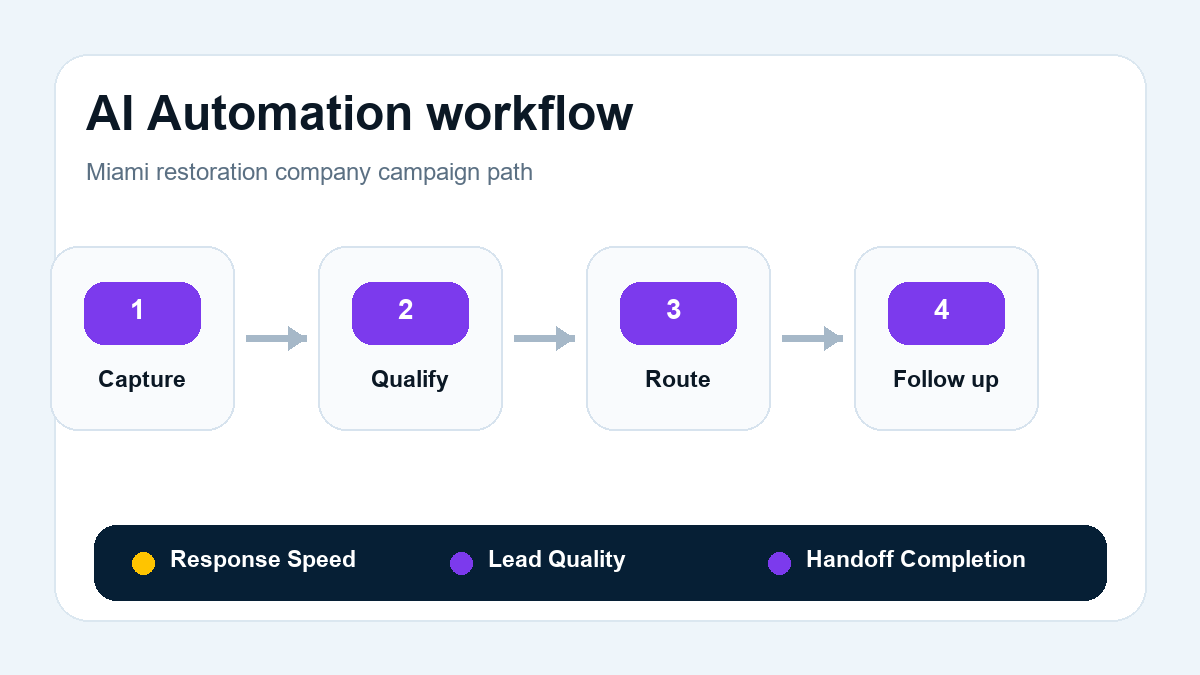
A small but complete build is better than a large campaign with no feedback loop. Start with one page or offer, connect it to the parent AI Automation service, support it with proof for the Restoration Companies audience, and point local readers toward the Miami service area. Then use call and form data to decide what deserves expansion.
Local examples to make the content stronger
A stronger Miami page can include a short section for neighborhoods or service zones, a short explanation of seasonal demand, and a practical note about how buyers compare providers. For this post, the local examples should connect South Florida context with restoration companies buying behavior.
For example, a restoration company serving Miami might need one message for urgent searchers, another for research-stage buyers, and another for high-value projects. The content should not pretend all leads are equal. It should explain how the business qualifies opportunities, what proof matters most, and what happens after the visitor takes action.
That is also where AI Automation becomes more than a marketing label. The service should help the business decide what to publish, what to promote, what to track, and what to stop doing. If a keyword gets impressions but no qualified action, the answer may be stronger proof, a clearer offer, better routing, or a more specific page.
Internal links and topical authority
This page should not sit alone. It supports the parent AI Automation page, reinforces the Restoration Companies industry section, and connects back to the Miami service area. Those internal links help the article pass relevance back to the pages that matter most for Nexgen’s core SEO.
Internal links should be useful to the reader, not forced into every sentence. The best pattern is simple: link up to the parent service, link sideways to related Florida posts, and link forward to a clear conversion action such as a strategy review or contact page.
Frequently asked questions
How can AI Automation help restoration companies in Miami?
AI Automation helps a restoration company in Miami connect local intent to a clearer conversion path. The goal is to show the right proof, route the right inquiries, and measure lead quality instead of only counting traffic.
What should a Miami restoration company build first?
Start with one priority service, one primary page or offer, call and form tracking, and proof that matches Brickell, Coral Gables, Miami Beach, Doral, and high-rise condo corridors. After the first data comes in, expand into related services, nearby neighborhoods, or supporting blog content.
How long should restoration companies track this before scaling?
A useful test should run long enough to collect impressions, clicks, calls, forms, booked appointments, and disqualified lead notes. The decision to expand should come from lead quality and conversion data, not from traffic volume alone.
What makes this different from a generic Florida marketing page?
This page connects AI Automation, restoration companies, and Miami search behavior in one place. It uses local context, industry proof, internal links, and a tracking plan so the page can support both users and core service SEO.
Author and review note
About this guide: This article is published under Vanessa Bailey’s Nexgen Local Marketing author profile and reviewed against Nexgen’s local search, paid media, conversion tracking, and content-quality checklist. It avoids unsupported ranking, lead, or revenue promises and focuses on practical steps a Florida business can verify.
Tracking, pruning, and improvement plan
After publishing, the page should be monitored in Google Search Console and Bing Webmaster Tools. The most useful early signals are impressions for the target topic, queries that include Miami, clicks from qualified searches, engagement with the call-to-action, and whether leads mention the service or location the page was built around.
Every quarter, the page should be reviewed. If it earns impressions but no clicks, the title and meta description may need work. If it earns clicks but no qualified actions, the offer, proof, form, or call path may need improvement. If it earns no meaningful impressions after enough time, it should be improved, merged into a stronger article, redirected, or noindexed instead of staying live as weak content.
Need a stronger Florida growth page for restoration companies?
Nexgen can review your Miami market, service mix, page structure, proof assets, and tracking setup before you scale content or ads.
Call 407-307-1995, email info@nexgenlocalmarketing.com, or request a Florida strategy review.
Orlando Pool Builders: Turning Local SEO Into Better Local Leads
Search Engine Optimization
Local SEO for pool builders in Orlando FL is a narrow search, which is exactly why the page has to be useful. A pool builder in Orlando is not looking for a broad marketing definition. They need to understand what to build, what to measure, and how the strategy should fit the local market.
Quick answer
Local SEO for pool builders in Orlando FL should be built as a focused local asset, not a generic marketing article. The page needs city context, industry proof, a conversion path, and tracking that shows whether the traffic becomes qualified conversations.
In this expanded guide
Primary keyword
Local SEO for pool builders in Orlando FL
Best-fit intent
A local business owner or manager comparing whether Local SEO can create better leads, better follow-up, or better search visibility for pool builders in Orlando.
Why the Orlando market changes the strategy
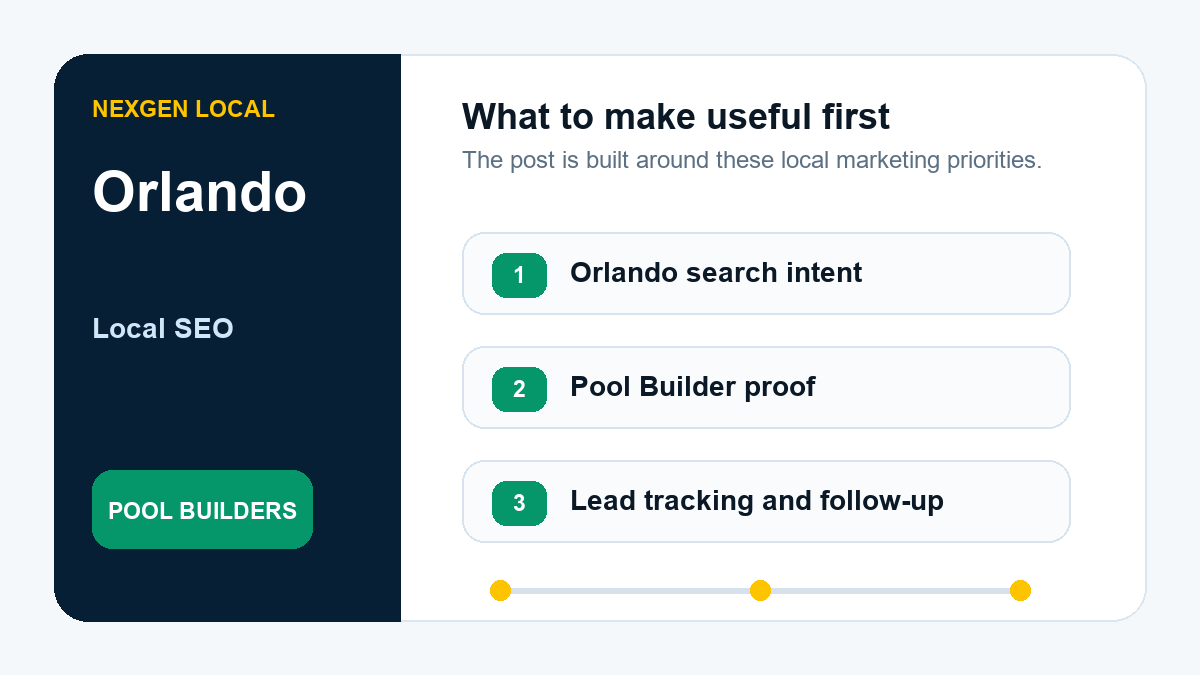
Orlando demand often splits between tourism corridors, Lake Nona growth, Winter Park searches, and contractors serving suburbs across Central Florida.
Seasonality often comes from travel cycles, summer storms, convention traffic, and families moving across Central Florida suburbs. That matters because local search is not just a list of keywords. The same phrase can mean a quick emergency call, a research-stage project, a bid request, or a high-trust consultation depending on the neighborhood, service line, and buyer type.
For pool builders, a useful page should make the local fit obvious. It should mention the service area in plain language, explain who the offer is for, show proof that matches the work, and give the visitor one clear next step. When a page only swaps in a city name, it may technically target the keyword, but it usually fails to answer the buyer’s real question.
What Orlando pool builders need to prove
High-ticket projects need visual proof, financing clarity, and strong local credibility. In Orlando, that pain point becomes more specific because the market includes theme-park corridors, Lake Nona, Winter Park, and surrounding suburbs. The page should reduce doubt before the visitor calls, clicks, or fills out a form.
Pool projects are high-ticket and comparison-heavy, so the campaign has to show process, design fit, financing or timeline clarity, and local credibility.
A custom pool lead should be qualified by project type, location, timeline, financing interest, and whether the buyer needs design, resurfacing, or enclosure work.
Useful proof for this audience can include Gallery pages, process explainers, permit or timeline FAQs, service-area pages, review themes, and quote request tracking.. These details are not decoration. They help real visitors decide whether the company understands their job, and they help search engines connect the page to the right entity, service, and local context.
The Local SEO plan for this keyword
Local SEO should connect service intent, local proof, Google Business Profile signals, and service-area pages into one useful search footprint.
For Local SEO for pool builders in Orlando FL, the strategy should start with one primary intent and one conversion path. The campaign can still support secondary questions, but the main page should not drift into every possible marketing topic. A focused article is easier to optimize, easier to measure, and easier to improve after Search Console data starts showing real queries.
Use language that reflects custom pools, pool resurfacing, or screen enclosures when those are the jobs the business actually wants.
Reference theme-park corridors, Lake Nona, Winter Park, and surrounding suburbs, service-area fit, project types, photos, reviews, or process details that help a Orlando buyer trust the next step.
Separate calls, forms, booked appointments, disqualified leads, and follow-up notes so the page is judged by qualified opportunities instead of traffic alone.
What to build first
The first version should be practical enough that a business owner can see the work. For pool builders, the strongest page usually combines local explanation, industry proof, a clear call-to-action, and a measurement plan. That gives the content a reason to exist beyond keyword coverage.
| Build area | What to add | How to measure it |
|---|---|---|
| Page relevance | Build pages around real services, neighborhoods, proof, FAQs, and conversion paths instead of thin location swaps. | Track local impressions, map actions, organic leads, service-area visibility, and page-level engagement for Orlando pool builders. |
| GBP alignment | Keep categories, services, photos, reviews, posts, and calls consistent with what the website is trying to rank for. | Track local impressions, map actions, organic leads, service-area visibility, and page-level engagement for Orlando pool builders. |
| Authority building | Use internal links, citations, content updates, and review themes to reinforce the same local topics over time. | Track local impressions, map actions, organic leads, service-area visibility, and page-level engagement for Orlando pool builders. |
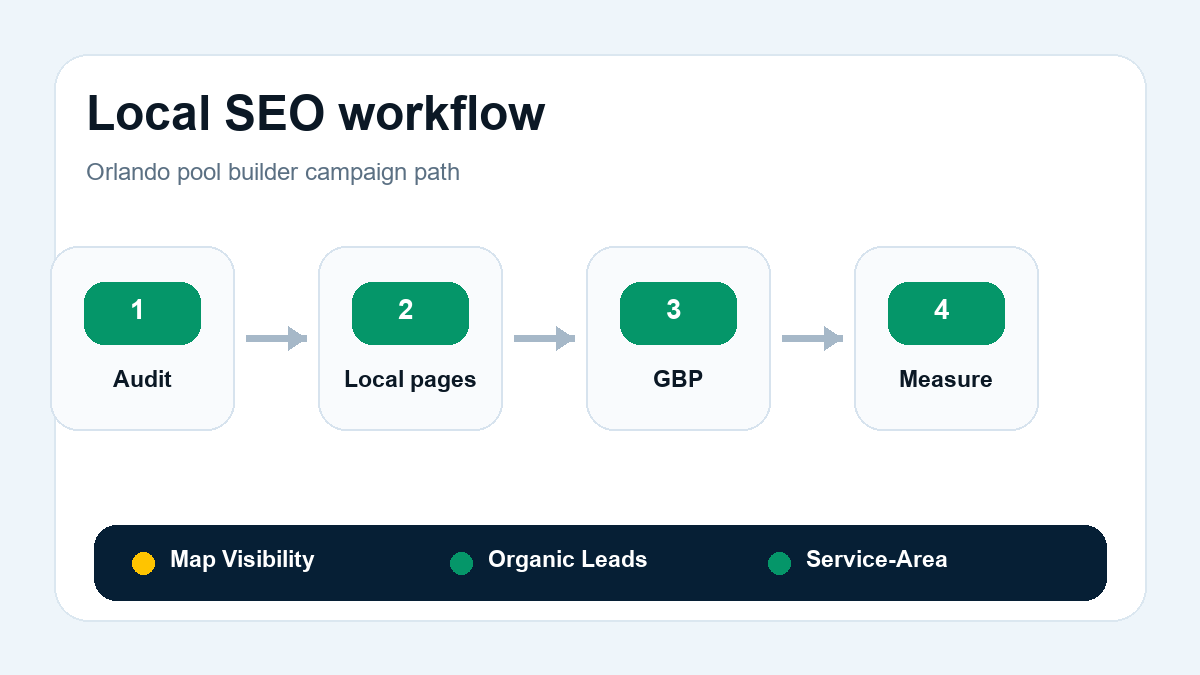
A small but complete build is better than a large campaign with no feedback loop. Start with one page or offer, connect it to the parent Local SEO service, support it with proof for the Pool Builders audience, and point local readers toward the Orlando service area. Then use call and form data to decide what deserves expansion.
Local examples to make the content stronger
A stronger Orlando page can include a short section for neighborhoods or service zones, a short explanation of seasonal demand, and a practical note about how buyers compare providers. For this post, the local examples should connect Central Florida context with pool builders buying behavior.
For example, a pool builder serving Orlando might need one message for urgent searchers, another for research-stage buyers, and another for high-value projects. The content should not pretend all leads are equal. It should explain how the business qualifies opportunities, what proof matters most, and what happens after the visitor takes action.
That is also where Local SEO becomes more than a marketing label. The service should help the business decide what to publish, what to promote, what to track, and what to stop doing. If a keyword gets impressions but no qualified action, the answer may be stronger proof, a clearer offer, better routing, or a more specific page.
Internal links and topical authority
This page should not sit alone. It supports the parent Local SEO page, reinforces the Pool Builders industry section, and connects back to the Orlando service area. Those internal links help the article pass relevance back to the pages that matter most for Nexgen’s core SEO.
Internal links should be useful to the reader, not forced into every sentence. The best pattern is simple: link up to the parent service, link sideways to related Florida posts, and link forward to a clear conversion action such as a strategy review or contact page.
Frequently asked questions
How can Local SEO help pool builders in Orlando?
Local SEO helps a pool builder in Orlando connect local intent to a clearer conversion path. The goal is to show the right proof, route the right inquiries, and measure lead quality instead of only counting traffic.
What should a Orlando pool builder build first?
Start with one priority service, one primary page or offer, call and form tracking, and proof that matches theme-park corridors, Lake Nona, Winter Park, and surrounding suburbs. After the first data comes in, expand into related services, nearby neighborhoods, or supporting blog content.
How long should pool builders track this before scaling?
A useful test should run long enough to collect impressions, clicks, calls, forms, booked appointments, and disqualified lead notes. The decision to expand should come from lead quality and conversion data, not from traffic volume alone.
What makes this different from a generic Florida marketing page?
This page connects Local SEO, pool builders, and Orlando search behavior in one place. It uses local context, industry proof, internal links, and a tracking plan so the page can support both users and core service SEO.
Author and review note
About this guide: This article is published under Vanessa Bailey’s Nexgen Local Marketing author profile and reviewed against Nexgen’s local search, paid media, conversion tracking, and content-quality checklist. It avoids unsupported ranking, lead, or revenue promises and focuses on practical steps a Florida business can verify.
Tracking, pruning, and improvement plan
After publishing, the page should be monitored in Google Search Console and Bing Webmaster Tools. The most useful early signals are impressions for the target topic, queries that include Orlando, clicks from qualified searches, engagement with the call-to-action, and whether leads mention the service or location the page was built around.
Every quarter, the page should be reviewed. If it earns impressions but no clicks, the title and meta description may need work. If it earns clicks but no qualified actions, the offer, proof, form, or call path may need improvement. If it earns no meaningful impressions after enough time, it should be improved, merged into a stronger article, redirected, or noindexed instead of staying live as weak content.
Need a stronger Florida growth page for pool builders?
Nexgen can review your Orlando market, service mix, page structure, proof assets, and tracking setup before you scale content or ads.
Call 407-307-1995, email info@nexgenlocalmarketing.com, or request a Florida strategy review.
Orlando Roofing Companies AI Automation: A Practical Local Growth Plan
AI Automation
AI Automation for roofing companies in Orlando FL is a narrow search, which is exactly why the page has to be useful. A roofing company in Orlando is not looking for a broad marketing definition. They need to understand what to build, what to measure, and how the strategy should fit the local market.
Quick answer
AI Automation for roofing companies in Orlando FL should be built as a focused local asset, not a generic marketing article. The page needs city context, industry proof, a conversion path, and tracking that shows whether the traffic becomes qualified conversations.
In this expanded guide
Primary keyword
AI Automation for roofing companies in Orlando FL
Best-fit intent
A local business owner or manager comparing whether AI Automation can create better leads, better follow-up, or better search visibility for roofing companies in Orlando.
Why the Orlando market changes the strategy
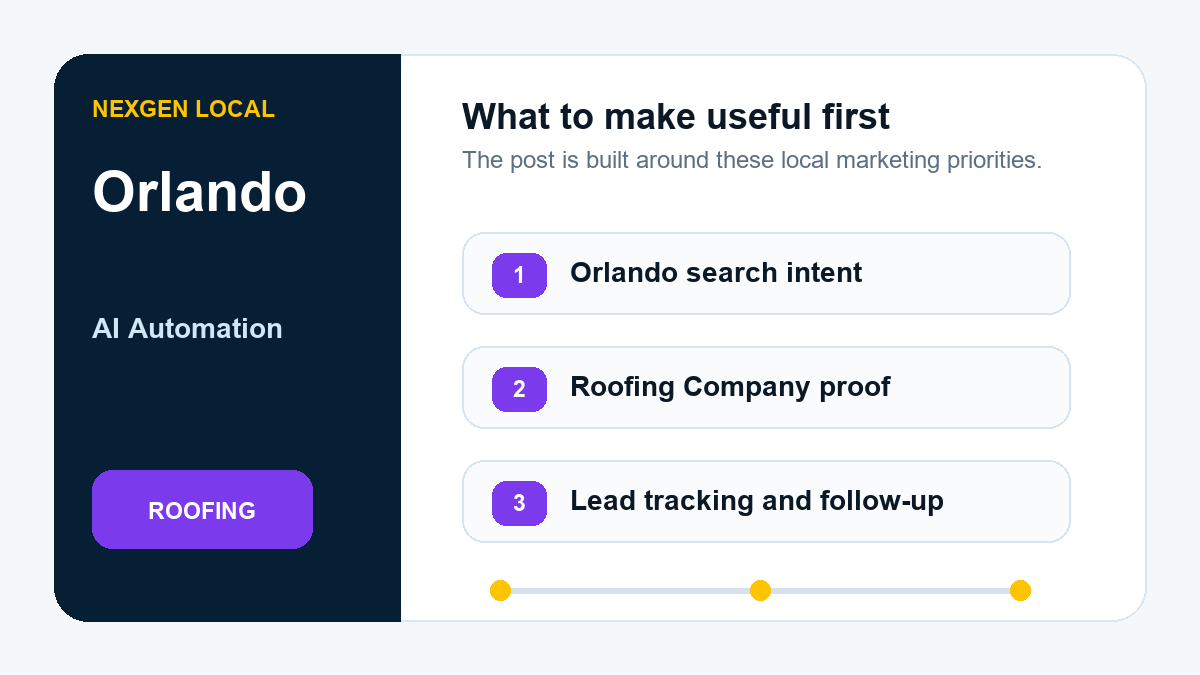
Orlando demand often splits between tourism corridors, Lake Nona growth, Winter Park searches, and contractors serving suburbs across Central Florida.
Seasonality often comes from travel cycles, summer storms, convention traffic, and families moving across Central Florida suburbs. That matters because local search is not just a list of keywords. The same phrase can mean a quick emergency call, a research-stage project, a bid request, or a high-trust consultation depending on the neighborhood, service line, and buyer type.
For roofing companies, a useful page should make the local fit obvious. It should mention the service area in plain language, explain who the offer is for, show proof that matches the work, and give the visitor one clear next step. When a page only swaps in a city name, it may technically target the keyword, but it usually fails to answer the buyer’s real question.
What Orlando roofing companies need to prove
Storm-driven demand can spike quickly, and slow response usually means the job goes elsewhere. In Orlando, that pain point becomes more specific because the market includes theme-park corridors, Lake Nona, Winter Park, and surrounding suburbs. The page should reduce doubt before the visitor calls, clicks, or fills out a form.
A roofing page should separate repair, replacement, inspection, and storm-response intent because each visitor is in a different buying moment.
For a roof replacement lead, the page should show roof type, service area, inspection process, financing or estimate language if offered, and the follow-up path after the form is submitted.
Useful proof for this audience can include Project photos, roof-material pages, warranty language, inspection checklists, review themes, and clear emergency-response expectations.. These details are not decoration. They help real visitors decide whether the company understands their job, and they help search engines connect the page to the right entity, service, and local context.
The AI Automation plan for this keyword
The job of AI automation is not to replace the sales process. It is to remove delays between inquiry, qualification, routing, and follow-up.
For AI Automation for roofing companies in Orlando FL, the strategy should start with one primary intent and one conversion path. The campaign can still support secondary questions, but the main page should not drift into every possible marketing topic. A focused article is easier to optimize, easier to measure, and easier to improve after Search Console data starts showing real queries.
Use language that reflects storm repair, tile roof replacement, or roof inspections when those are the jobs the business actually wants.
Reference theme-park corridors, Lake Nona, Winter Park, and surrounding suburbs, service-area fit, project types, photos, reviews, or process details that help a Orlando buyer trust the next step.
Separate calls, forms, booked appointments, disqualified leads, and follow-up notes so the page is judged by qualified opportunities instead of traffic alone.
What to build first
The first version should be practical enough that a business owner can see the work. For roofing companies, the strongest page usually combines local explanation, industry proof, a clear call-to-action, and a measurement plan. That gives the content a reason to exist beyond keyword coverage.
| Build area | What to add | How to measure it |
|---|---|---|
| Lead capture | Use forms, chat, call notes, and CRM fields to capture the actual service need, location, urgency, and next step. | Track response speed, qualified lead rate, missed-call recovery, booked appointments, and handoff completion for Orlando roofing companies. |
| Qualification | Route poor-fit requests away from the sales calendar and push qualified prospects toward booking, quoting, or consultation. | Track response speed, qualified lead rate, missed-call recovery, booked appointments, and handoff completion for Orlando roofing companies. |
| Follow-up | Trigger same-day reminders, missed-call replies, quote follow-ups, and no-show recovery without making the process feel robotic. | Track response speed, qualified lead rate, missed-call recovery, booked appointments, and handoff completion for Orlando roofing companies. |
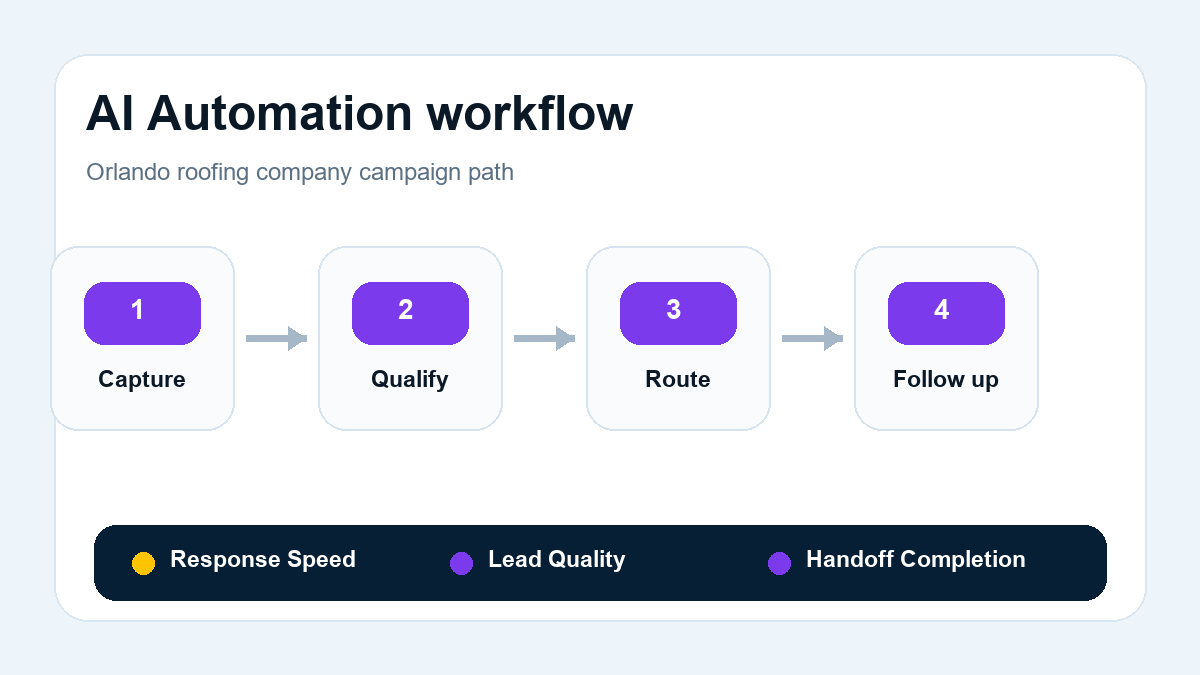
A small but complete build is better than a large campaign with no feedback loop. Start with one page or offer, connect it to the parent AI Automation service, support it with proof for the Roofing Companies audience, and point local readers toward the Orlando service area. Then use call and form data to decide what deserves expansion.
Local examples to make the content stronger
A stronger Orlando page can include a short section for neighborhoods or service zones, a short explanation of seasonal demand, and a practical note about how buyers compare providers. For this post, the local examples should connect Central Florida context with roofing companies buying behavior.
For example, a roofing company serving Orlando might need one message for urgent searchers, another for research-stage buyers, and another for high-value projects. The content should not pretend all leads are equal. It should explain how the business qualifies opportunities, what proof matters most, and what happens after the visitor takes action.
That is also where AI Automation becomes more than a marketing label. The service should help the business decide what to publish, what to promote, what to track, and what to stop doing. If a keyword gets impressions but no qualified action, the answer may be stronger proof, a clearer offer, better routing, or a more specific page.
Internal links and topical authority
This page should not sit alone. It supports the parent AI Automation page, reinforces the Roofing Companies industry section, and connects back to the Orlando service area. Those internal links help the article pass relevance back to the pages that matter most for Nexgen’s core SEO.
Internal links should be useful to the reader, not forced into every sentence. The best pattern is simple: link up to the parent service, link sideways to related Florida posts, and link forward to a clear conversion action such as a strategy review or contact page.
Frequently asked questions
How can AI Automation help roofing companies in Orlando?
AI Automation helps a roofing company in Orlando connect local intent to a clearer conversion path. The goal is to show the right proof, route the right inquiries, and measure lead quality instead of only counting traffic.
What should a Orlando roofing company build first?
Start with one priority service, one primary page or offer, call and form tracking, and proof that matches theme-park corridors, Lake Nona, Winter Park, and surrounding suburbs. After the first data comes in, expand into related services, nearby neighborhoods, or supporting blog content.
How long should roofing companies track this before scaling?
A useful test should run long enough to collect impressions, clicks, calls, forms, booked appointments, and disqualified lead notes. The decision to expand should come from lead quality and conversion data, not from traffic volume alone.
What makes this different from a generic Florida marketing page?
This page connects AI Automation, roofing companies, and Orlando search behavior in one place. It uses local context, industry proof, internal links, and a tracking plan so the page can support both users and core service SEO.
Author and review note
About this guide: This article is published under Vanessa Bailey’s Nexgen Local Marketing author profile and reviewed against Nexgen’s local search, paid media, conversion tracking, and content-quality checklist. It avoids unsupported ranking, lead, or revenue promises and focuses on practical steps a Florida business can verify.
Tracking, pruning, and improvement plan
After publishing, the page should be monitored in Google Search Console and Bing Webmaster Tools. The most useful early signals are impressions for the target topic, queries that include Orlando, clicks from qualified searches, engagement with the call-to-action, and whether leads mention the service or location the page was built around.
Every quarter, the page should be reviewed. If it earns impressions but no clicks, the title and meta description may need work. If it earns clicks but no qualified actions, the offer, proof, form, or call path may need improvement. If it earns no meaningful impressions after enough time, it should be improved, merged into a stronger article, redirected, or noindexed instead of staying live as weak content.
Need a stronger Florida growth page for roofing companies?
Nexgen can review your Orlando market, service mix, page structure, proof assets, and tracking setup before you scale content or ads.
Call 407-307-1995, email info@nexgenlocalmarketing.com, or request a Florida strategy review.
Local SEO for Dentists: Why It Costs More and Returns More in 2026
Search Engine Optimization
You’ve seen the proposals. You’ve heard the pitches. Why does effective local SEO for dentists command a higher budget than for almost any other local business? It’s because the return on that investment isn't just incremental—it's practice-defining, capable of delivering high-value patients whose lifetime value dwarfs the initial marketing spend.
Quick answer
Dental SEO costs more because each new patient can create repeat value, reviews matter heavily, and map visibility must be built with care.
GBP strength
This is one of the core pieces that makes dental local SEO work as a practical business strategy.
Review velocity
This is one of the core pieces that makes dental local SEO work as a practical business strategy.
This guide breaks down the precise economics, strategies, and compliance requirements for dental SEO in 2026. We’ll explore why this channel provides such high leverage, what it actually costs, and what you should expect from a top-tier campaign.
The Dental SEO Economics in 2026
The math behind premium dental SEO is straightforward. Unlike a restaurant where a new customer might spend $50, a new dental patient represents a significant long-term asset. A single new patient’s lifetime value (LTV) can range from $1,500 for routine check-ups to over $50,000 for complex cosmetic or restorative cases like full-arch implants.
Consider the value of a single keyword. Ranking in the top 3 on Google for a high-intent term like “dental implants [Your City]” might bring in just two or three new patients a month. However, if each of those cases is worth $25,000, that single ranking is generating $50,000-$75,000 in monthly revenue. A single month of high visibility can pay for multiple years of a comprehensive SEO campaign. This LTV-to-cost ratio is why successful practices view SEO not as an expense, but as their most critical growth investment.
Why Local SEO is the Highest-Leverage Marketing Channel for Dentists
While channels like mailers, radio, and even pay-per-click ads have their place, local SEO offers unparalleled leverage for dental practices. When a potential patient searches for “emergency dentist near me” or “Invisalign in [neighborhood],” they have an immediate, pressing need. You aren’t creating demand; you are capturing existing intent at the exact moment of decision.
- General Dentists: Attract a steady flow of new families and individuals for cleanings and routine care, the bedrock of a stable practice.
- Cosmetic Practices: Connect with patients actively seeking high-value procedures like veneers, teeth whitening, and full smile makeovers.
- Pediatric Practices: Be the trusted choice for parents searching for a “kids dentist” in their area, building a patient base that can last for years.
- Specialty Practices (Endodontists, Orthodontists, etc.): Capture referrals and direct searches from patients who know they need a specific, complex procedure.
No other channel targets these high-intent moments as effectively. A well-executed search engine optimization strategy ensures your practice is the one they find, call, and book.
Google Business Profile: Your Digital Front Door
For dentists, your Google Business Profile (GBP) is no longer just a listing; it’s your most important digital asset. It’s often the first—and sometimes only—interaction a potential patient has with your practice online. Winning here requires a dental-specific strategy.
Category Strategy: Your primary category must be chosen carefully. While “Dentist” is common, “General Dentist” is often better. Then, use secondary categories to capture your high-value services, such as “Cosmetic Dentist,” “Pediatric Dentist,” or “Endodontist.”
Services List: Don’t just list services; detail them. For each service (e.g., “Dental Implants,” “Root Canal Therapy”), add a full description explaining the procedure, the benefits, and why a patient should choose your practice for it. This adds keyword relevance and educates patients.
Photos and Videos: Patients are choosing a healthcare provider, and trust is paramount. Your GBP photos should go beyond stock images. Showcase your modern, clean office; the friendly faces of your staff and dentists; and advanced technology. Before-and-after shots (with patient consent) are incredibly powerful for cosmetic services. A short office tour video can also build significant trust before a patient ever steps through the door.
Optimizing your Google Business Profile is a critical component of any campaign focused on local SEO for dentists.
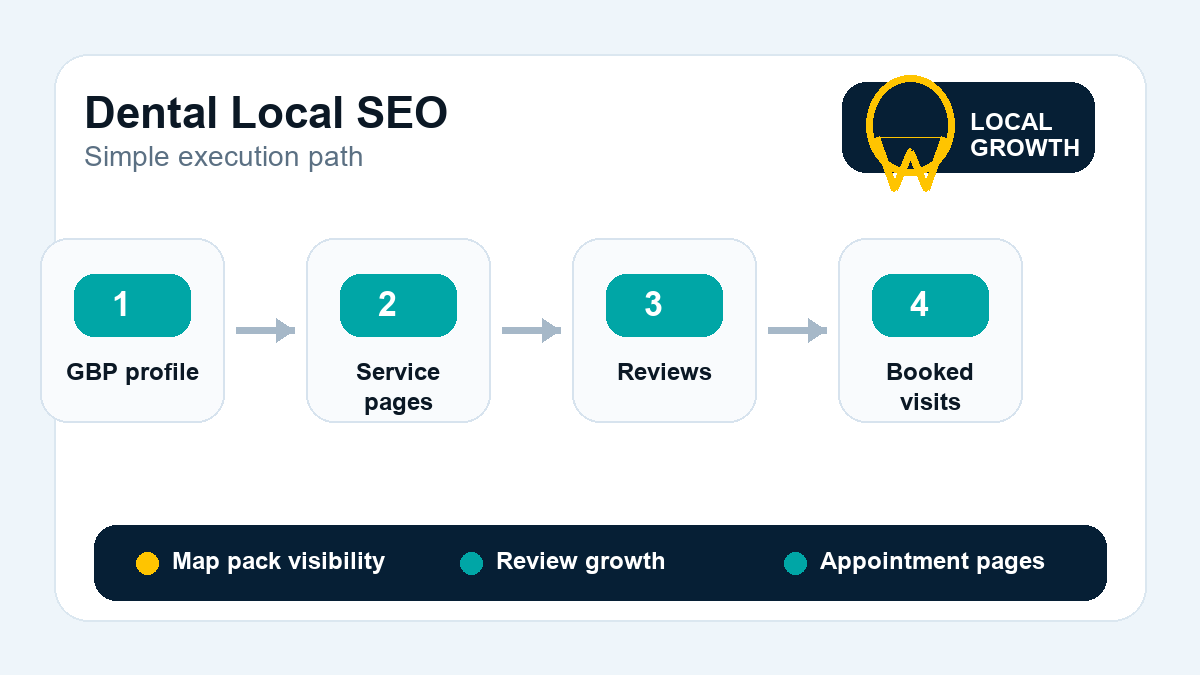
The Review Imperative: 4.7 Stars and 100+ Reviews
In 2026, having a few good reviews is not enough. The dental market is too competitive. To stand out in a crowded local search result, practices need to aim for two key benchmarks:
- A 4.7-star rating or higher: The difference between 4.5 and 4.8 stars can be the deciding factor for a patient choosing between two otherwise identical practices.
- 100+ recent reviews: A high volume of reviews signals to both Google and patients that your practice is active, established, and consistently provides a positive experience.
Prospective patients scrutinize reviews for mentions of gentleness, staff friendliness, wait times, and billing transparency. A steady stream of positive, detailed reviews is one of the most powerful signals for both search engine rankings and patient conversions.
Hyperlocal Content: Winning the Neighborhood
Patients want a dentist who is not just in their city, but in their corner of the city. A sophisticated local SEO for dentists strategy goes beyond targeting the main city name and drills down to the neighborhood level. This is achieved through a robust hyperlocal content strategy.
- Neighborhood-Level Pages: Create dedicated pages for the key neighborhoods you serve (e.g., “Your Dentist in Baldwin Park,” “Winter Park’s Choice for Family Dentistry”). These pages should feature unique content relevant to that specific area.
- Condition-Specific Landing Pages: Build out high-performance landing pages for your most valuable services combined with location terms. Examples include “Invisalign Cost in Lake Nona” or “Emergency Dental Care in Downtown Orlando.” These pages are built to convert searchers with a very specific need.
- Insurance Acceptance Pages: Many patients begin their search with the insurance they carry. Creating pages like “Dentist that Accepts Cigna in Orlando” can capture highly qualified traffic that your competitors might be missing.
This content strategy positions your practice as the preeminent local authority, directly answering the specific questions your ideal patients are asking. This is a cornerstone of modern dentist marketing.
Patient-Intent Keyword Strategy
Ranking #1 for “dentist” is great, but it’s a vanity metric. True success comes from ranking for keywords that demonstrate clear patient intent and map directly to your high-value services. Your keyword strategy must be diverse and reflect the different stages of the patient journey:
- Emergency Intent: “emergency dentist,” “cracked tooth repair,” “toothache relief near me”
- General Intent: “dentist near me,” “best dentist in [city],” “family dentist accepting new patients”
- Cosmetic Intent: “cosmetic dentist,” “veneers cost,” “professional teeth whitening”
- Pediatric Intent: “kids dentist near me,” “pediatric dentist for toddlers”
- Specialty Intent: “sedation dentistry,” “dental implants [city],” “orthodontist for adults”
A successful campaign identifies the most profitable keywords for your specific service mix and builds a comprehensive strategy to achieve top rankings for them.
Schema for Dentists: Speaking Google’s Language
Schema markup is code you add to your website to help search engines understand the context of your content. For dentists, it’s a powerful tool to gain a competitive edge. It helps Google display rich results, like star ratings and FAQs, directly in the search results. An advanced strategy involves layering multiple schema types:
- Dentist (LocalBusiness Sub-type): This is the foundation. It clearly tells Google that your business is a dental practice, and includes crucial information like your address, phone number, and hours.
- MedicalProcedure: For each service you offer (like fillings, crowns, or implants), you can use this schema to describe the procedure, its purpose, and how it’s performed.
- FAQPage: Use this on your FAQ pages (or even service pages with Q&A sections) to have your questions and answers appear directly in Google’s search results, dominating more screen real estate.
- Person: Each dentist in your practice should have `Person` schema applied to their bio, highlighting their credentials, education, and specializations. This builds authority and trust.
Properly implemented schema ensures that Google sees your practice not just as a local business, but as a specialized medical authority.
HIPAA-Compliant Marketing Constraints
Patient privacy is non-negotiable. The Health Insurance Portability and Accountability Act (HIPAA) governs how you can use and disclose Protected Health Information (PHI). This has direct implications for your marketing.
You cannot use patient testimonials that include specific health details without explicit, written authorization. Responding to a negative review with details about a patient’s treatment is a serious violation. Your staff and any marketing agency you partner with must be trained on these constraints. This means focusing marketing copy on procedures, technology, and patient experience in general terms, rather than on individual patient stories or outcomes, unless you have cleared the extensive legal hurdles for using a specific, authorized case study.
Budget Benchmarks for Dental Local SEO in 2026
Dental SEO is not a commodity. The investment required correlates directly with market competitiveness and the practice’s growth goals. While precise figures vary, here are some realistic monthly budget benchmarks for 2026. For a more detailed breakdown, see our Orlando local SEO cost guide.
- Single-Practitioner Practice (Moderate Competition): $2,500 – $5,000/month. This level of investment supports core local SEO, GBP management, content creation for key services, and reputation management.
- 2-4 Doctor Practice (High Competition): $5,000 – $10,000/month. This budget allows for a more aggressive strategy, including hyperlocal content, advanced schema, digital PR, and link building to compete in a crowded urban market.
- DSO / Multi-Location Practice (Very High Competition): $10,000 – $25,000+/month. At this scale, the strategy must manage multiple GBP listings, create content for numerous locations and services, and often includes a significant budget for earning high-authority backlinks and local citations.
Be wary of low-cost providers. Ineffective SEO is worse than no SEO; it wastes time and can even harm your online reputation.
Frequently Asked Questions About Dental SEO
How soon will I see new patients from local SEO?
While some quick wins from GBP optimization can yield results in 1-3 months, foundational SEO is a long-term strategy. You should expect to see meaningful increases in organic traffic and new patient calls within 4-6 months, with the campaign’s full impact building over 9-12 months as your website’s authority grows.
Can a small practice rank against DSOs?
Yes. While Dental Service Organizations (DSOs) have massive budgets, they often lack local authenticity. A single-location practice can win by being more agile, building a stronger local brand, generating more authentic reviews from a tight-knit patient base, and creating highly specific hyperlocal content that a large corporation’s marketing team might overlook.
Is Google Business Profile enough, or do I need a website too?
You absolutely need a professional, modern website. Your GBP is your digital storefront, but your website is your entire store. It’s where you control the narrative, build deep authority with service and condition-specific pages, host your dentist bios, and ultimately convert high-value patients who want to do more thorough research before booking.
Do paid ads and SEO work together?
They work exceptionally well together. Paid ads on Google can generate patient leads immediately while your long-term SEO strategy gains traction. Furthermore, you can use data from your paid ads campaigns—like which keywords convert best—to inform and prioritize your SEO efforts, creating a powerful feedback loop for growth.
What if I open a second location?
Opening a second location requires a distinct local SEO strategy for that new address. This includes creating a new, separate Google Business Profile, building location-specific pages on your website, and launching a new citation and review generation campaign targeted at the new service area. It’s not as simple as adding the new address to your existing website; it requires a dedicated effort to establish that new location as its own local entity.
Ultimately, a strategic investment in local SEO for dentists is one of the most reliable paths to sustainable, long-term practice growth. By focusing on patient intent, building trust through reviews and content, and executing a technically sound strategy, you can attract the high-value patients you need to thrive. To see how other practices have achieved this, review some of our client case studies or call our team directly at 407-307-1995 to discuss a custom analysis for your practice.
Action checklist
Want to understand your dental SEO opportunity?
Nexgen can review your market, reviews, competitors, and local search visibility.
SEO for HVAC Contractors: Capturing Emergency Service Calls in 2026
Search Engine Optimization
Your phone rings at 8 PM on a sweltering July night. The person on the other end isn't price-shopping; their AC is out, and they need help now . This is the money call in the HVAC business, and in 2026, it's won or lost on the first page of Google. This post breaks down the exact strategies required to capture those high-intent, emergency service calls through smart, modern SEO for HVAC contractors .
Quick answer
HVAC SEO works when emergency intent, service-area pages, reviews, and fast mobile pages are aligned around real calls.
Emergency intent
This is one of the core pieces that makes HVAC SEO work as a practical business strategy.
Map pack trust
This is one of the core pieces that makes HVAC SEO work as a practical business strategy.
Why HVAC is a Brutal SEO Category in 2026
Competing for visibility in the HVAC space has never been more intense. Three core challenges make it a formidable landscape for independent contractors. First, national franchises and private equity-backed consolidators are pouring unprecedented amounts of money into digital advertising, often buying up prime digital real estate and driving up costs for everyone. Their massive budgets allow for sustained, aggressive campaigns that can drown out smaller players.
Second, this heavy spending directly impacts Pay-Per-Click (PPC) advertising. Cost-per-click (CPC) for valuable keywords like “emergency ac repair” can be astronomically high, making a pure PPC strategy unsustainable for many. This economic pressure makes a strong organic presence through SEO not just a nice-to-have, but a critical component of a profitable lead generation engine. Organic results deliver qualified traffic without a per-click cost, providing a much higher return on investment over time.
Finally, the inherent seasonality of the HVAC industry creates a feast-or-famine cycle. Extreme heat waves and sudden cold snaps cause demand to spike, but what about the milder months? A robust SEO strategy ensures your business remains visible year-round, capturing leads for maintenance, system replacements, and indoor air quality solutions during the shoulder seasons. Without that consistent visibility, your business is left vulnerable to unpredictable weather patterns and intense, concentrated competition during peak times.
The Keyword Landscape That Actually Books Service Calls
A winning SEO strategy for an HVAC contractor hinges on understanding user intent—the “why” behind a search. Not all keywords are created equal. We can separate them into two main categories: emergency-intent keywords and research-intent keywords.
Emergency-intent keywords are phrases typed by people who need immediate help. These are your highest-value targets for booking service calls. They are specific, problem-oriented, and often include terms that signal urgency.
- “AC not cooling”
- “furnace won’t turn on”
- “no heat in house”
- “heat pump making loud noise”
- “emergency hvac repair near me”
- “24/7 ac service orlando”
These searchers are not comparison shopping for a system replacement next year; they are looking for a fast, reliable solution to an immediate and uncomfortable problem. Your website and Google Business Profile must be optimized to directly answer these queries to capture the lead.
Research-intent keywords, on the other hand, are used by people in the earlier stages of the buying cycle. They are gathering information, comparing options, or planning for future projects.
- “how often to replace hvac system”
- “cost of new heat pump”
- “best ac unit for florida home”
- “seer rating explained”
- “gas furnace vs heat pump”
While these keywords may not lead to an immediate service call, they are incredibly valuable for building trust and establishing your company as an authority. By providing helpful answers to these questions on your blog, you attract potential customers early, nurturing them until they are ready to make a purchase or require service. A comprehensive HVAC marketing plan targets both types of intent to build a sustainable sales pipeline.
Google Business Profile: The #1 Lever for HVAC SEO in 2026
For a local service business like an HVAC company, your Google Business Profile (GBP) is not just a listing—it is your single most powerful SEO asset. In 2026, Google is placing more emphasis than ever on GBP as a primary source of information for ranking businesses in the local map pack. It is often the first interaction a potential customer has with your brand.
Optimizing your GBP is non-negotiable. Start with the fundamentals: ensure your primary category is “HVAC contractor” and then add secondary categories like “Air conditioning contractor,” “Heating contractor,” and “Air conditioning repair service.” From there, meticulously build out your list of services. Don’t just list “AC Repair”; add specific, long-tail services like “Ductless mini-split installation,” “Thermostat repair,” and “Emergency furnace service.” This level of detail directly impacts your relevance for specific user searches.
Active management is key. During a heat wave, use Google Posts to share a message like, “Experiencing an AC outage? Our team is working extended hours to serve you.” During a cold snap, post about furnace tune-ups. Regularly upload high-quality photos of your team, your service vans, and completed installations. These actions signal to Google that your business is active, relevant, and engaged. Finally, focus on generating a steady stream of positive reviews, as this is a cornerstone of both prominence and customer trust. A well-managed GBP is the foundation of local SEO success, and our team provides expert Google Business Profile services to ensure you’re maximizing this critical platform. For a deeper dive, review our guide to Google Business Profile setup and optimization in 2026.
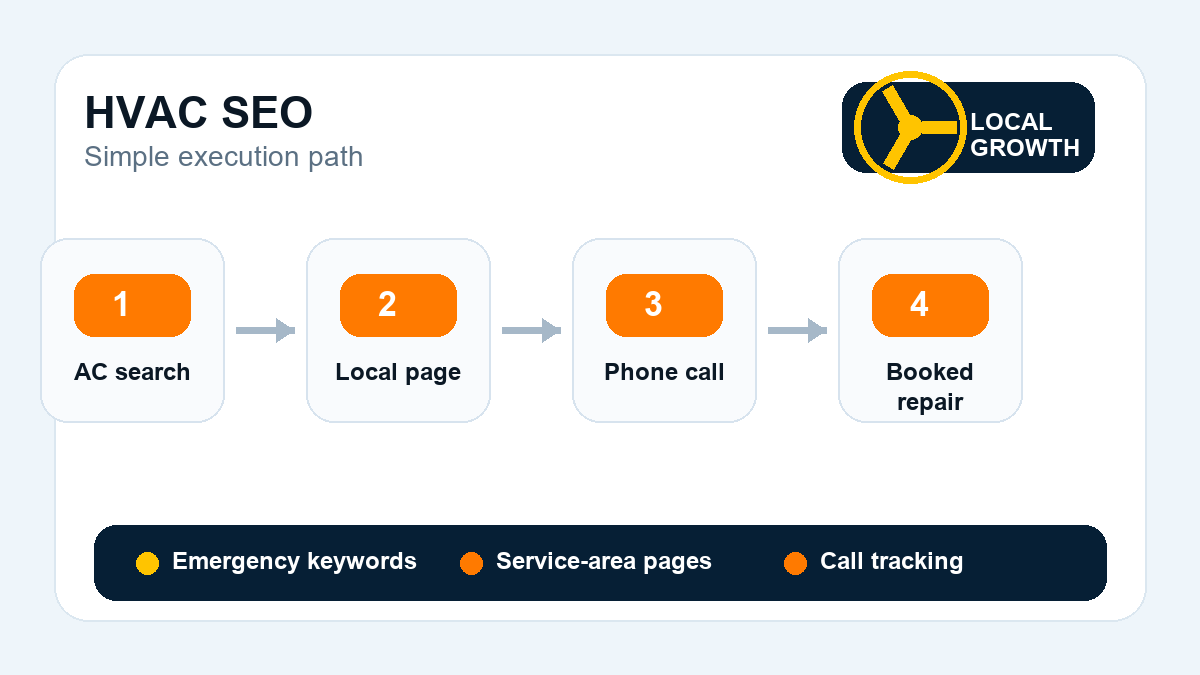
Local Pack Ranking Factors Specific to HVAC
Appearing in the coveted Google “Local Pack” (the map and three business listings at the top of local search results) is the primary goal of SEO for HVAC contractors. This is where emergency-service customers find their provider. Three core factors determine your ranking: proximity, prominence, and relevance.
- Proximity: This refers to how close your business is to the person searching. While you can’t change your physical address, you can signal your service area clearly to Google through your GBP settings and service-area pages on your website. For a search like “ac repair near me,” Google will heavily favor businesses that are geographically close to the user’s location.
- Prominence: This is a measure of how well-known and well-regarded your business is. In the digital world, prominence is largely defined by your review profile. The quantity, quality (average star rating), and velocity (the speed at which you get new reviews) of your Google reviews are immensely important. Prominence is also influenced by the consistency of your business name, address, and phone number (NAP) across key online directories and mentions of your brand on other local websites.
- Relevance: This is how well your business matches the user’s search query. This is where the detailed work on your Google Business Profile pays off. Having “Emergency heat pump repair” listed as a specific service in your GBP makes you far more relevant for that search than a competitor who just has “Heating service.” The completeness of your GBP profile, including services, categories, photos, and posts, all contribute to your relevance score.
For HVAC contractors, these factors are magnified. A customer with a broken AC in August needs a relevant (AC repair), proximate (near them), and prominent (well-reviewed and trustworthy) provider immediately. Excelling in these three areas is the formula for winning the click.
Service-Area Pages and City-by-City SEO
Many HVAC contractors serve multiple towns or even counties. A common but outdated SEO tactic was to create dozens of nearly identical pages, simply swapping out the city name. In 2026, this approach will get you penalized. Google’s Helpful Content System is designed to demote content that appears created solely for search engines, and thin, duplicative “city pages” are a prime target.
So, how do you rank in surrounding areas without creating spammy content? The key is to build genuinely useful, unique service-area pages. Instead of a generic “We provide AC repair in [City Name]” page, create a resource that has local texture.
- Mention a specific landmark or neighborhood you recently served in that city.
- Include a testimonial from a customer in that specific city.
- Discuss any local particularities relevant to HVAC, such as common issues in older homes in a historic district or specific building codes.
- Embed a map of the service area you cover in and around that city.
The goal is to prove to Google and to users that you actually do business in that location and understand its unique context. For example, a page for “HVAC Services in Winter Park, FL” could mention the challenges of cooling older homes with historic preservation rules. This approach is more work, but it creates a durable asset that signals authority and helps you rank across your entire service radius, forming a core part of a comprehensive strategy for search engine optimization.
Content That Ranks: Seasonal Guides and Decision Trees
Beyond service and city pages, a content strategy that addresses your customers’ questions is essential for building topical authority and attracting research-intent searchers. A blog is the perfect platform for this. By consistently publishing helpful content, you signal to Google that you are an expert in the HVAC field.
Effective content for an HVAC website includes:
- Seasonal Maintenance Guides: “Your 5-Point Checklist Before Turning on Your AC for the Summer” or “How to Prepare Your Furnace for Winter in Florida.” These articles attract homeowners at key moments in the year and position you as a helpful expert.
- System-by-System Buying Guides: Many homeowners are confused about their options. In-depth articles comparing “Heat Pump vs. Gas Furnace in Central Florida” or “The Pros and Cons of a Ductless Mini-Split System” can attract high-value searchers who are close to making a major purchase decision.
- Emergency Decision Trees: Create content that helps users diagnose a problem before they call. A post titled “AC Not Cooling? Try These 3 Things Before Calling for Service” can build immense trust. Even if they can’t solve it themselves, you will be the first company they call because you already helped them.
This type of content does more than just attract traffic. It pre-sells your expertise and professionalism, making the actual sales conversation much easier. It demonstrates that your business is more than just a service provider; it’s a trusted resource.
Technical SEO for HVAC Sites: Speed, Mobile, and Schema
A technically sound website is the foundation upon which all other SEO efforts are built. For HVAC contractors, whose customers are often searching from a mobile device in a state of distress, three technical elements are paramount: site speed, mobile-first indexing, and schema markup.
Site Speed: If a potential customer’s AC is out and your website takes more than three seconds to load, they will leave and call your competitor. It’s that simple. Many HVAC websites are slowed down by oversized images and heavy homepage sliders or carousels. Ditch the slider—they are proven to be ineffective—and compress all images. A fast, responsive website is crucial for converting emergency searchers.
Mobile-First Indexing: The vast majority of emergency HVAC searches happen on a smartphone. Google recognizes this and primarily uses the mobile version of your website for indexing and ranking. Your site must be flawless on mobile devices. This means large, easy-to-tap buttons (especially “click-to-call” buttons), readable text without pinching or zooming, and simple navigation.
Schema Markup: Schema is a type of code that helps search engines understand the content and context of your website more effectively. For an HVAC business, several types of schema are critical. LocalBusiness schema tells Google your address, phone number, and service area. Service schema can define specific offerings like “AC Repair” and their prices. FAQPage schema can be used on your FAQ page to make your questions and answers eligible to appear directly in search results, answering user questions before they even click.
Reviews + Reputation: The Biggest Single Ranking Factor in 2026
In the high-stakes, trust-based business of HVAC, your online reputation is everything. When a homeowner needs to let a stranger into their house to perform a costly repair, they look for social proof. In 2026, that social proof is your collection of online reviews. Your Google review profile is arguably the single most impactful ranking factor for local service businesses.
A strong review profile has three components: high average rating (aim for 4.8 stars or higher), a high quantity of reviews, and a steady velocity of new reviews. A profile with 150 reviews that are two years old is less powerful than one with 100 reviews where five were left in the last month. This freshness signals to Google that you are an active, thriving business that consistently satisfies customers.
To achieve this, you must build a sustainable review-acquisition cadence. This isn’t a one-time campaign; it needs to be part of your daily process.
- Train your technicians to mention leaving a review at the end of every successful service call.
- Use a software platform to send a review request via text or email shortly after the job is completed.
- Make it easy. Include a direct link to your Google review form in your request.
- Personally respond to every single review, both positive and negative. Thanking happy customers and professionally addressing concerns shows you are engaged and care about feedback.
A powerful reputation built on authentic customer feedback is your ultimate competitive advantage, and some of our most successful client outcomes are built on this foundation.
Citations and Directory Presence: What Still Matters
Citations are mentions of your business’s name, address, and phone number (NAP) on other websites. A few years ago, the prevailing wisdom was to get your business listed in as many online directories as possible. Today, the “quantity over quality” approach is outdated. In 2026, it’s about being present and consistent in the places that matter.
Focus your efforts on the handful of high-authority directories that customers and search engines actually trust. For an HVAC contractor, these are:
- Google Business Profile (the most important one)
- Bing Places for Business
- Yelp
- Better Business Bureau (BBB)
- Angi (formerly Angie’s List)
- HomeAdvisor
- Nextdoor
The absolute key is NAP consistency. The way your business name, address, and phone number appear on these sites must be identical to how they appear on your website and Google Business Profile. Inconsistencies can confuse search engines and erode the trust they have in your location and contact data. Don’t waste time or money on services that promise to submit your site to hundreds of obscure directories. Focus on the big players, ensure your information is perfect, and move on.
FAQ on SEO for HVAC Contractors
How long does it take to see results from HVAC SEO?
SEO is a long-term investment, not an overnight fix. While foundational improvements to your Google Business Profile can sometimes yield results in as little as 30-60 days, a comprehensive content and authority-building strategy typically takes 6-12 months to show significant impact. The timeline depends on your starting point, your market’s competitiveness, and the consistency of your efforts. Unlike ads, the results of SEO are cumulative and create a lasting asset.
Is HVAC SEO worth it compared to just buying leads from LSAs?
It’s not an “either/or” question; it’s a “both/and” strategy. Google Local Services Ads (LSAs) are excellent for generating immediate, high-intent leads and should be part of your marketing mix. However, you are entirely dependent on Google’s platform and pay for every lead. SEO builds your own brand asset. The traffic you earn is your own, it has no marginal cost per click, and it builds long-term authority that makes all of your marketing more effective. A strong SEO presence can also improve your LSA performance, as Google may use your organic reputation as a quality signal.
Do I really need a separate webpage for each city I service?
You need a unique, valuable page for each city you consider a priority market. Do not create hundreds of thin, copy-paste pages. As we covered earlier, focus on 5-10 of your most important surrounding cities and build out genuinely useful pages with local details, testimonials, and specific project examples. For smaller, surrounding towns, a well-optimized “Areas We Serve” page that lists them is often sufficient.
What about creating content on heat pump rebates and tax credits?
Absolutely. This is a perfect example of timely, high-intent research content. Homeowners are actively searching for information on these incentives. By creating a clear, comprehensive guide to federal, state, and local utility rebates for heat pumps and high-efficiency systems, you attract highly qualified buyers. This positions you as an expert who can not only perform the installation but also help customers save money, building immense trust early in the process.
Can I really rank against the big franchises with a smaller budget?
Yes. You can’t outspend them, so you must out-smart them. Franchises often have generic, corporate-driven marketing. As an independent contractor, your advantage is your local authenticity. You can hyper-focus on your specific service area, build a reputation based on real community relationships (which translates into powerful reviews), and be more agile in your content and GBP posting. By focusing intently on the local pack ranking factors and showcasing your local expertise, you can absolutely win the battle for emergency service calls in your own backyard. Many of our case studies show how local focus can overcome a larger competitor’s budget.
Mastering SEO for HVAC contractors is a marathon, not a sprint. It requires a disciplined focus on your local reputation, a commitment to providing helpful content, and a technically sound website. By building your strategy around the real-world, emergency needs of your customers, you can turn your website into a powerful, predictable engine for profitable service calls. If you’re ready to stop buying leads and start owning your online presence, contact our team of strategists today. Give us a call at 407-307-1995 to discuss how we can build a dominant digital footprint for your HVAC business.
Action checklist
Need more emergency service calls?
We can identify the HVAC search gaps that matter most in your local market.
Orlando Local SEO Cost Guide 2026: What Local Businesses Should Budget
Search Engine Optimization
Wondering what a realistic budget for local SEO in Orlando looks like? You're not alone. This guide cuts through the noise to give you transparent, up-to-date pricing ranges and a clear breakdown of exactly what your investment should cover in 2026, helping you plan effectively without the hard sell.
Quick answer
Orlando local SEO budgets depend on competition, service area size, technical issues, review strength, and how much content must be built.
Local competition
This is one of the core pieces that makes Orlando local SEO work as a practical business strategy.
GBP strength
This is one of the core pieces that makes Orlando local SEO work as a practical business strategy.
The Honest Answer: Typical Orlando Local SEO Budget Ranges in 2026
The most common question we hear from local businesses is, “What does local SEO actually cost?” The truthful answer is: it depends. Your industry, competition level, and growth goals are the biggest factors. However, for business owners in the Orlando area, here are realistic budget ranges you can expect for 2026.
It’s helpful to separate the initial, one-time setup from the ongoing monthly retainer. The setup is a foundational project, while the retainer is for continuous growth and optimization.
- One-Time Foundational Setup: A comprehensive one-time setup project typically costs between $2,500 and $7,500. This involves a deep dive into technical SEO, extensive keyword research, Google Business Profile (GBP) creation and optimization, on-page SEO for core pages, and setting up essential analytics and reporting dashboards.
- Monthly Retainers: After the initial setup, ongoing optimization is crucial for results.
- Small / Maintenance Tier: $750 – $1,500 per month. This is suitable for small businesses in low-to-moderate competition niches who need to maintain their local presence and gradually grow their visibility.
- Mid / Growth Tier: $1,500 – $4,000 per month. This is the most common range for businesses aiming for steady, measurable growth in competitive markets. This budget allows for consistent content creation, proactive link acquisition, and more in-depth optimization.
- Aggressive / Competitive Tier: $4,000+ per month. For businesses in highly competitive industries (like law, home services, or healthcare) or those targeting a wide service area across Central Florida, a more aggressive investment is required to gain a significant market share.
Understanding the orlando local seo cost is the first step. The next is knowing what you’re paying for.
What’s Actually Included at Each Tier?
Transparency is key. Vague promises of “better rankings” aren’t enough. Here’s a breakdown of concrete deliverables you should expect at different investment levels. This is how we structure our search engine optimization programs.
Small / Maintenance Tier ($750 – $1,500/mo):
- Monthly Google Business Profile posts and Q&A management
- Ongoing monitoring of rankings, traffic, and key performance indicators (KPIs)
- Basic citation cleanup and monitoring
- Monthly performance reporting and a strategy call
- Light on-page SEO tweaks and optimizations
Mid / Growth Tier ($1,500 – $4,000/mo):
- All services from the Small Tier, plus:
- Creation of one to two new pieces of content per month (e.g., blog posts, location pages)
- Proactive, high-quality local link building and outreach
- In-depth conversion rate optimization (CRO) analysis for key pages
- Schema markup implementation and updates (e.g., for events, services, reviews)
- Regular technical SEO audits and fixes
- More detailed monthly reporting with deeper performance analysis
Aggressive / Competitive Tier ($4,000+/mo):
- All services from the Mid Tier, plus:
- A robust content marketing strategy with multiple new assets per month
- A dedicated and significant portion of the budget for high-authority link acquisition
- Custom reporting dashboards and more frequent strategy sessions
- Video SEO optimization (for YouTube and on-page embeds)
- Reputation management and review generation campaigns
- Competitive gap analysis to consistently find new opportunities
Pricing Models Compared
How an agency structures its fees can tell you a lot about its approach. Here are the four most common models for local SEO services.
- Monthly Retainer: The most common and often most effective model. It provides your SEO partner with a predictable budget to execute a consistent, long-term strategy. This is ideal for the ongoing nature of SEO, which requires continuous effort to build and maintain momentum.
- Project-Based: This involves a fixed price for a specific, one-time project, like a technical SEO audit and implementation or a Google Business Profile optimization push. It’s great for businesses that have a clear, defined need but may not be ready for a monthly commitment.
- Performance-Based: This model sounds attractive, as the agency only gets paid when they achieve specific results (e.g., a #1 ranking). However, it can incentivize agencies to use risky, short-term tactics (black-hat SEO) to get quick results, which can harm your site in the long run. We advise caution with this model.
- Hybrid: A combination of a modest monthly retainer plus a performance bonus for hitting pre-agreed KPIs. This can be a good balance, aligning the agency’s goals with your business outcomes while ensuring a stable budget for foundational work.
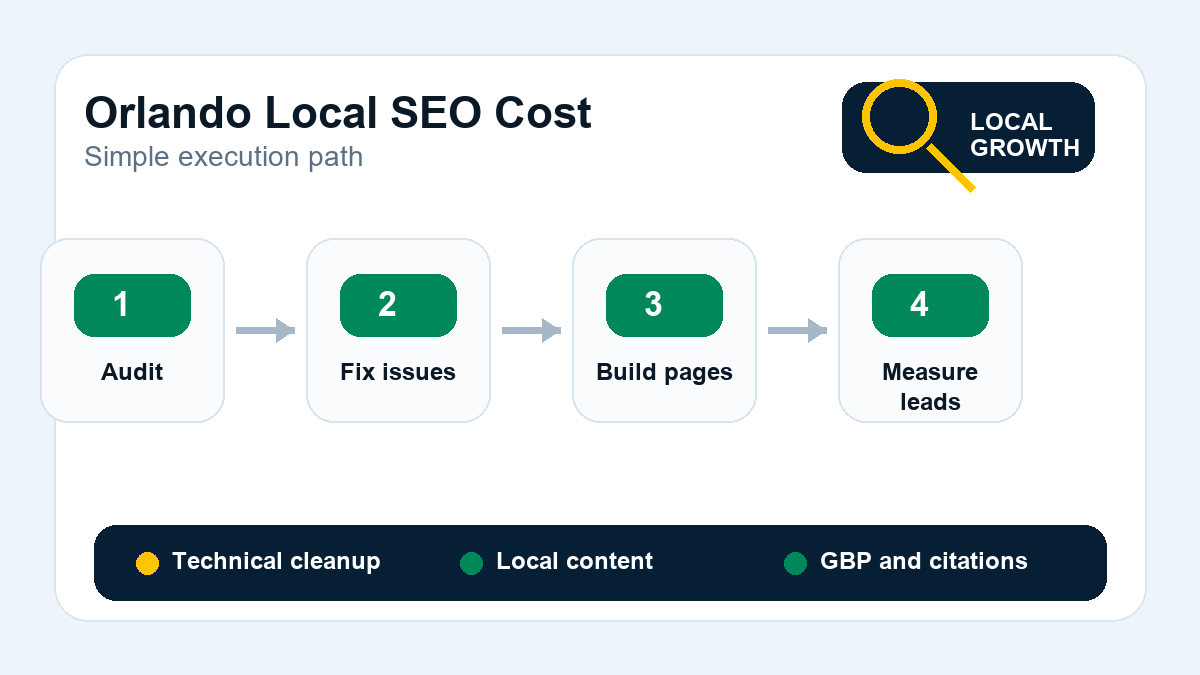
Where The Money Goes
A reputable agency invests your budget into specific, results-driven activities. The orlando local seo cost is a reflection of the time, tools, and expertise required to perform these essential tasks.
- Technical SEO: This is the foundation. It involves ensuring your website is fast, mobile-friendly, secure, and easily crawlable by search engines. This includes optimizing site structure, fixing broken links, and implementing schema markup.
- Content Creation: High-quality, locally relevant content is non-negotiable. This includes writing service pages, blog posts that answer customer questions, location-specific pages (like for our Orlando service area), and case studies.
- Google Business Profile (GBP) Optimization: Your GBP listing is often your most important local SEO asset. This involves optimizing every section, publishing regular updates, managing Q&As, responding to reviews, and analyzing performance data.
- Citation Building: This is the process of getting your business name, address, and phone number (NAP) listed consistently across relevant online directories (like Yelp, BBB, and industry-specific sites). Consistency is crucial for building trust with Google.
- Link Acquisition: Earning high-quality backlinks from other reputable local websites tells Google your site is a trusted authority. This is not about buying spammy links; it’s about strategic outreach, content promotion, and building real relationships. You can see how this drives results in our case studies.
- Reporting & Strategy: A significant portion of time is spent analyzing data, creating performance reports, and holding strategy calls to ensure the campaign is on track and aligned with your business goals.
Red Flags + Warning Signs
The SEO industry has its share of bad actors. Here are some red flags to watch out for when evaluating an agency:
- “$99/mo SEO” Packages: Effective, customized SEO takes significant time and expertise. Extremely low prices are a sign that the agency is likely using automated, low-quality tactics, or simply not doing much at all. The real orlando local seo cost for meaningful work is far higher.
- Guaranteed #1 Rankings: No one can guarantee a specific ranking on Google. Google’s algorithm is complex and ever-changing. Reputable agencies focus on proven strategies to improve visibility and drive traffic, not on making impossible promises.
- Secretive Processes or “Proprietary Methods”: A good partner will be transparent about their strategy and what they are doing. If an agency won’t explain their methods, they may be using outdated or risky (black-hat) techniques.
- Focus on Sketchy Link-Building: If an agency’s pitch is all about getting you “hundreds of links” from private blog networks (PBNs) or link farms, run away. This is a violation of Google’s guidelines and can lead to severe penalties.
How to Evaluate a Local SEO Agency in Orlando
Choosing the right partner is a critical business decision. Arm yourself with the right questions to make an informed choice.
Questions to Ask:
- What is your process for keyword research and content strategy?
- Can you show me examples of local SEO results you’ve achieved for businesses similar to mine?
- How will you approach link building for my website?
- What does your reporting look like, and how often will we meet to discuss progress?
- What specific KPIs will you use to measure the success of this campaign?
- How will we communicate, and who will be my primary point of contact?
What to Ask for in Writing:
- A detailed proposal outlining the full scope of work, including all one-time and monthly deliverables.
- A clear statement of the pricing model and payment terms.
- Clearly defined campaign goals and the metrics that will be used to track them.
Frequently Asked Questions
What is a typical timeline to see results from local SEO?
While some quick wins can be seen in the first 1-3 months (like improved GBP rankings from initial optimization), significant, lasting results from local SEO typically take 6 to 12 months. It’s a long-term strategy that builds momentum over time. Be wary of anyone promising instant results.
What’s usually included in the one-time setup fee?
The setup fee covers the essential foundational work. This typically includes a comprehensive technical SEO audit, in-depth keyword research and mapping, competitor analysis, creating and fully optimizing your Google Business Profile, on-page optimization for your core website pages, and setting up analytics and rank tracking software.
Is it better to pay for a monthly service or a one-time project?
A one-time project is great for fixing a specific issue or getting your foundation in place. However, for sustained growth, a monthly service is essential. SEO isn’t a “set it and forget it” activity; it requires ongoing content creation, link building, and optimization to compete effectively.
Can a small business with a limited budget still afford local SEO?
Yes. While you may not be able to fund an aggressive campaign, a smaller, focused retainer can still deliver significant value. The key is to prioritize activities with the highest impact, such as hyper-local content and meticulous Google Business Profile management. Consistency at a smaller scale is better than doing nothing at all.
What happens if I stop or cancel my local SEO services?
The technical improvements and on-page SEO work done on your website are permanent. The content that was created will remain on your site. However, you will lose the ongoing benefits of new content, link building, and proactive optimization. Over time, your competitors who are continuing to invest in SEO will likely outpace you, and your visibility may decline.
Ready to understand what a tailored local SEO strategy could look like for your Orlando business? Our team is here to provide a transparent, no-obligation proposal based on your specific goals. Contact us today to start the conversation or call us directly at 407-307-1995 to speak with a strategist.
Action checklist
Want a realistic Orlando SEO budget?
Nexgen can review your current visibility and show which SEO work should come first.
Setting Goals and Analyzing Your Metrics
Social Media Marketing
Updated for 2026 by Vanessa Bailey , Senior SEO Strategist at Nexgen Local Marketing.
Quick answer
Marketing goals should connect activity to business outcomes, not just likes, views, or vague awareness metrics.
SMART goals
This is one of the core pieces that makes goals and metrics work as a practical business strategy.
Channel KPIs
This is one of the core pieces that makes goals and metrics work as a practical business strategy.
Set Goals That Matter
A specific, measurable, achievable, relevant, and time-based (SMART) goal is essential when it comes to social media marketing in 2026. Once you have determined your goal, you can then focus your efforts accordingly. This article will show you how to build an effective social media team and how to analyze your metrics for success. Analyzing social media metrics Analyzing social media metrics is a critical part of any successful marketing campaign. It helps you understand your audience, determine what content resonates, and identify which changes drive results. This analysis should be performed on a regular basis, ideally every month, to stay agile.
The first step is defining your primary goal. For most businesses, this will be increasing conversions from website visitors. Once you’ve defined your goal, you can analyze the key performance indicators (KPIs) that show progress. For example, you may want to track return on investment (ROI), conversion rates, or lead quality from social channels.
The next step is to identify which platforms (like Instagram, LinkedIn, or even X) are most effective for your audience. This data informs your social media strategy. Benchmarking is another vital step. This is closely related to competitor analysis, as it provides a point of comparison and helps you see how your campaign is performing against others in your industry. Creating a social media strategy When you create a social media marketing strategy, set specific goals and a clear process for measuring progress. Your metrics can be broken down into key areas: awareness (reach, impressions), engagement (likes, comments, shares), and conversion (clicks, leads, sales). The engagement level shows how well your audience is connecting with your content, whether it’s a blog post, an infographic, or a short-form video on Instagram Reels or YouTube Shorts.
These goals can be measured in various ways, including tracking click-through rates (CTR) and cost-per-click (CPC) on paid campaigns.
Using UTM parameters is crucial for tracking social visitors as they navigate your website. These tracking codes help you attribute conversions directly to your social media efforts, proving what’s working and what isn’t. This data is invaluable for refining your strategy over time. You can also use analytics reports to track and improve customer service. This data should complement your other business goals and analytics from tools like Google Analytics.
A comprehensive social media strategy is an essential step that helps you plan the content that best promotes your brand and connects with your audience. Your plan should include your goals, target KPIs, content calendar, and a high-level overview of your approach. Creating shareable content When creating shareable content, make sure it provides inherent value. It can’t be the same listicle your competitors published. Instead, it needs to inspire, entertain, or educate your audience. Often, the best way to create shareable content is to teach your audience something useful they can apply themselves.
Before you start creating, research your target audience. Use platform-native tools to see what topics are trending and what your audience finds interesting—this is especially true on platforms with powerful algorithms like TikTok. This will significantly increase the chances of your content being shared. Also, try to find different angles on popular topics. For example, you could connect your brand to relevant news or cultural moments, but only if it aligns with your brand voice.
In addition to researching your audience, it’s important to study the content published by your competitors. See what’s resonating for them. Keeping track of your competitors’ successful posts can help you spot content gaps and identify what your target buyers want to see. Establishing a structure for a social media team A well-organized team of social media professionals is crucial for a company’s success. To ensure everyone is aligned, a social media governance plan can help. This might involve key employees, stakeholders, and subject matter experts who keep the company focused on its social media goals. These people should be involved in strategic planning and decision-making.
The ideal size of a social media team varies depending on the company’s size and goals. For some small businesses, one dedicated manager is enough. For larger companies with multiple brands or many clients, creating several smaller, focused teams may be more effective.
Assigning clear roles and tasks to specific team members makes it easy to monitor work and measure results. For example, one person might focus on content creation, while another manages community engagement and customer service inquiries.
Regardless of who you hire, your social media team should follow clear guidelines to ensure a consistent brand voice and successful outcomes. It is also critical to set realistic deadlines and use project management tools to track your team’s progress effectively.
Choose Better Metrics
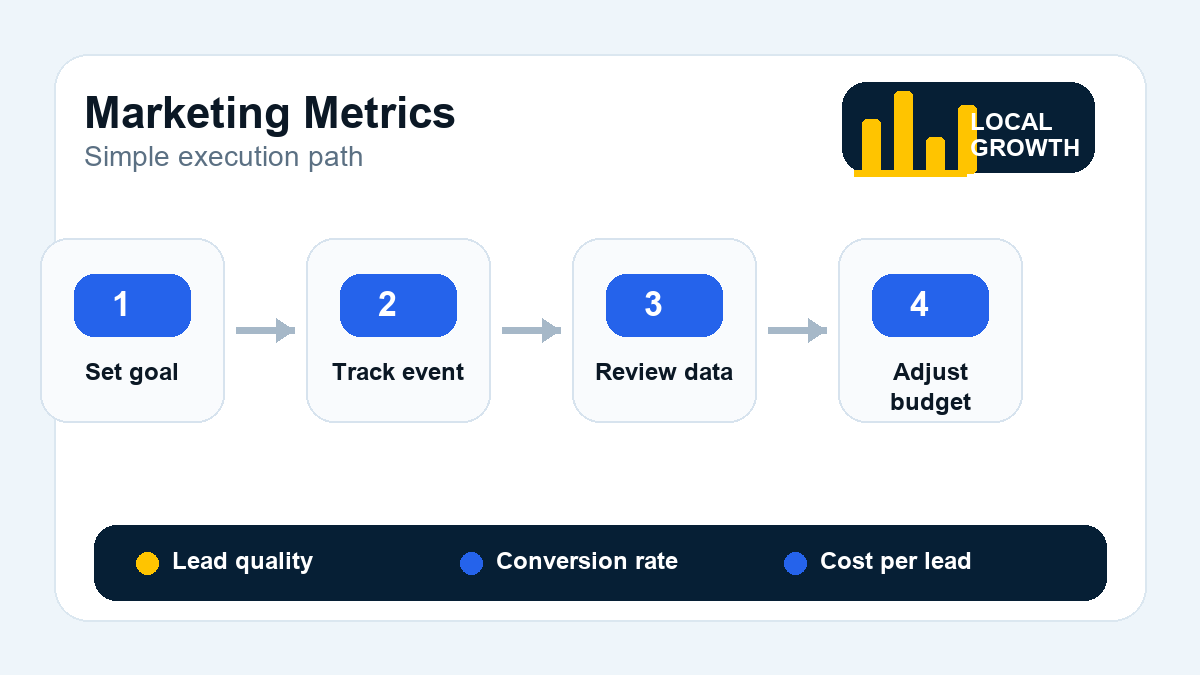
Review Performance Monthly
Action checklist
Need cleaner marketing reporting?
We can help connect your marketing metrics to leads, calls, and revenue.