

Search Engine Optimization
Your phone rings at 8 PM on a sweltering July night. The person on the other end isn't price-shopping; their AC is out, and they need help now . This is the money call in the HVAC business, and in 2026, it's won or lost on the first page of Google. This post breaks down the exact strategies required to capture those high-intent, emergency service calls through smart, modern SEO for HVAC contractors .
Quick answer
HVAC SEO works when emergency intent, service-area pages, reviews, and fast mobile pages are aligned around real calls.
Emergency intent
This is one of the core pieces that makes HVAC SEO work as a practical business strategy.
Map pack trust
This is one of the core pieces that makes HVAC SEO work as a practical business strategy.
Why HVAC is a Brutal SEO Category in 2026
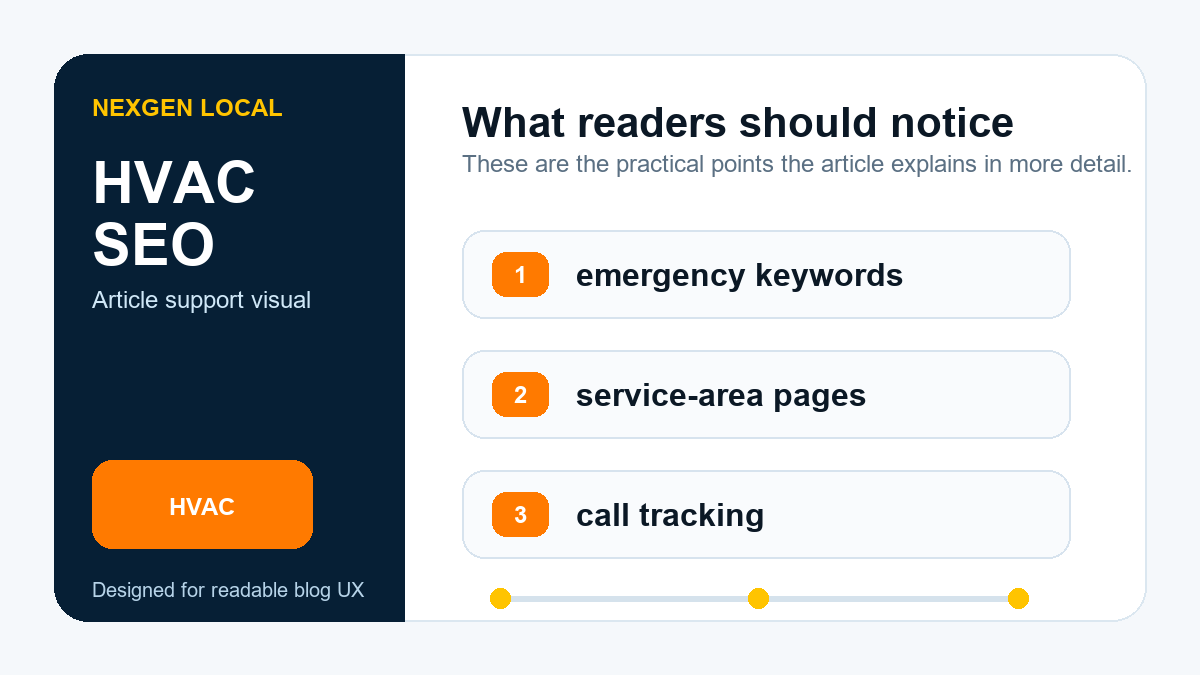
Competing for visibility in the HVAC space has never been more intense. Three core challenges make it a formidable landscape for independent contractors. First, national franchises and private equity-backed consolidators are pouring unprecedented amounts of money into digital advertising, often buying up prime digital real estate and driving up costs for everyone. Their massive budgets allow for sustained, aggressive campaigns that can drown out smaller players.
Second, this heavy spending directly impacts Pay-Per-Click (PPC) advertising. Cost-per-click (CPC) for valuable keywords like “emergency ac repair” can be astronomically high, making a pure PPC strategy unsustainable for many. This economic pressure makes a strong organic presence through SEO not just a nice-to-have, but a critical component of a profitable lead generation engine. Organic results deliver qualified traffic without a per-click cost, providing a much higher return on investment over time.
Finally, the inherent seasonality of the HVAC industry creates a feast-or-famine cycle. Extreme heat waves and sudden cold snaps cause demand to spike, but what about the milder months? A robust SEO strategy ensures your business remains visible year-round, capturing leads for maintenance, system replacements, and indoor air quality solutions during the shoulder seasons. Without that consistent visibility, your business is left vulnerable to unpredictable weather patterns and intense, concentrated competition during peak times.
The Keyword Landscape That Actually Books Service Calls
A winning SEO strategy for an HVAC contractor hinges on understanding user intent—the “why” behind a search. Not all keywords are created equal. We can separate them into two main categories: emergency-intent keywords and research-intent keywords.
Emergency-intent keywords are phrases typed by people who need immediate help. These are your highest-value targets for booking service calls. They are specific, problem-oriented, and often include terms that signal urgency.
- “AC not cooling”
- “furnace won’t turn on”
- “no heat in house”
- “heat pump making loud noise”
- “emergency hvac repair near me”
- “24/7 ac service orlando”
These searchers are not comparison shopping for a system replacement next year; they are looking for a fast, reliable solution to an immediate and uncomfortable problem. Your website and Google Business Profile must be optimized to directly answer these queries to capture the lead.
Research-intent keywords, on the other hand, are used by people in the earlier stages of the buying cycle. They are gathering information, comparing options, or planning for future projects.
- “how often to replace hvac system”
- “cost of new heat pump”
- “best ac unit for florida home”
- “seer rating explained”
- “gas furnace vs heat pump”
While these keywords may not lead to an immediate service call, they are incredibly valuable for building trust and establishing your company as an authority. By providing helpful answers to these questions on your blog, you attract potential customers early, nurturing them until they are ready to make a purchase or require service. A comprehensive HVAC marketing plan targets both types of intent to build a sustainable sales pipeline.
Google Business Profile: The #1 Lever for HVAC SEO in 2026
For a local service business like an HVAC company, your Google Business Profile (GBP) is not just a listing—it is your single most powerful SEO asset. In 2026, Google is placing more emphasis than ever on GBP as a primary source of information for ranking businesses in the local map pack. It is often the first interaction a potential customer has with your brand.
Optimizing your GBP is non-negotiable. Start with the fundamentals: ensure your primary category is “HVAC contractor” and then add secondary categories like “Air conditioning contractor,” “Heating contractor,” and “Air conditioning repair service.” From there, meticulously build out your list of services. Don’t just list “AC Repair”; add specific, long-tail services like “Ductless mini-split installation,” “Thermostat repair,” and “Emergency furnace service.” This level of detail directly impacts your relevance for specific user searches.
Active management is key. During a heat wave, use Google Posts to share a message like, “Experiencing an AC outage? Our team is working extended hours to serve you.” During a cold snap, post about furnace tune-ups. Regularly upload high-quality photos of your team, your service vans, and completed installations. These actions signal to Google that your business is active, relevant, and engaged. Finally, focus on generating a steady stream of positive reviews, as this is a cornerstone of both prominence and customer trust. A well-managed GBP is the foundation of local SEO success, and our team provides expert Google Business Profile services to ensure you’re maximizing this critical platform. For a deeper dive, review our guide to Google Business Profile setup and optimization in 2026.
Local Pack Ranking Factors Specific to HVAC
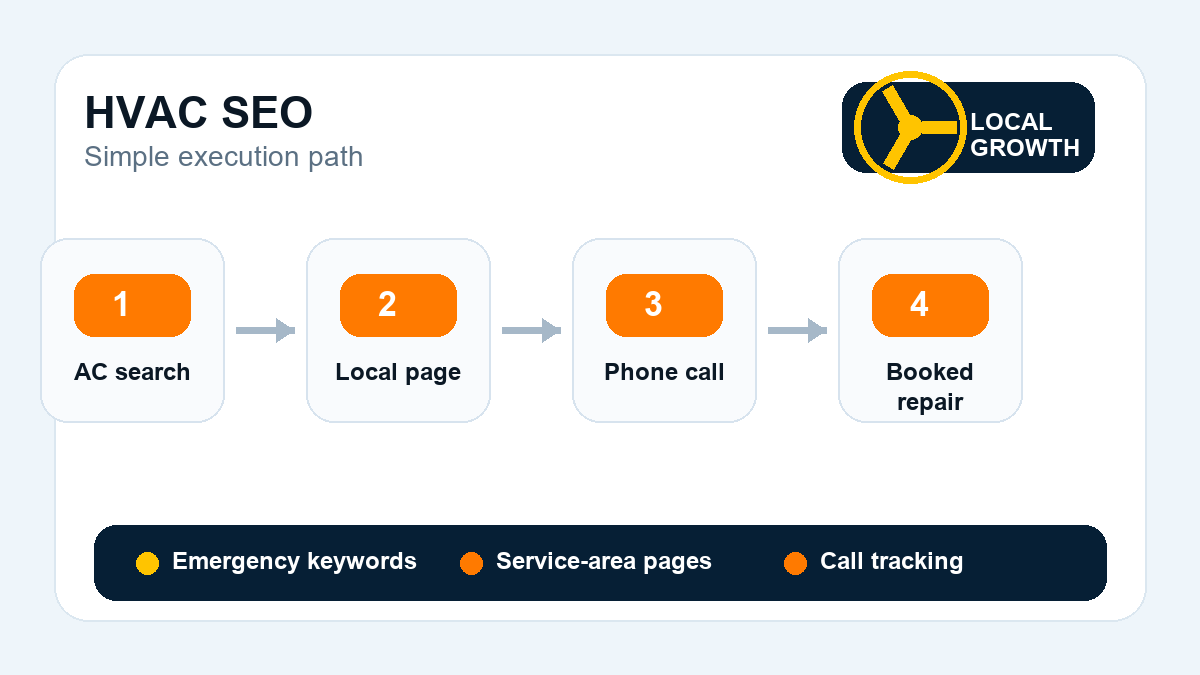
Appearing in the coveted Google “Local Pack” (the map and three business listings at the top of local search results) is the primary goal of SEO for HVAC contractors. This is where emergency-service customers find their provider. Three core factors determine your ranking: proximity, prominence, and relevance.
- Proximity: This refers to how close your business is to the person searching. While you can’t change your physical address, you can signal your service area clearly to Google through your GBP settings and service-area pages on your website. For a search like “ac repair near me,” Google will heavily favor businesses that are geographically close to the user’s location.
- Prominence: This is a measure of how well-known and well-regarded your business is. In the digital world, prominence is largely defined by your review profile. The quantity, quality (average star rating), and velocity (the speed at which you get new reviews) of your Google reviews are immensely important. Prominence is also influenced by the consistency of your business name, address, and phone number (NAP) across key online directories and mentions of your brand on other local websites.
- Relevance: This is how well your business matches the user’s search query. This is where the detailed work on your Google Business Profile pays off. Having “Emergency heat pump repair” listed as a specific service in your GBP makes you far more relevant for that search than a competitor who just has “Heating service.” The completeness of your GBP profile, including services, categories, photos, and posts, all contribute to your relevance score.
For HVAC contractors, these factors are magnified. A customer with a broken AC in August needs a relevant (AC repair), proximate (near them), and prominent (well-reviewed and trustworthy) provider immediately. Excelling in these three areas is the formula for winning the click.
Service-Area Pages and City-by-City SEO
Many HVAC contractors serve multiple towns or even counties. A common but outdated SEO tactic was to create dozens of nearly identical pages, simply swapping out the city name. In 2026, this approach will get you penalized. Google’s Helpful Content System is designed to demote content that appears created solely for search engines, and thin, duplicative “city pages” are a prime target.
So, how do you rank in surrounding areas without creating spammy content? The key is to build genuinely useful, unique service-area pages. Instead of a generic “We provide AC repair in [City Name]” page, create a resource that has local texture.
- Mention a specific landmark or neighborhood you recently served in that city.
- Include a testimonial from a customer in that specific city.
- Discuss any local particularities relevant to HVAC, such as common issues in older homes in a historic district or specific building codes.
- Embed a map of the service area you cover in and around that city.
The goal is to prove to Google and to users that you actually do business in that location and understand its unique context. For example, a page for “HVAC Services in Winter Park, FL” could mention the challenges of cooling older homes with historic preservation rules. This approach is more work, but it creates a durable asset that signals authority and helps you rank across your entire service radius, forming a core part of a comprehensive strategy for search engine optimization.
Content That Ranks: Seasonal Guides and Decision Trees
Beyond service and city pages, a content strategy that addresses your customers’ questions is essential for building topical authority and attracting research-intent searchers. A blog is the perfect platform for this. By consistently publishing helpful content, you signal to Google that you are an expert in the HVAC field.
Effective content for an HVAC website includes:
- Seasonal Maintenance Guides: “Your 5-Point Checklist Before Turning on Your AC for the Summer” or “How to Prepare Your Furnace for Winter in Florida.” These articles attract homeowners at key moments in the year and position you as a helpful expert.
- System-by-System Buying Guides: Many homeowners are confused about their options. In-depth articles comparing “Heat Pump vs. Gas Furnace in Central Florida” or “The Pros and Cons of a Ductless Mini-Split System” can attract high-value searchers who are close to making a major purchase decision.
- Emergency Decision Trees: Create content that helps users diagnose a problem before they call. A post titled “AC Not Cooling? Try These 3 Things Before Calling for Service” can build immense trust. Even if they can’t solve it themselves, you will be the first company they call because you already helped them.
This type of content does more than just attract traffic. It pre-sells your expertise and professionalism, making the actual sales conversation much easier. It demonstrates that your business is more than just a service provider; it’s a trusted resource.
Technical SEO for HVAC Sites: Speed, Mobile, and Schema
A technically sound website is the foundation upon which all other SEO efforts are built. For HVAC contractors, whose customers are often searching from a mobile device in a state of distress, three technical elements are paramount: site speed, mobile-first indexing, and schema markup.
Site Speed: If a potential customer’s AC is out and your website takes more than three seconds to load, they will leave and call your competitor. It’s that simple. Many HVAC websites are slowed down by oversized images and heavy homepage sliders or carousels. Ditch the slider—they are proven to be ineffective—and compress all images. A fast, responsive website is crucial for converting emergency searchers.
Mobile-First Indexing: The vast majority of emergency HVAC searches happen on a smartphone. Google recognizes this and primarily uses the mobile version of your website for indexing and ranking. Your site must be flawless on mobile devices. This means large, easy-to-tap buttons (especially “click-to-call” buttons), readable text without pinching or zooming, and simple navigation.
Schema Markup: Schema is a type of code that helps search engines understand the content and context of your website more effectively. For an HVAC business, several types of schema are critical. LocalBusiness schema tells Google your address, phone number, and service area. Service schema can define specific offerings like “AC Repair” and their prices. FAQPage schema can be used on your FAQ page to make your questions and answers eligible to appear directly in search results, answering user questions before they even click.
Reviews + Reputation: The Biggest Single Ranking Factor in 2026
In the high-stakes, trust-based business of HVAC, your online reputation is everything. When a homeowner needs to let a stranger into their house to perform a costly repair, they look for social proof. In 2026, that social proof is your collection of online reviews. Your Google review profile is arguably the single most impactful ranking factor for local service businesses.
A strong review profile has three components: high average rating (aim for 4.8 stars or higher), a high quantity of reviews, and a steady velocity of new reviews. A profile with 150 reviews that are two years old is less powerful than one with 100 reviews where five were left in the last month. This freshness signals to Google that you are an active, thriving business that consistently satisfies customers.
To achieve this, you must build a sustainable review-acquisition cadence. This isn’t a one-time campaign; it needs to be part of your daily process.
- Train your technicians to mention leaving a review at the end of every successful service call.
- Use a software platform to send a review request via text or email shortly after the job is completed.
- Make it easy. Include a direct link to your Google review form in your request.
- Personally respond to every single review, both positive and negative. Thanking happy customers and professionally addressing concerns shows you are engaged and care about feedback.
A powerful reputation built on authentic customer feedback is your ultimate competitive advantage, and some of our most successful client outcomes are built on this foundation.
Citations and Directory Presence: What Still Matters
Citations are mentions of your business’s name, address, and phone number (NAP) on other websites. A few years ago, the prevailing wisdom was to get your business listed in as many online directories as possible. Today, the “quantity over quality” approach is outdated. In 2026, it’s about being present and consistent in the places that matter.
Focus your efforts on the handful of high-authority directories that customers and search engines actually trust. For an HVAC contractor, these are:
- Google Business Profile (the most important one)
- Bing Places for Business
- Yelp
- Better Business Bureau (BBB)
- Angi (formerly Angie’s List)
- HomeAdvisor
- Nextdoor
The absolute key is NAP consistency. The way your business name, address, and phone number appear on these sites must be identical to how they appear on your website and Google Business Profile. Inconsistencies can confuse search engines and erode the trust they have in your location and contact data. Don’t waste time or money on services that promise to submit your site to hundreds of obscure directories. Focus on the big players, ensure your information is perfect, and move on.
FAQ on SEO for HVAC Contractors
How long does it take to see results from HVAC SEO?
SEO is a long-term investment, not an overnight fix. While foundational improvements to your Google Business Profile can sometimes yield results in as little as 30-60 days, a comprehensive content and authority-building strategy typically takes 6-12 months to show significant impact. The timeline depends on your starting point, your market’s competitiveness, and the consistency of your efforts. Unlike ads, the results of SEO are cumulative and create a lasting asset.
Is HVAC SEO worth it compared to just buying leads from LSAs?
It’s not an “either/or” question; it’s a “both/and” strategy. Google Local Services Ads (LSAs) are excellent for generating immediate, high-intent leads and should be part of your marketing mix. However, you are entirely dependent on Google’s platform and pay for every lead. SEO builds your own brand asset. The traffic you earn is your own, it has no marginal cost per click, and it builds long-term authority that makes all of your marketing more effective. A strong SEO presence can also improve your LSA performance, as Google may use your organic reputation as a quality signal.
Do I really need a separate webpage for each city I service?
You need a unique, valuable page for each city you consider a priority market. Do not create hundreds of thin, copy-paste pages. As we covered earlier, focus on 5-10 of your most important surrounding cities and build out genuinely useful pages with local details, testimonials, and specific project examples. For smaller, surrounding towns, a well-optimized “Areas We Serve” page that lists them is often sufficient.
What about creating content on heat pump rebates and tax credits?
Absolutely. This is a perfect example of timely, high-intent research content. Homeowners are actively searching for information on these incentives. By creating a clear, comprehensive guide to federal, state, and local utility rebates for heat pumps and high-efficiency systems, you attract highly qualified buyers. This positions you as an expert who can not only perform the installation but also help customers save money, building immense trust early in the process.
Can I really rank against the big franchises with a smaller budget?
Yes. You can’t outspend them, so you must out-smart them. Franchises often have generic, corporate-driven marketing. As an independent contractor, your advantage is your local authenticity. You can hyper-focus on your specific service area, build a reputation based on real community relationships (which translates into powerful reviews), and be more agile in your content and GBP posting. By focusing intently on the local pack ranking factors and showcasing your local expertise, you can absolutely win the battle for emergency service calls in your own backyard. Many of our case studies show how local focus can overcome a larger competitor’s budget.
Mastering SEO for HVAC contractors is a marathon, not a sprint. It requires a disciplined focus on your local reputation, a commitment to providing helpful content, and a technically sound website. By building your strategy around the real-world, emergency needs of your customers, you can turn your website into a powerful, predictable engine for profitable service calls. If you’re ready to stop buying leads and start owning your online presence, contact our team of strategists today. Give us a call at 407-307-1995 to discuss how we can build a dominant digital footprint for your HVAC business.
Action checklist
Need more emergency service calls?
We can identify the HVAC search gaps that matter most in your local market.