

Pay Per Click Marketing
You’ve seen the numbers and heard the stories: truck accident keywords costing hundreds of dollars for a single click. Is it possible to generate a positive return on investment with numbers like that? This post breaks down the precise math and strategic requirements needed to make PPC for personal injury law firms not just viable, but incredibly profitable in 2026.
Quick answer
Personal injury PPC can work in 2026, but only when the case value, intake speed, close rate, and tracking system support the cost per click.
Case value first
This is one of the core pieces that makes legal PPC work as a practical business strategy.
Tight geography
This is one of the core pieces that makes legal PPC work as a practical business strategy.
The PI Legal PPC Reality in 2026
Let’s be direct: pay-per-click advertising in the legal sector, especially for personal injury, operates on a different plane. It hosts the most expensive keywords on the internet. It’s not uncommon to see top-of-page bids for “18-wheeler accident lawyer” or “offshore injury attorney” soar past $200, $300, or even $400. For firms outside this niche, such costs would be unthinkable. But for a PI practice, this is simply the cost of admission for the most direct, high-intent lead generation channel available.
Why does this seemingly insane math work? The value of a single case. A catastrophic truck accident case can settle for seven figures, and even more common auto accident cases can carry values of $50,000 to $250,000 or more. When a single signed client can represent tens or hundreds of thousands of dollars in firm revenue, investing a few thousand dollars on clicks to acquire that case becomes a sound business decision. The key isn’t just spending the money; it’s having a bulletproof system to convert that expensive click into a signed client. This is where most firms fail and where a sophisticated PPC management strategy becomes critical.
Practice-Area Economics: What Is a Case Worth?
Not all legal keywords are created equal, because not all case types are worth the same. Understanding the potential value of a case is the first step in setting a realistic PPC budget and bid strategy. While every case is unique, here are some illustrative value ranges for common practice areas that pursue PPC.
- Truck Accidents: Often the highest value, ranging from $100,000 into the multi-millions, justifying the highest CPCs.
- Medical Malpractice: Highly complex with significant potential damages, cases can be worth $250,000 to over $1,000,000.
- Auto Accidents: The most common PI case type. Value ranges widely from $15,000 for minor injuries to over $200,000 for more serious ones.
- Slip-and-Fall (Premises Liability): These can range from $10,000 to $75,000+, highly dependent on the severity of the injury and the liability of the property owner.
- Workers’ Compensation: Case values are often defined by state statutes but can represent a steady source of firm revenue, typically in the $20,000 to $60,000 range.
- Family Law / Divorce: While not PI, this is another high-CPC area. The value is tied to marital assets, often making the client value significant, but the ROI calculation is different.
- Estate Planning: Lower “case value” in the traditional sense, but high lifetime client value. PPC here is more about volume and efficiency than high-margin single cases.
Your firm’s target practice areas directly inform your approach to PPC for personal injury law firms. You can’t bid for a truck accident keyword with a slip-and-fall budget.
Geographic Targeting Strategy: Radius, Metro, and County
Where you show your ads is as important as what they say. For legal PPC, geographic strategy is paramount and falls into a few key models:
- Tight Radius Targeting: Best for urban firms or those targeting a specific neighborhood. A 5-10 mile radius around your office can capture “near me” searches and clients who prioritize proximity. This is cost-effective but limits volume.
- Metro-Wide Targeting: Targeting an entire Designated Market Area (DMA), like the Orlando or Miami-Fort Lauderdale metro areas. This maximizes reach and volume but requires a larger budget and careful negative keyword management to filter out irrelevant searches from surrounding towns.
- County-Level Targeting: This is a critical strategy for legal practices. Since many cases are filed and tried at the county level, targeting by county ensures your ads are seen by potential clients within the correct jurisdiction. This is especially vital for family law and other practices tied to local courts.
The right strategy often involves a combination of these. For example, a PI firm might target their home county aggressively, the surrounding counties with a smaller budget, and use a tight radius for hyper-local terms like “personal injury lawyer near me.”
Case-Intake Math: Why a $400 CPC Can Be Profitable
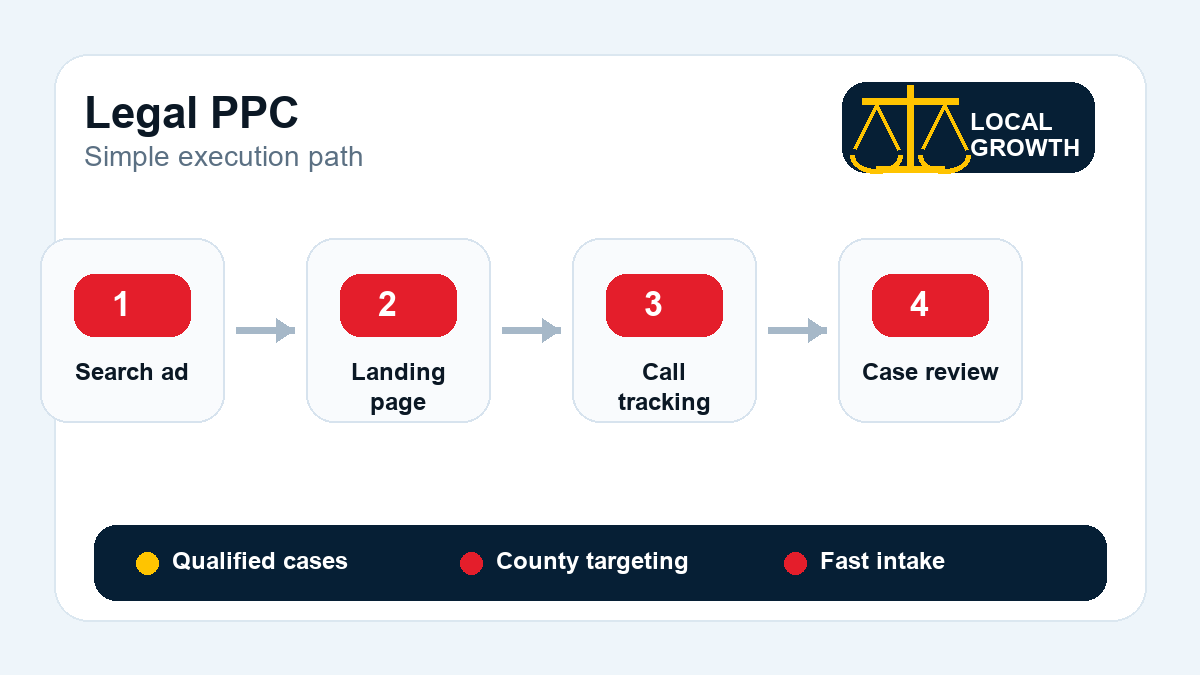
The sticker shock of a high CPC is misleading. The metric that matters is Cost Per Signed Case. Let’s walk through a realistic, albeit simplified, example for a competitive PI keyword.
- Cost-Per-Click (CPC): $400
- Clicks to get one qualified phone call (Conversion Rate): Let’s assume a 10% conversion rate from click-to-call, which is strong for this space. This means you need 10 clicks to get one phone call.
- Cost-Per-Call: 10 clicks x $400/click = $4,000
- Qualified Calls to get one signed case (Intake Qualification Rate): Your intake team is skilled and qualifies 1 in every 4 calls as a potential case worth pursuing.
- Cost-Per-Qualified-Lead: 4 calls x $4,000/call = $16,000
- Qualified Leads to Signed Case (Closing Rate): Your attorneys sign 1 of every 2 qualified leads they meet with.
- Final Cost-Per-Signed-Case: 2 qualified leads x $16,000/lead = $32,000
If that signed case has a conservative value of $150,000, with a standard 33% contingency fee, the firm’s revenue is $50,000. Spending $32,000 to generate $50,000 in revenue is a profitable model. This illustrates why optimizing the conversion rate and the intake process is just as important as managing the CPC. Improving the landing page conversion rate to 12% or the intake team’s qualification rate can dramatically improve the ROI.
Bar Association Advertising Rules and Ethics
Legal advertising is regulated. Running afoul of your state’s Bar Association rules can lead to serious consequences. While rules vary, some common principles apply to PPC:
- You Cannot Guarantee Results: Ad copy like “We guarantee a win” is a major violation. Language must be carefully chosen to avoid making promises.
- Avoid Misleading Claims: Phrases like “the best PI lawyer” are often prohibited unless they are verifiably true through a specific, recognized distinction.
- Dramatizations and Actors: If you use actors or create a dramatization, you must disclose it.
– Disclaimers are Often Required: Many states require ad copy or landing pages to include “This is an advertisement” or similar language.
An agency experienced in lawyer marketing will be well-versed in these nuances, including checking the specific rules for your state (e.g., The Florida Bar vs. The State Bar of California). Ignorance is not a defense, and a compliant campaign is a prerequisite for long-term success.
Landing Pages That Actually Convert Legal Traffic
Sending a $400 click to your homepage is like setting money on fire. You need a dedicated landing page designed for one purpose: conversion. Key elements include:
- Above-the-Fold Trust Signals: The moment the page loads, the user should see reasons to trust you. This includes awards (Super Lawyers, Martindale-Hubbell), “Years of Experience,” “Millions Recovered for Clients,” and professional attorney photos.
- Clear, Empathetic Messaging: The headline should match the ad copy and speak directly to the visitor’s pain point (e.g., “Injured in a Truck Accident? Get the Compensation You Deserve.”).
- Obvious Calls-to-Action (CTAs): Use a combination of a clickable phone number and a simple contact form. For legal, the phone call is often the most valuable lead. Make the number prominent.
- “Free Consultation” Language: This is the standard offer in the legal space. It removes the barrier to entry and financial risk for the potential client.
- Mobile-First Design: The vast majority of these searches happen on a mobile device, often moments after an incident. The page must be flawless on a smartphone, with a large, tap-to-call button.
Check out our case studies to see how we’ve structured campaigns for similar high-value industries.
Call Tracking + Intake-Team Integration
A sophisticated PPC campaign generates calls; a great business process converts them. This requires technology and training. Dynamic Number Insertion (DNI) is a technology that shows a unique tracking phone number on your website based on the advertising source. This allows you to know with 100% certainty which calls came from your Google Ads campaign.
Furthermore, all calls should be recorded for quality assurance. This isn’t about spying; it’s about training. Your intake team or receptionist must be trained to handle the specific nature of a paid lead. These individuals are often in distress, have high expectations, and need to be handled with empathy and efficiency. Is your team asking the right qualifying questions? Are they scheduling the consultation effectively? Reviewing call recordings provides the data needed to optimize this critical part of the funnel.
When NOT to Do Legal PPC
As a responsible agency, we have to be honest: PPC is not for every law firm. It can be a fast way to lose a lot of money if the right conditions aren’t met. You should reconsider investing heavily in Google Ads if:
- You are a true solo practitioner with no intake support. If you are in court all day and can’t answer the phone, you will be wasting money on calls that go to voicemail.
- Your practice areas have low case values. If your average case value doesn’t support a multi-thousand-dollar acquisition cost, the math will never work. This is why PPC for traffic tickets, for example, is a different game entirely.
- You operate in a small, low-competition market. In some rural areas, a strong Google Business Profile and local SEO strategy can generate more than enough leads at a fraction of the cost of PPC.
- You have an unrealistic budget. While budget depends on many factors, a $1,000/month budget for PI keywords in a major metro is simply not enough to gather data, let alone compete. You can learn more about typical costs in our post on what PPC should cost a local business.
Local Services Ads (LSAs) for Attorneys
A major development has been Google’s expansion of Local Services Ads (LSAs) into the legal vertical. These are the “Google Screened” listings that appear at the very top of the search results. Unlike PPC, you pay per lead (a phone call), not per click. For some practice areas like family law or estate planning, LSAs can be a fantastic, cost-effective starting point. For hyper-competitive PI, they are a great supplement to traditional ads, but may not provide the volume a large firm requires. The “Google Screened” badge requires a background check process, adding a layer of trust. The bottom line: it’s a powerful tool that should be part of the overall paid search strategy, but it doesn’t typically replace a well-run traditional Google Ads campaign for firms seeking high volume.
Frequently Asked Questions
What is the minimum monthly budget for legal PPC?
For competitive personal injury in a medium to large city, a test budget should start no lower than $5,000 – $7,500 per month in ad spend. Anything less and you risk not getting enough data to make intelligent decisions. Tier-2 markets or less competitive practice areas might start closer to $3,000, but for PI, you must be prepared to invest.
Can a solo practitioner afford this?
Yes, but only if they have the infrastructure. A solo attorney with a dedicated, trained paralegal or intake specialist to handle calls can absolutely succeed with PPC. A solo attorney who tries to do it all themselves is unlikely to see a positive ROI, as missed calls are a primary source of wasted ad spend.
What about Avvo/FindLaw vs. Google PPC?
Legal directories like Avvo, FindLaw, and Justia are lead aggregators. You pay them a flat fee, and they generate leads from their own SEO and marketing efforts. It can be a good, predictable source of leads. The difference with Google PPC is control. With your own campaign, you control the landing page, the ad copy, the targeting, and you own the data. Directory leads are often less exclusive. A balanced strategy for a large firm often includes both.
How long does it take to get the first signed case from PPC?
This varies greatly, but it’s possible to get calls on day one. A realistic timeline would be to generate your first qualified leads within the first 30 days and aim for your first signed case within 60-90 days. It takes time to gather data, optimize bids, and for a potential client to go through the consultation and signing process.
What if my CPC is higher than my case value?
This should never happen if the campaign is structured correctly. Your CPC is only one part of the equation. If your CPC for a specific keyword is genuinely higher than the total potential value of that case type, you should not be bidding on that keyword. This scenario points to a mismatch between your target practice area and your keyword selection, and the campaign needs an immediate strategic review.
Making the math work for PPC for personal injury law firms requires more than just a large budget; it requires a deep understanding of legal economics, technology, and process. When done correctly, it’s one of the most powerful and scalable client acquisition channels available. If you’re ready to see if a data-driven PPC strategy is right for your firm, contact our team for a no-obligation consultation at 407-307-1995.
Action checklist
Need a PPC model before spending on legal keywords?
We can map the budget, intake path, and conversion math before you commit to an expensive campaign.