

Search Engine Optimization
You’ve seen the proposals. You’ve heard the pitches. Why does effective local SEO for dentists command a higher budget than for almost any other local business? It’s because the return on that investment isn't just incremental—it's practice-defining, capable of delivering high-value patients whose lifetime value dwarfs the initial marketing spend.
Quick answer
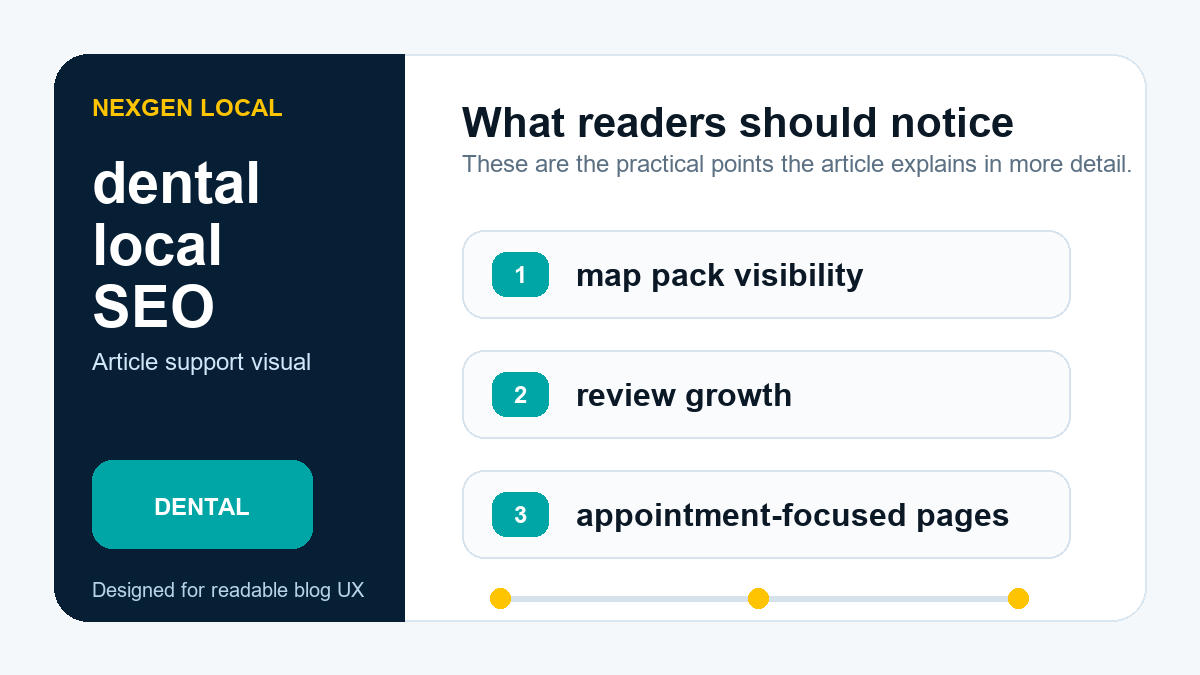
Dental SEO costs more because each new patient can create repeat value, reviews matter heavily, and map visibility must be built with care.
GBP strength
This is one of the core pieces that makes dental local SEO work as a practical business strategy.
Review velocity
This is one of the core pieces that makes dental local SEO work as a practical business strategy.
This guide breaks down the precise economics, strategies, and compliance requirements for dental SEO in 2026. We’ll explore why this channel provides such high leverage, what it actually costs, and what you should expect from a top-tier campaign.
The Dental SEO Economics in 2026
The math behind premium dental SEO is straightforward. Unlike a restaurant where a new customer might spend $50, a new dental patient represents a significant long-term asset. A single new patient’s lifetime value (LTV) can range from $1,500 for routine check-ups to over $50,000 for complex cosmetic or restorative cases like full-arch implants.
Consider the value of a single keyword. Ranking in the top 3 on Google for a high-intent term like “dental implants [Your City]” might bring in just two or three new patients a month. However, if each of those cases is worth $25,000, that single ranking is generating $50,000-$75,000 in monthly revenue. A single month of high visibility can pay for multiple years of a comprehensive SEO campaign. This LTV-to-cost ratio is why successful practices view SEO not as an expense, but as their most critical growth investment.
Why Local SEO is the Highest-Leverage Marketing Channel for Dentists
While channels like mailers, radio, and even pay-per-click ads have their place, local SEO offers unparalleled leverage for dental practices. When a potential patient searches for “emergency dentist near me” or “Invisalign in [neighborhood],” they have an immediate, pressing need. You aren’t creating demand; you are capturing existing intent at the exact moment of decision.
- General Dentists: Attract a steady flow of new families and individuals for cleanings and routine care, the bedrock of a stable practice.
- Cosmetic Practices: Connect with patients actively seeking high-value procedures like veneers, teeth whitening, and full smile makeovers.
- Pediatric Practices: Be the trusted choice for parents searching for a “kids dentist” in their area, building a patient base that can last for years.
- Specialty Practices (Endodontists, Orthodontists, etc.): Capture referrals and direct searches from patients who know they need a specific, complex procedure.
No other channel targets these high-intent moments as effectively. A well-executed search engine optimization strategy ensures your practice is the one they find, call, and book.
Google Business Profile: Your Digital Front Door
For dentists, your Google Business Profile (GBP) is no longer just a listing; it’s your most important digital asset. It’s often the first—and sometimes only—interaction a potential patient has with your practice online. Winning here requires a dental-specific strategy.
Category Strategy: Your primary category must be chosen carefully. While “Dentist” is common, “General Dentist” is often better. Then, use secondary categories to capture your high-value services, such as “Cosmetic Dentist,” “Pediatric Dentist,” or “Endodontist.”
Services List: Don’t just list services; detail them. For each service (e.g., “Dental Implants,” “Root Canal Therapy”), add a full description explaining the procedure, the benefits, and why a patient should choose your practice for it. This adds keyword relevance and educates patients.
Photos and Videos: Patients are choosing a healthcare provider, and trust is paramount. Your GBP photos should go beyond stock images. Showcase your modern, clean office; the friendly faces of your staff and dentists; and advanced technology. Before-and-after shots (with patient consent) are incredibly powerful for cosmetic services. A short office tour video can also build significant trust before a patient ever steps through the door.
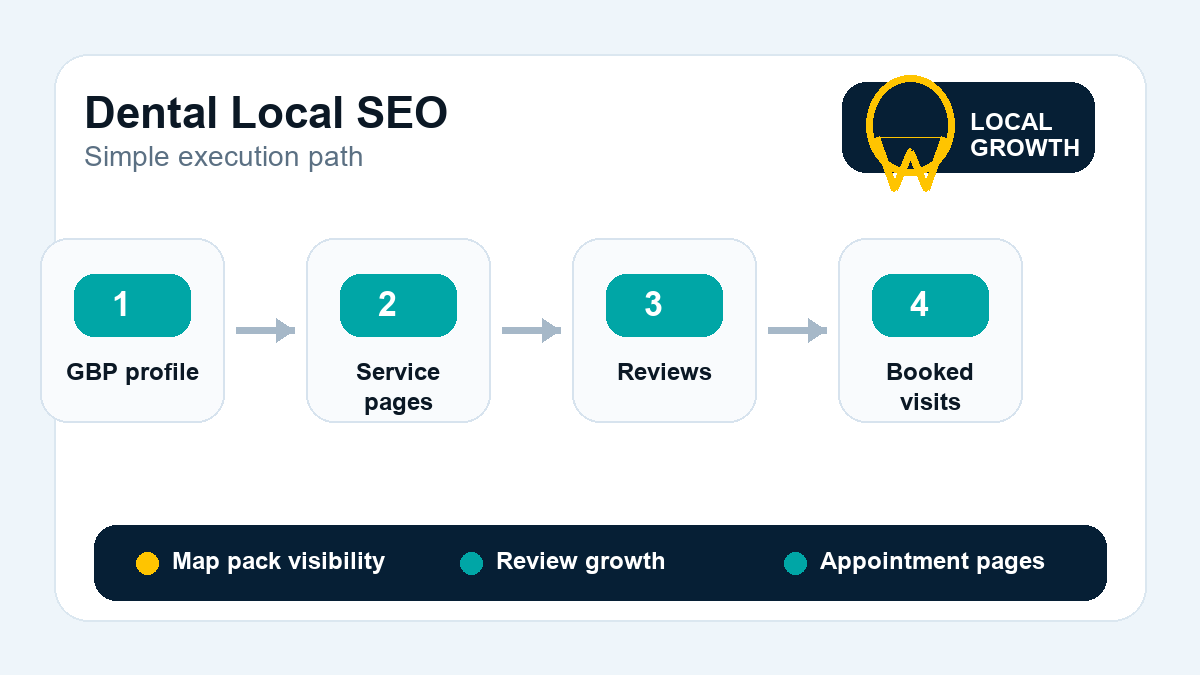
Optimizing your Google Business Profile is a critical component of any campaign focused on local SEO for dentists.
The Review Imperative: 4.7 Stars and 100+ Reviews
In 2026, having a few good reviews is not enough. The dental market is too competitive. To stand out in a crowded local search result, practices need to aim for two key benchmarks:
- A 4.7-star rating or higher: The difference between 4.5 and 4.8 stars can be the deciding factor for a patient choosing between two otherwise identical practices.
- 100+ recent reviews: A high volume of reviews signals to both Google and patients that your practice is active, established, and consistently provides a positive experience.
Prospective patients scrutinize reviews for mentions of gentleness, staff friendliness, wait times, and billing transparency. A steady stream of positive, detailed reviews is one of the most powerful signals for both search engine rankings and patient conversions.
Hyperlocal Content: Winning the Neighborhood
Patients want a dentist who is not just in their city, but in their corner of the city. A sophisticated local SEO for dentists strategy goes beyond targeting the main city name and drills down to the neighborhood level. This is achieved through a robust hyperlocal content strategy.
- Neighborhood-Level Pages: Create dedicated pages for the key neighborhoods you serve (e.g., “Your Dentist in Baldwin Park,” “Winter Park’s Choice for Family Dentistry”). These pages should feature unique content relevant to that specific area.
- Condition-Specific Landing Pages: Build out high-performance landing pages for your most valuable services combined with location terms. Examples include “Invisalign Cost in Lake Nona” or “Emergency Dental Care in Downtown Orlando.” These pages are built to convert searchers with a very specific need.
- Insurance Acceptance Pages: Many patients begin their search with the insurance they carry. Creating pages like “Dentist that Accepts Cigna in Orlando” can capture highly qualified traffic that your competitors might be missing.
This content strategy positions your practice as the preeminent local authority, directly answering the specific questions your ideal patients are asking. This is a cornerstone of modern dentist marketing.
Patient-Intent Keyword Strategy
Ranking #1 for “dentist” is great, but it’s a vanity metric. True success comes from ranking for keywords that demonstrate clear patient intent and map directly to your high-value services. Your keyword strategy must be diverse and reflect the different stages of the patient journey:
- Emergency Intent: “emergency dentist,” “cracked tooth repair,” “toothache relief near me”
- General Intent: “dentist near me,” “best dentist in [city],” “family dentist accepting new patients”
- Cosmetic Intent: “cosmetic dentist,” “veneers cost,” “professional teeth whitening”
- Pediatric Intent: “kids dentist near me,” “pediatric dentist for toddlers”
- Specialty Intent: “sedation dentistry,” “dental implants [city],” “orthodontist for adults”
A successful campaign identifies the most profitable keywords for your specific service mix and builds a comprehensive strategy to achieve top rankings for them.
Schema for Dentists: Speaking Google’s Language
Schema markup is code you add to your website to help search engines understand the context of your content. For dentists, it’s a powerful tool to gain a competitive edge. It helps Google display rich results, like star ratings and FAQs, directly in the search results. An advanced strategy involves layering multiple schema types:
- Dentist (LocalBusiness Sub-type): This is the foundation. It clearly tells Google that your business is a dental practice, and includes crucial information like your address, phone number, and hours.
- MedicalProcedure: For each service you offer (like fillings, crowns, or implants), you can use this schema to describe the procedure, its purpose, and how it’s performed.
- FAQPage: Use this on your FAQ pages (or even service pages with Q&A sections) to have your questions and answers appear directly in Google’s search results, dominating more screen real estate.
- Person: Each dentist in your practice should have `Person` schema applied to their bio, highlighting their credentials, education, and specializations. This builds authority and trust.
Properly implemented schema ensures that Google sees your practice not just as a local business, but as a specialized medical authority.
HIPAA-Compliant Marketing Constraints
Patient privacy is non-negotiable. The Health Insurance Portability and Accountability Act (HIPAA) governs how you can use and disclose Protected Health Information (PHI). This has direct implications for your marketing.
You cannot use patient testimonials that include specific health details without explicit, written authorization. Responding to a negative review with details about a patient’s treatment is a serious violation. Your staff and any marketing agency you partner with must be trained on these constraints. This means focusing marketing copy on procedures, technology, and patient experience in general terms, rather than on individual patient stories or outcomes, unless you have cleared the extensive legal hurdles for using a specific, authorized case study.
Budget Benchmarks for Dental Local SEO in 2026
Dental SEO is not a commodity. The investment required correlates directly with market competitiveness and the practice’s growth goals. While precise figures vary, here are some realistic monthly budget benchmarks for 2026. For a more detailed breakdown, see our Orlando local SEO cost guide.
- Single-Practitioner Practice (Moderate Competition): $2,500 – $5,000/month. This level of investment supports core local SEO, GBP management, content creation for key services, and reputation management.
- 2-4 Doctor Practice (High Competition): $5,000 – $10,000/month. This budget allows for a more aggressive strategy, including hyperlocal content, advanced schema, digital PR, and link building to compete in a crowded urban market.
- DSO / Multi-Location Practice (Very High Competition): $10,000 – $25,000+/month. At this scale, the strategy must manage multiple GBP listings, create content for numerous locations and services, and often includes a significant budget for earning high-authority backlinks and local citations.
Be wary of low-cost providers. Ineffective SEO is worse than no SEO; it wastes time and can even harm your online reputation.
Frequently Asked Questions About Dental SEO
How soon will I see new patients from local SEO?
While some quick wins from GBP optimization can yield results in 1-3 months, foundational SEO is a long-term strategy. You should expect to see meaningful increases in organic traffic and new patient calls within 4-6 months, with the campaign’s full impact building over 9-12 months as your website’s authority grows.
Can a small practice rank against DSOs?
Yes. While Dental Service Organizations (DSOs) have massive budgets, they often lack local authenticity. A single-location practice can win by being more agile, building a stronger local brand, generating more authentic reviews from a tight-knit patient base, and creating highly specific hyperlocal content that a large corporation’s marketing team might overlook.
Is Google Business Profile enough, or do I need a website too?
You absolutely need a professional, modern website. Your GBP is your digital storefront, but your website is your entire store. It’s where you control the narrative, build deep authority with service and condition-specific pages, host your dentist bios, and ultimately convert high-value patients who want to do more thorough research before booking.
Do paid ads and SEO work together?
They work exceptionally well together. Paid ads on Google can generate patient leads immediately while your long-term SEO strategy gains traction. Furthermore, you can use data from your paid ads campaigns—like which keywords convert best—to inform and prioritize your SEO efforts, creating a powerful feedback loop for growth.
What if I open a second location?
Opening a second location requires a distinct local SEO strategy for that new address. This includes creating a new, separate Google Business Profile, building location-specific pages on your website, and launching a new citation and review generation campaign targeted at the new service area. It’s not as simple as adding the new address to your existing website; it requires a dedicated effort to establish that new location as its own local entity.
Ultimately, a strategic investment in local SEO for dentists is one of the most reliable paths to sustainable, long-term practice growth. By focusing on patient intent, building trust through reviews and content, and executing a technically sound strategy, you can attract the high-value patients you need to thrive. To see how other practices have achieved this, review some of our client case studies or call our team directly at 407-307-1995 to discuss a custom analysis for your practice.
Action checklist
Want to understand your dental SEO opportunity?
Nexgen can review your market, reviews, competitors, and local search visibility.